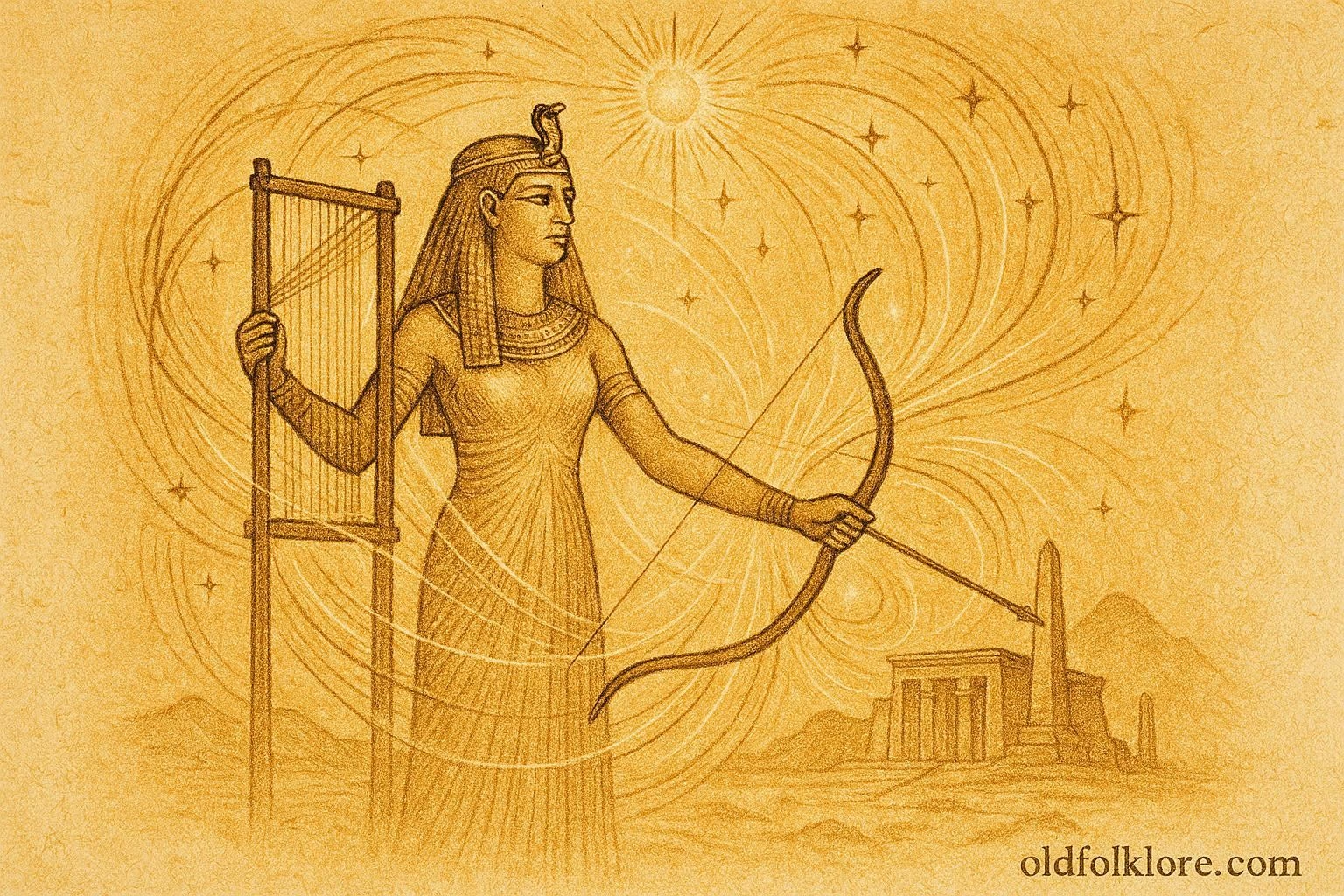
Neith is among the oldest and most enigmatic goddesses of Ancient Egypt, a primordial being whose presence reaches back to the Early Dynastic era. Revered as a creator, a cosmic weaver, a fierce protector, and a divine judge, she occupies a position both foundational and mysterious. Her primary cult center was the ancient city of Sais in the Nile Delta, where she was honored as “Neith the Great, Mother of the Gods.”
Her symbols include the shuttle and loom, emblems of her role in weaving existence itself; and the bow and crossed arrows, revealing her martial authority. She presides over creation, warfare, the ordering of cosmic law, and the judgment of souls. Some traditions proclaim her the mother of Ra, the sun god; others describe her as the creator of the first divine beings, emerging alone from the primordial waters to generate life.
Neith’s worship was ancient and enduring. Pharaohs sought her blessing in warfare, artisans invoked her precision and skill, and mothers prayed to her for protection during childbirth. In funerary texts, she stands as a guide and judge, guarding the path of the deceased through the Duat. Her shrine at Sais housed sacred veils described by classical writers, textiles that symbolized the mystery and vastness of her creative power.
Mythic Story
In the beginning, before the first sunrise and before the Nile carved its path through the land, there was only the silent, endless expanse of Nun, the primordial waters. From that depthless stillness came a single spark, a presence older than the gods themselves. She rose not from birth, nor from union, but from pure being. This was Neith, the First Mother, the Weaver, the One Who Was Alone.
The waters parted around her as she emerged, bearing in her hands the tools that would shape the universe: a shuttle of light, a loom of silence, and the fierce bow that signified the power to protect all she would create. Neith looked upon the unformed darkness and understood her purpose. She stretched the first thread across the void, a strand of radiant gold, and with that motion, time began.
With each movement of her loom, she called forth a new element of existence. The sky unfurled from her upper threads, a vast blue canopy woven from breath and eternity. The earth settled beneath, shaped from the lower strands, firm, fertile, and waiting. Stars scattered across the heavens like sparks shaken from her weaving shuttle, each glowing with her essence. And in the heart of the great tapestry, she spun a disk of fire: Ra, whose journey across the sky would become the rhythm of life.
In some ancient accounts, Ra himself rose from her hands. In others, she created the first gods, fierce and luminous beings, who then continued the work she began. But all traditions agree: Neith stands at the origin, before separation and duality, before the balance of order (ma’at) and chaos.
Once creation took form, Neith withdrew to observe the unfolding of her tapestry. She watched as the gods shaped mountains, carved rivers, and breathed life into the creatures who walked, swam, and flew. She saw the emergence of humanity, fragile yet filled with potential, and she blessed them with the ability to craft, build, weave, and make war when necessary. In every art that required precision, weaving, smithing, archery, her unseen hand guided.
But Neith was not only a creator. She was a guardian.
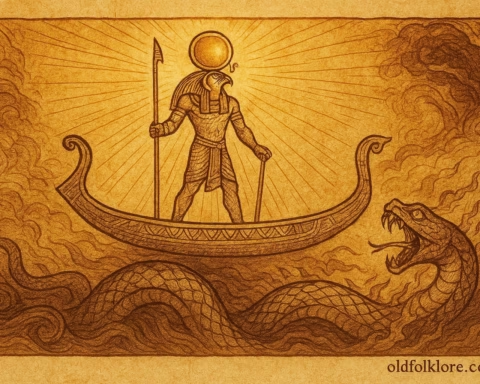
When the forces of disorder threatened the harmony she had woven, she did not hesitate to take up her bow. In the early ages of the cosmos, when serpents of night sought to swallow the sun, Neith was there. Legends say that it was she who fashioned the arrows that pierced the darkness and protected the solar barque on its perilous nightly voyage through the Duat.
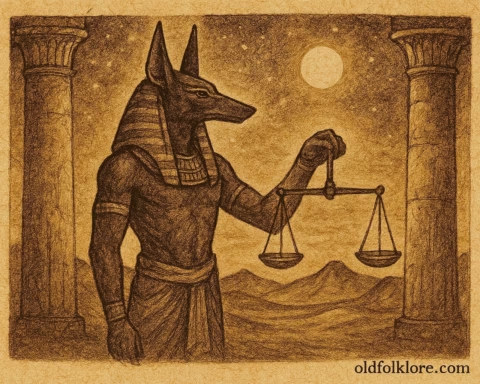
Her authority extended beyond the living world. In the silent domain of the dead, Neith served as a judge and protector. She helped weigh the hearts of the deceased, ensuring truth prevailed. She comforted the righteous and defended them from the terrors of the underworld. Many tombs invoke her name, asking her to open the way for the soul to ascend into eternal light.
As centuries passed, dynasties rose and fell, but Neith’s presence never faded. At Sais, her high priestesses spoke of the sacred veil that hung in her temple, embroidered with cosmic symbols no mortal fully understood. Greek visitors later described this veil, claiming that inscribed upon it were the words: “I am all that has been, and is, and will be, and no mortal has ever unveiled me.” Whether that saying is literal or symbolic, it reflects the truth of Neith’s nature: she is the mystery at the heart of creation, the first spark behind all existence.
Even in times of war, rulers sought her blessing. Soldiers carried her emblem into battle, believing she stood beside them, bow drawn, arrows poised. Yet her warfare was not born of bloodlust, but of protection. She fought only to preserve what she had woven, to maintain the balance of ma’at.
And when the day ends and the sky turns dark, Egyptians believed Neith begins her work anew. For every night, the world returns to a moment of unmaking. And every dawn, creation is rewoven, the sun reborn, the sky restored, the order of the cosmos reaffirmed by her eternal hands.
Thus the goddess stands: serene, ancient, unchanging. Not only the mother of gods, but the mother of possibility itself.
Author’s Note
Neith’s myth reveals the Egyptian understanding of creation as an act of skill, intention, and continual renewal. She embodies the balance between creativity and protection, teaching that the world is woven through both craft and courage. Her presence reminds us that existence is not static; it is a tapestry constantly reworked through wisdom, discipline, and reverence for cosmic order.
Knowledge Check
Q1: What is Neith’s primary domain?
A: Creation, weaving, warfare, and divine judgment.
Q2: Where was Neith’s major cult center?
A: The city of Sais in the Nile Delta.
Q3: What tools symbolize her creative power?
A: The loom and shuttle.
Q4: What martial symbol is associated with Neith?
A: The bow and crossed arrows.
Q5: According to some traditions, whom did Neith create?
A: Ra or the first divine beings.
Q6: What role does Neith play in the afterlife?
A: She acts as a judge and protector of souls.
Source: Ancient Egyptian Mythology, Egypt.
Source Origin: Ancient Egypt