Hanuman is one of the most revered figures in Hindu mythology, celebrated for his extraordinary strength, unwavering devotion, and protective nature. Often depicted as a powerful monkey-faced deity, Hanuman is a central hero in the epic Ramayana, serving Lord Rama with courage and wisdom. He possesses supernatural abilities: the power to fly, to change size, and to leap across oceans.
Symbolically, Hanuman embodies devotion (bhakti), moral righteousness, and the relentless pursuit of duty. His worship spans India and Southeast Asia, with temples dedicated to him throughout the subcontinent. Tuesdays and the festival of Hanuman Jayanti are considered especially auspicious for invoking his blessings. Devotees seek his protection, courage in adversity, and spiritual guidance.
Hanuman is closely associated with sacred objects and animals: the mace (gada) representing power, the mountain he lifted to retrieve medicinal herbs, and his own monkey form symbolizing energy, agility, and loyalty. His relationships in the pantheon are profound: as Rama’s devoted servant, he bridges the divine and mortal realms, inspiring humans to emulate devotion and integrity.
Mythic Story: Hanuman in the Ramayana
Long ago, in the ancient land of Ayodhya, a kingdom ruled by the virtuous Rama, a darkness descended. Ravana, the mighty king of Lanka, had abducted Sita, Rama’s beloved wife, carrying her across the sea to his fortress island. The heavens themselves seemed to hold their breath as despair touched the hearts of mortals and divine beings alike. It was in this moment that Hanuman, the monkey god, rose as the beacon of hope.
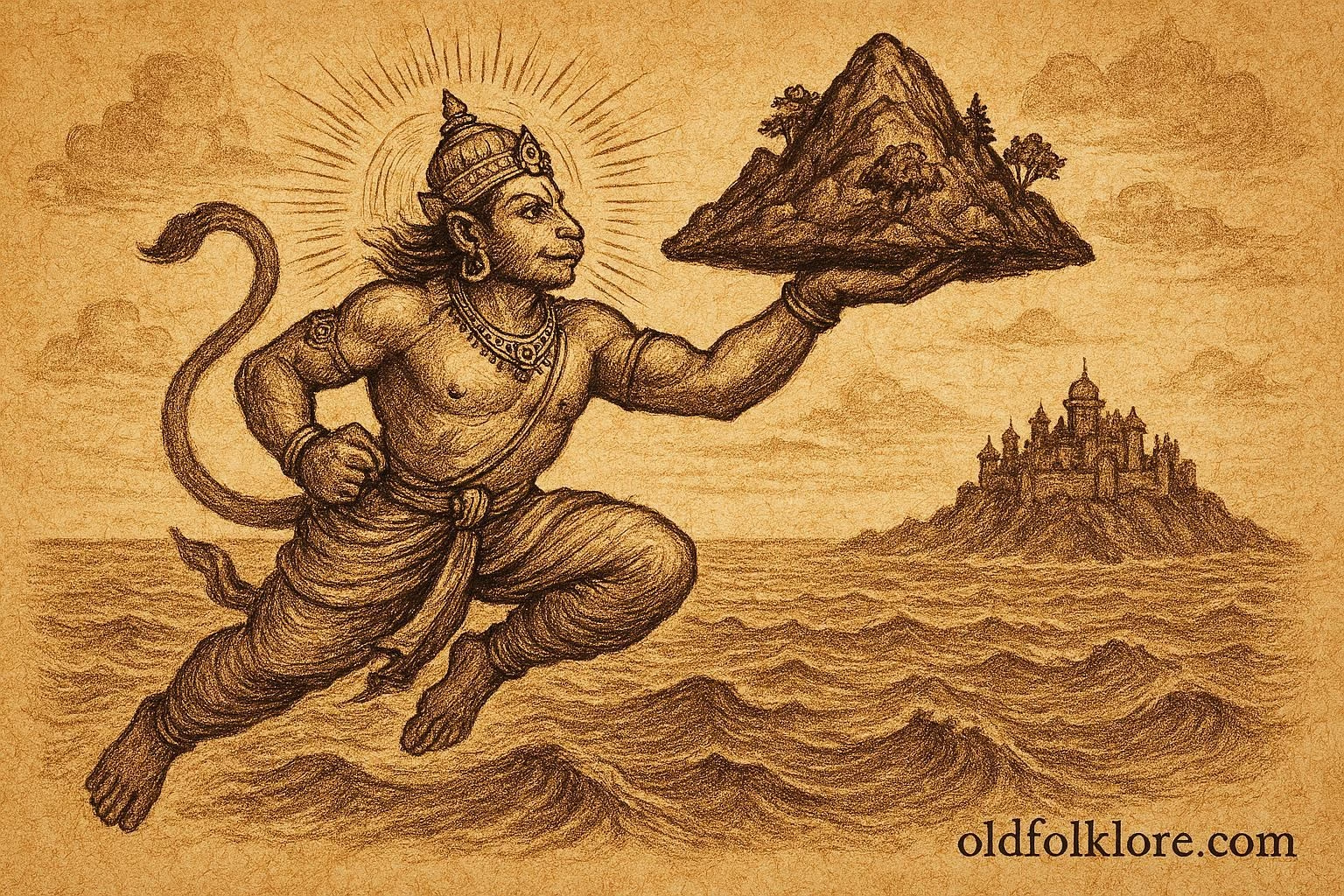
Hanuman, son of the wind god Vayu, possessed strength unmatched by any mortal or celestial. Yet his power was not mere might; it was tempered by humility, devotion, and intelligence. When the task fell to him to locate Sita, he did not hesitate. With a heart unwavering in loyalty and a mind sharp as a blade, he leapt across the ocean, spanning miles of roiling water in a single bound, his tail streaming like a banner of fire in the wind.
Upon reaching Lanka, Hanuman found the golden city bristling with soldiers and walls of unmatched height. He assumed a tiny form, slipping past guards with quiet steps, and found Sita weeping in Ravana’s gardens. With words gentle yet imbued with divine authority, he revealed his identity and Rama’s promise: “Fear not, noble lady. I am Hanuman, servant of Rama. Your husband’s love reaches you, and I shall bear your message back, and bring aid soon.”
Ravana, enraged by the intrusion, ordered his captors to seize Hanuman. The monkey god, undaunted, grew to colossal size, crushing entire battalions beneath his feet. When fire threatened the city, Hanuman’s tail blazed and consumed the enemy’s defenses in a controlled inferno, demonstrating both destructive power and moral purpose. Yet, even amidst battle, he acted with restraint; his fury was aimed at evil, not the innocent.
Before departing, Hanuman courageously allowed himself to be captured to meet Ravana face-to-face, challenging the tyrant with words that were both respectful and defiant. The king, in his arrogance, ordered Hanuman’s tail set ablaze. With divine strength, Hanuman broke free, using the fire as a weapon to illuminate Lanka’s skyline in a brilliant warning of justice and righteousness.
Returning across the ocean, Hanuman carried Sita’s token to Rama, and his feats inspired the alliance of monkeys and bears that would march to Lanka’s shores. In the ensuing battle, Hanuman’s courage and strength were unmatched, lifting mountains to heal the wounded, flying through the chaos to deliver messages, and striking fear into the hearts of evil. His devotion to Rama guided every leap, every strike, every strategy; power without purpose would have been empty, but in Hanuman, might and loyalty coalesced into divine service.
The battle ended with the triumph of Rama and the rescue of Sita, and Hanuman’s role was celebrated as eternal. He did not seek reward, for his joy was in service, his honor in devotion. Even mortals, witnessing the tale, understood that courage, faith, and moral strength are as vital as weapons or physical might.
Discover the gods, goddesses, and divine spirits who ruled the heavens and shaped human fate
Author’s Note
Hanuman’s story transcends mere heroism. He teaches that true strength is inseparable from devotion, humility, and wisdom. His leaps across oceans and battles with demons are metaphors for human struggle: the courage to face insurmountable odds, the steadfastness to remain loyal to truth and love, and the guidance that comes from aligning one’s power with purpose. Hanuman embodies the belief that spiritual strength can overcome any worldly obstacle.
Knowledge Check
Q1: What is Hanuman primarily known for?
A: Strength, devotion, and protection.
Q2: In which epic does Hanuman play a central role?
A: The Ramayana.
Q3: How did Hanuman reach Lanka to find Sita?
A: By leaping across the ocean using his supernatural powers.
Q4: What objects or symbols are associated with Hanuman?
A: The mace (gada), the medicinal mountain, and his monkey form.
Q5: What qualities distinguish Hanuman’s power from mere force?
A: Humility, intelligence, moral purpose, and unwavering devotion.
Q6: Which festivals or days are especially associated with Hanuman?
A: Tuesdays and Hanuman Jayanti.
Source: Ramayana (Valmiki), India.
Source Origin: India