Long before mortal chronicles carved their ink across parchment, the heavens whispered of a child born from two destinies, one of iron, one of light. Olivier, future companion of Roland, sprang not only from the noble blood of Girart de Vienne but from a lineage older still. For it was said that his foremother once received a blessing from St. Michael himself, who touched her womb with a spark of celestial clarity. From this spark came a line of warriors whose gaze could pierce deception, whose hearts beat in rhythm with divine justice. Olivier, third of this blessed line, carried the gift most strongly: sight that could read the intentions of men and spirits alike.
As a youth, he trained under Charlemagne’s stern captains, excelling not only in swordplay but in judgment. Where others rushed, Olivier measured. Where others thundered, he questioned. Yet no caution dimmed his courage; instead, it honed it. Soon he joined the Twelve Peers of France, shining beside Roland, whose fire matched Olivier’s contemplation like sun to moon. Together, they became the twin pillars of Charlemagne’s might.
The tale that marks Olivier’s greatness begins on the eve of the Battle of Roncevaux, when Saracen hosts and mountain spirits alike rose against the Franks. Rumors drifted through the camp of a monstrous champion, the Black Ifrit of Zaragoza, whose strength was said to equal fifty men and whose breath carried the stench of burning stone. Roland, ablaze with heroic zeal, laughed at these tales. But Olivier, his keen gaze fixed upon the shadowed peaks, felt the trembling of the earth and knew a deeper truth: the foe was not merely mortal.
That night, a wind carved from frost swept through the camp, and with it came an apparition cloaked in smoke, the Ifrit itself, towering, horned, its eyes twin furnaces. It spoke in a thunderous tongue, proclaiming that Roncevaux would swallow the Franks whole unless their greatest champion faced it in single combat.
Roland reached for Durendal, but Olivier rose first.
“Let me face him,” Olivier declared. “For this foe is not one answered by flame alone.”
Roland frowned. “Brother of my heart, your wisdom is great, but this is a test for fire, not for restraint.”
Olivier answered softly, “Even fire must know when to bend, lest it consume itself.”
Charlemagne, hearing them, granted Olivier the challenge, for he trusted in the youth’s heavenly gift.
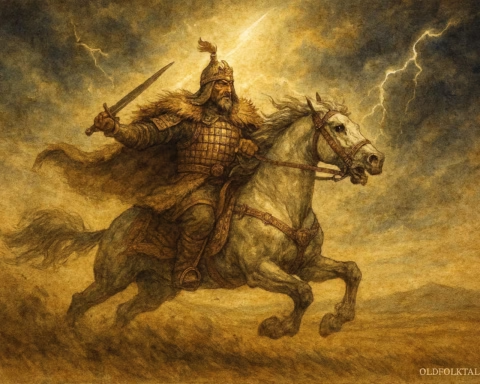
At dawn, the two champions met in a narrow valley where the cliffs shimmered with heat from the Ifrit’s breath. Olivier bore Hauteclere, his shining sword whose blade sang like chimes when raised. The Ifrit roared, sending boulders cracking down the mountainside.
Their battle began in torrents of flame and bursts of ringing steel. Olivier’s clarity saved him time and again; he studied each strike, each plume of fire, each tremor beneath his feet. Where Roland might have charged, Olivier sidestepped. Where Roland might have dared the flames, Olivier redirected them with the flat of Hauteclere.
But the Ifrit’s inferno grew, fed by ancient wrath. The heat blinded even Olivier’s blessed vision. In those moments, doubt, the greatest peril to one anchored in clarity, filled him. Could wisdom alone withstand fury incarnate? Was there honor in retreating from strength too great?
Then a memory rose: his mother’s voice, reciting the divine blessing of St. Michael, Strength unveils itself through steadfastness, not terror, and through discernment, not arrogance.
Olivier drove his sword into the ground, calling upon the heavenly spark that lingered in his blood. Hauteclere shone like a star fallen to earth. A ring of light burst outward, dispelling the flames. The Ifrit staggered, its inferno shrinking to embers.
Yet Olivier did not strike the killing blow.
Instead, he spoke: “Your rage is not born of malice but of ancient wounds. Lay down this destruction, and I shall grant you mercy.”
The Ifrit, bewildered, beheld the calm certainty in Olivier’s gaze. Slowly, painfully, it bowed. Its body dissolved into harmless smoke, leaving behind only a warm wind.
Olivier returned to the Frankish camp bearing not triumph but solemn understanding. But his challenge had exhausted him, and though he fought bravely alongside Roland at Roncevaux, he knew fate had woven the ending of his mortal thread. In the final clash, surrounded by enemies and prophecy alike, Olivier spoke his last to Roland:
“Brother, your courage lights the world, but remember, no fire burns forever. Let wisdom temper steel.”
He fell with a serenity that mirrored his life’s essence, his blood sinking into the mountain path that became a symbol of loyalty, balance, and truth.
And so the clear-eyed paladin passed into legend, not for his strength alone, but for the harmony he forged between judgment and valor, mercy and might.
AUTHOR’S NOTE
Olivier endures as the counterbalance to Roland’s fire, an embodiment of discernment within heroism. His legacy teaches that clarity of purpose is as mighty as any sword, and that true bravery lies not only in facing death but in seeing the world as it truly is. His tale reminds readers and warriors alike that every triumph of strength must be guided by wisdom, lest valor turn to ruin.
KNOWLEDGE CHECK (6 Questions)
-
What divine blessing marked Olivier’s lineage?
-
How did Olivier’s character differ from Roland’s?
-
What supernatural foe challenged the Franks before Roncevaux?
-
What strategy allowed Olivier to defeat the Ifrit?
-
Why did Olivier refuse to kill the creature?
-
What message did Olivier leave Roland before his death?
CULTURAL ORIGIN: Medieval French epic tradition; Carolingian cycle; rooted in Christian chivalric literature and oral heroic culture.
SOURCE: La Chanson de Roland (The Song of Roland), composed c. 11th century; transmitted through Old French epic poetry.