In the time before men walked upon the land, when the heavens were young and the oceans still whispered secrets of creation, there lived two brothers of divine lineage: Maui, the cunning demi-god, and Irawaru, whose heart was steadfast and whose loyalty knew no bounds. Born of the sacred blood of gods, their mother, Taranga, had sung the stars into being, and their father, Makea, had lent them strength of spirit and body. From birth, the brothers were bound by love, rivalry, and the spark of destiny.
Maui, ever restless and curious, sought to shape the world in daring ways: to slow the sun, to fish the islands from the deep, to wrest secrets from the heavens. Irawaru, his elder by subtle measure, possessed a tempered wisdom, a mind for strategy, and a courage unshaken by fear. Together, they were a force that could rival the storms, the seas, and even the capricious gods themselves. Yet their bond was not without trial, for even among divinity, envy and pride festered like hidden reefs beneath tranquil waves.
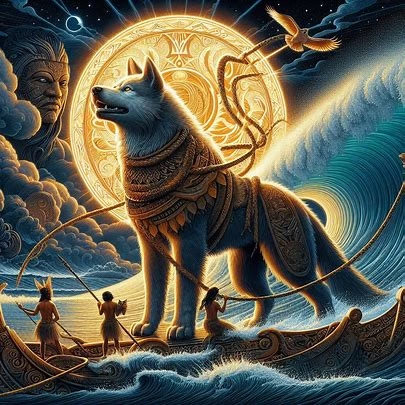
It came to pass that one day, as Maui plotted a trick to tease the mighty god Tangaroa, Irawaru, loyal and perceptive, spoke words of caution. “Brother,” he said, “not every tide can be turned without peril. A path of cleverness may invite sorrow for those we hold dear.” But Maui, impetuous and brimming with pride, laughed at caution, believing his wits to outmatch all dangers. Frustration simmered between them. Maui, convinced that Irawaru’s counsel hindered the perfection of his plans, acted rashly. With a flick of his fingers and the weaving of a secret incantation, he transformed Irawaru into a creature of fur and keen instinct, a dog, mortal in appearance yet divine in essence.
Irawaru, though shorn of human form, retained the mind and valor of his former self. His eyes shone with the glimmer of celestial knowledge, and his heart beat with the rhythm of heroism. Though betrayed, he did not turn from his brother. Instead, he became Maui’s companion in his most perilous undertakings, guiding him through darkness and danger with a loyalty that even the gods admired.
The first of these trials was the capture of the sun. Maui, determined to slow its scorching journey across the sky, sought to bind it with ropes of divine flax. In the blistering heat of the noonday sun, his hands blistered, and despair threatened to conquer him. It was Irawaru, with instincts keener than any mortal’s, who sensed the sun’s subtle shifts and warned Maui of its impending resistance. Together, the brothers, one human, one canine yet both divine, crafted a net of cunning, and the sun’s bound fury was tamed. The islands below rejoiced, and men would henceforth greet each day with the knowledge that light could be held, however briefly, by courage and cleverness united.
Yet it was not mere conquest that defined Irawaru’s heroism, but his moral steadfastness. Time and again, Maui’s schemes tempted him toward hubris and cruelty, but the dog-formed brother reminded him of balance, of justice, and of mercy. When Maui sought to wrest fire from the gods or to challenge the ocean’s deepest currents, Irawaru would press close, nipping at errors, guiding the hand of his brother away from pride’s edge. In this way, he became not only a participant in feats of legend but a living compass of ethical fortitude, proving that heroism is measured not merely by strength or cleverness, but by the courage to guard virtue even when unseen by others.
In the end, Irawaru’s transformation became a symbol. The gods, observing his devotion, were moved to bless him with agility, sight, and strength beyond mortal measure. Though he walked upon four paws, he touched realms of the divine and remained a bridge between men, gods, and the untamed forces of nature. His loyalty and heroism ensured that Maui’s quests, though perilous, achieved their intended harmony, and the mortal world was forever enriched by the gifts of ingenuity and courage.
And so Irawaru, once a man, now a dog, became the eternal companion of heroes, a guardian of quests, a symbol of unwavering loyalty and ethical guidance. He prowls the edges of myth and memory, reminding all who would dare great deeds that greatness is not achieved alone, and that even in forms unanticipated, the heart of heroism endures.
Author’s Note
Irawaru’s legacy lies not merely in the feats he aided but in the moral compass he represented. Though transformed and humbled by his brother’s impetuosity, he embodied loyalty, wisdom, and courage. Across Polynesia, the figure of the dog as companion and guide carries echoes of Irawaru’s presence, a reminder that divine influence often appears in humble forms. His story teaches that heroism is both action and principle, and that even the smallest ally can shift the tide of destiny.
Knowledge Check
-
Who are Irawaru and Maui in the context of Polynesian mythology?
-
What divine qualities did Irawaru retain after being transformed into a dog?
-
How did Irawaru assist Maui in capturing the sun?
-
What moral function does Irawaru serve in the epic?
-
Why is Irawaru considered a symbol of loyalty and heroism?
-
How does the story of Irawaru reflect the broader values of Polynesian culture?
Cultural Origin: Polynesia
Source: Grey, G. (1855). Polynesian Mythology.