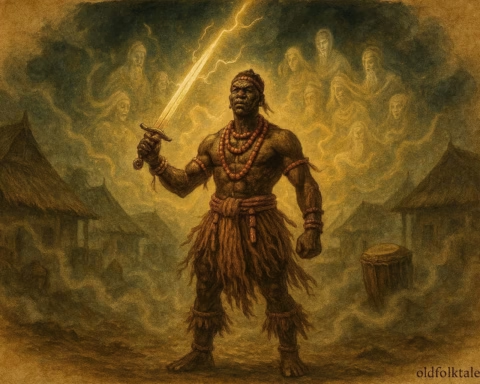
In the days when the forest whispered secrets to the winds and rivers carried the songs of the ancestors, there came a child born of heaven and earth, a spirit clothed in flesh. His name was Oba, and from his first breath, the elders of the land sensed the weight of destiny upon him. Legends say that the gods themselves had conspired in his making, sending omens of power and wisdom into the hearts of men. From the heights of Udo, where the first rains kissed the fertile soil, Oba’s eyes were like twin lanterns, piercing the mists of uncertainty, seeing the paths that mortal men could not.
Oba was not merely a man but a vessel of divine counsel. From childhood, he walked between worlds: listening to the whispers of spirits in the forest, interpreting the flight of birds and the dance of flames in sacred fires. His heart, tempered in the crucible of foresight, yearned to unite the scattered peoples under a banner of justice and order. Yet he knew that such a destiny demanded courage, for the path of a king was lined with trials that could break the strongest of men.
As he grew, the land around him fell into discord. Rival clans fought over riverbanks and farmlands; elders quarreled over laws, and the spirits of the land mourned the absence of balance. Oba, sensing the cries of both the living and the dead, called upon the counsel of Oranmiyan, the divine warrior-king whose voice echoed in dreams and visions. “You shall forge a kingdom,” Oranmiyan intoned, “a city whose walls will rise to the heavens, whose people will know both the law of men and the law of the gods. But beware, for power without virtue will crumble like dry clay.”
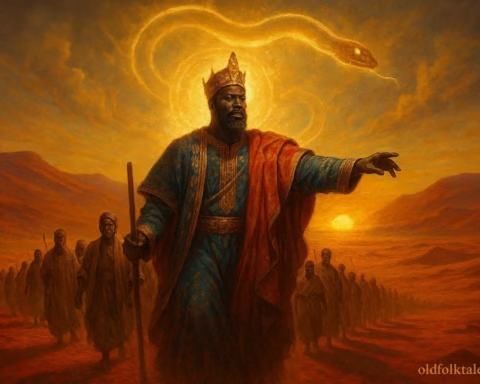
Thus, Oba set forth on a journey through shadowed forests and across treacherous rivers, gathering allies from distant villages and winning over reluctant chiefs with words that carried the weight of truth. His hands bore the signs of labor and battle, for he did not sit in splendor but moved among the people, healing rifts, mediating disputes, and confronting tyrants who ruled through fear. Every challenge tested his resolve: a river that would not yield passage, a warlord who defied the gods, a famine that tested the loyalty of his followers. In each, Oba discerned the subtle voice of the divine, guiding his decisions, teaching him that kingship is not mere conquest, but the cultivation of harmony between the human and the sacred.
Finally, guided by visions of a city rising like a crown upon the earth, Oba arrived at a fertile plain at the heart of the forest. Here, he laid the foundations of Benin, calling forth artisans, builders, and priests. The walls were not only stone and earth but sacred lines etched with prayers, telling the story of ancestors, spirits, and the law that would govern the living. Oba himself planted the first ceremonial tree, a living symbol of growth, justice, and the unity of all clans. The city thrummed with life as marketplaces, shrines, and halls of council rose from the soil, each structure echoing the divine order that Oba embodied.
Yet even as the city flourished, Oba faced the supreme moral trial: the temptation to rule with pride and fear, to wield his semi-divine power for glory rather than the welfare of his people. In the solitude of the moonlit palace, he wrestled with his own ambition. The gods watched silently, and the spirits of ancestors whispered counsel. Oba knelt upon the sacred earth and spoke the words that would define his reign: “Let my power be justice. Let my might protect the weak. Let the law be my sword, and mercy my shield.” From that night onward, Oba ruled with a balance so rare that even the restless spirits of the land found peace.
Through his wisdom, Benin became a kingdom unlike any other, a city of sacred order where art, law, and ritual intertwined. The walls of the city did not merely protect; they symbolized the covenant between the king, the people, and the divine. Oba’s legacy was not only in the stones and streets he raised but in the moral and political order that endured through generations, a reminder that true kingship is the stewardship of both heaven and earth.
Author’s Note
Oba’s story endures as more than the tale of a king; it is a mythic template for leadership grounded in virtue, wisdom, and divine counsel. His founding of Benin established a sacred city whose order and cultural richness reflected the harmony between mortals and the divine. Today, Oba’s legacy lives in the rituals, festivals, and reverence for the Oba as the spiritual and temporal anchor of Benin society. His life reminds us that power without virtue is hollow, and that leadership demands courage, wisdom, and a deep sense of moral duty.
Knowledge Check
-
What divine figure guided Oba during his journey to establish Benin?
-
How did Oba balance his semi-divine power with moral responsibility?
-
What role did visions and omens play in Oba’s decisions?
-
Why was the planting of the ceremonial tree significant in founding Benin?
-
How did Oba’s leadership transform the political and spiritual life of his people?
-
What does Oba’s story teach about the relationship between humans and the divine?
Cultural Origin: Benin Kingdom, Edo People
Source: Egharevba, J. U., A Short History of Benin (1924)