Abere is a fearsome demoness from Melanesian swamp mythology, notorious for her predatory cunning and supernatural powers. She inhabits the dense reeds and murky waters of swamps, riverbanks, and mangrove forests, waiting for unsuspecting travelers or fishermen who venture too close. Known for her cunning intelligence and terrifying patience, Abere embodies the dangers of venturing into treacherous terrain without caution or respect.
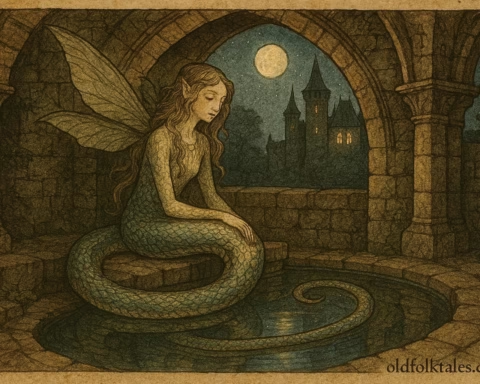
In terms of appearance, Abere is generally described as a tall, strikingly beautiful woman with an almost hypnotic allure. Her physical beauty, however, conceals her monstrous intentions. Some accounts describe her skin as pale and luminous, almost reflecting the moonlight off swamp waters, making her appear otherworldly at night. She is often depicted with elongated limbs, clawed hands, and sharp teeth, traits that reveal her predatory nature despite her initial attractiveness. In some stories, she possesses multiple eyes or a serpentine lower body, emphasizing her connection to the swamp’s murky, hidden dangers and her supernatural origin.
Learn the moral wisdom of ancient civilizations through proverbs that shaped cultural values
Behavior and Methods
Abere’s powers are multifaceted. She can charm or mesmerize men, luring them deep into the reeds where they become trapped in natural or magical snares. Some narratives emphasize her ability to manipulate the swamp itself, raising mud, pulling under water, or causing vines and reeds to twist and entangle victims. Once her prey is immobilized, she devours them, consuming both body and spirit, symbolizing a permanent disappearance from the human world. Certain versions mention that she has daughters or servants who act as extensions of her will, assisting in ensnaring victims and amplifying her influence throughout the swamp.
Her behavior, though malevolent, is consistent with the morality of Melanesian swamp myths. Abere’s interactions are almost exclusively with humans who fail to heed warnings or disrespect sacred territories. She acts as both punisher and cautionary figure, ensuring that boundaries, both physical (swamps, rivers) and social (rules, taboos), are respected. In this sense, Abere functions as an enforcer of environmental and social law, demonstrating how folklore often intertwines supernatural threat with practical guidance.
Myths and Beliefs
Abere appears in numerous oral traditions across the Melanesian islands, particularly in regions with extensive swamp systems. One recurring narrative tells of a young man who ignores warnings from elders and ventures alone into the swamp. He encounters a mesmerizing woman dancing among the reeds. Entranced by her beauty and the mysterious song she sings, he follows her deeper into the marsh. The reeds twist and trap him, while Abere’s servants or daughters appear to assist in immobilizing him. Ultimately, she consumes him, and in some variants, his spirit joins hers, warning others through haunting cries or spectral sightings. This tale serves as both an enthralling story and a practical warning about the dangers of isolated swamps.
Other accounts describe Abere as a guardian of sacred swamp regions. By punishing trespassers, she maintains the spiritual and ecological balance of these spaces. Her presence reminds the community that swamps are not merely obstacles to be traversed, but living, sacred landscapes with both resources and dangers. In some villages, rituals and offerings are performed to placate Abere or her minions, ensuring safe passage or honoring the spiritual authority of the swamp.
Some stories also describe Abere as possessing transformative powers. She may shift between a beautiful woman and a monstrous, amphibious form, reflecting both her seductive allure and her lethal capacity. This duality reinforces her symbolic function: she embodies temptation, danger, and the transformative power of the supernatural world, warning humans that appearances can be deceiving.
Cultural Role & Symbolism
Abere serves as a vivid embodiment of caution, social obedience, and environmental respect. She symbolizes the dangers inherent in the natural world, particularly treacherous terrains like swamps, rivers, and mangrove forests. Through her myths, communities impart essential survival knowledge: the importance of heeding local warnings, traveling in groups, and respecting dangerous or sacred spaces. Her stories often carry moral lessons about temptation, curiosity, and the consequences of disobedience.
Symbolically, Abere also reflects the idea of boundary enforcement. She is a guardian of the liminal space between the human world and the spirit realm. Trespassing into the swamp without respect or ritual acknowledgment results in punishment, reinforcing the concept that certain domains require proper understanding and reverence. In this way, Abere is both a spiritual and ecological sentinel, emphasizing the interconnectedness of morality, community rules, and the natural environment.
The presence of daughters or minions in some myths further enhances her symbolic weight, illustrating how danger is often not singular but systemic. Communities internalize these narratives, teaching children and newcomers to recognize hazards, respect boundaries, and avoid hubris when facing unfamiliar natural spaces.
Author’s Note
Abere’s stories are deeply rooted in Melanesian oral tradition, transmitted over generations to instill respect for the natural environment and communal wisdom. Although written sources like Godchecker and Wikipedia summarize her characteristics, the richness of her myth exists primarily in spoken narratives. Her tales reflect the ingenuity of local cultures in encoding survival strategies, ethical codes, and environmental awareness within compelling supernatural stories. As with all indigenous myth, modern retellings should preserve cultural context and avoid reducing her to a simple “monster” archetype.
Knowledge Check
- Who is Abere in Melanesian mythology?
Answer: A demoness who lures men into swamps and devours them. - Where does Abere primarily dwell?
Answer: Swamps, riverbanks, and mangrove forests. - What is the symbolic meaning of Abere?
Answer: She represents danger, caution, moral obedience, and environmental respect. - What powers does Abere possess?
Answer: Seduction, mesmerism, entrapment in reeds or mud, and transformation into monstrous forms. - How does Abere interact with humans in myths?
Answer: She punishes those who trespass or ignore warnings, sometimes aided by daughters or servants. - What lessons do Abere’s stories convey?
Answer: Respect sacred and dangerous natural spaces, heed warnings, avoid hubris, and recognize that appearances can be deceiving.
Source: Godchecker, Your Guide to the Gods, Melanesian oral folklore compilations, Wikipedia
Origin: Melanesia, swamp regions; oral and legendary tradition