Among the Ewe, the adzé is one of the most feared and fascinating witch-spirits in West African folklore. Its legend weaves together ideas of envy, illness, and invisible harm, reflecting deep insights into both spiritual belief and social tension.
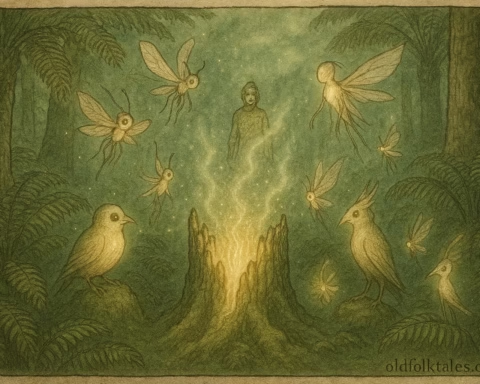
In its natural state, the adzé is said to take the form of a tiny luminous insect, usually described as resembling a firefly or glow-beetle. By night, it flickers through the air, sometimes appearing to pulse with an unnatural red or green light. When it finds a household marked by envy or misfortune, it slips silently inside, through keyholes, cracks in walls, or gaps beneath doors, seeking the warmth of human life.
Once within, the adzé lands upon a sleeping person, most often a child, and feeds by sucking their blood or consuming their life force. The victim weakens mysteriously, growing pale and listless; unexplained fevers, wasting, or sudden death may follow. In Ewe villages, such sickness, when no medical cause was known, was sometimes attributed to an adzé attack.
The creature’s most terrifying ability, however, lies in its dual nature. If the adzé is caught, by a hunter, diviner, or vigilant elder, its insect form transforms instantly into that of a human being. In this human guise, it is often identified as someone known to the victim: a jealous neighbor, a resentful kinswoman, or a rival in trade or affection. This revelation could bring accusations of witchcraft, exile, or ritual cleansing. Thus, the adzé bridges the supernatural and the social: it is both a spirit and a mirror for human resentment.
Some Ewe traditions describe the adzé not merely as a creature but as a spiritual condition, a witch’s power or presence within a person. When someone is said to be “possessed by adzé,” it may mean that the person has become an unwilling vessel of envy, or an agent of invisible harm. Healers and priests then perform rites to appease the spirit, banish jealousy, or reconcile feuding households.
In other accounts, the adzé may possess a witch rather than be the witch, an external parasite feeding on both the host’s malice and her victims’ fear. This ambiguity makes the adzé one of the richest symbols in Ewe cosmology: it embodies the unseen energies that disrupt community balance.
Scholars note that the adzé belief may also have natural roots: its blood-drinking habits echo mosquitoes or fireflies associated with malaria, a disease historically common in the region. Thus, the adzé functions simultaneously as myth, metaphor, and early epidemiology, a way of understanding invisible causes of sickness before modern medicine.
Cultural Role
In Ewe moral philosophy, balance between people, dzidzɔ (harmony), is the foundation of wellbeing. The adzé represents what happens when that balance is broken by envy, greed, or ill-will.
Its nocturnal attacks remind listeners that jealousy is parasitic, it consumes both the envier and the envied. A jealous heart, like the glowing firefly, may seem small but can destroy an entire household from within.
In village life, belief in the adzé historically served several social purposes:
- Moral Regulation: Fear of being suspected as an adzé discouraged envy and backbiting. Generosity, sharing of wealth, and public goodwill became protective virtues.
- Healing and Justice: When misfortune struck, diviners could “locate” the adzé through ritual. This allowed the community to address hidden conflicts and restore harmony.
- Metaphorical Medicine: The belief linked invisible causes of illness (mosquitoes, contagion) with moral causes (hatred, secrecy). In this sense, it preserved both social and physical health.
- Cultural Continuity: The adzé tale connects the living to ancestral laws of conduct, reinforcing respect for spiritual forces that sustain or withhold life.
Beyond its fearsome reputation, the adzé also teaches empathy and vigilance. To recognize one’s own jealousy before it “turns insect” is to protect both self and community. The firefly’s light thus becomes symbolic: even darkness can reveal truth if one dares to look closely.
In contemporary times, storytellers and folklorists reinterpret the adzé myth as a symbol of psychological possession, how internal bitterness, when unaddressed, consumes the soul. Artists in Ghana and Togo depict it as a glowing, ghostly insect surrounded by human faces, representing the collective consequences of hidden malice.
Author’s Note
When studying spirits like the adzé, one must understand that myth and medicine were never separate in African cosmologies. To the Ewe, spiritual and physical wellness are threads of the same cloth. The adzé myth survives not because it frightens, but because it explains,a world where envy, disease, and social fracture have the same invisible origins. The modern observer might read it as allegory, but for the communities that told these tales, it was lived reality and communal therapy.
Knowledge Check
- What physical form does the adzé usually take?
→ A glowing insect resembling a firefly that enters homes at night. - What happens when the adzé is captured?
→ It transforms into a human, often revealing a witch or jealous neighbor. - Which moral lesson does the adzé symbolize?
→ The destructive power of envy and the need for social harmony. - How did Ewe healers respond to suspected adzé activity?
→ Through divination, cleansing rituals, and reconciliation of social conflicts. - What natural phenomenon may underlie the adzé myth?
→ Illnesses caused by insect-borne diseases like malaria. - What larger cultural value does the adzé uphold?
→ Communal balance (dzidzɔ) and the responsibility to manage jealousy.
Source:
Peek, Philip M. & Kwesi Yankah, eds. African Folklore: An Encyclopedia (Routledge, 2004); field notes archived at the Institute of African Studies, University of Ghana; Atlas Obscura ethnographic synthesis (2020).
Origin:
Ewe (Anlo-Ewe and related groups) — Southeastern Ghana and Southern Togo, West Africa.
Period of attested record: late 19th–20th centuries (oral in origin, pre-colonial in practice).