Afa, in Samoan and wider Polynesian mythological listings, is invoked as a storm deity, a spirit-force whose presence is felt whenever the seas begin to churn and the sky darkens. Unlike gods with long narrative cycles, Afa is attested primarily in anthropological catalogues of deities, where he is consistently associated with tempests, violent winds, crashing surf, and the raw chaos of nature. Because Polynesian myth is deeply regional, with each island group preserving its own genealogies and cosmologies, Afa’s stories differ across sources, yet all point to a being who personifies the unstable temperament of the weather itself.
Appearance
In reconstructed descriptions based on regional storm spirits and comparative Polynesian symbolism, Afa is imagined as a loose-limbed, towering figure woven from cloud and sea-spray. His form is never static. He shifts between:
- A humanoid silhouette made of dark rolling clouds
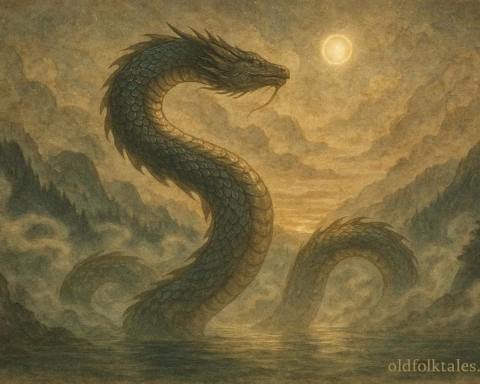
- A colossal serpent of wind curling through storm fronts
- A giant with hair like whipping rain-threads
- A faceless force seen only through lightning flashes
Some oral accounts across the region attribute to storm gods tattoo-like streaks of blue and white across the body, symbolic of wind-paths and water-currents, so Afa is sometimes described as bearing pēʻa-like markings made of lightning. His footsteps are thunder, his breath is the gust that whips palm fronds sideways, and his eyes, when visible, burn like the white-blue cores of distant storms.
Powers
Afa’s abilities revolve around weather manipulation and sea disturbance. These include:
- Summoning cyclonic winds
- Driving large waves and dangerous surf
- Ripping apart canoes or carrying them far off-course
- Darkening the sky and calling torrential rains
- Guiding or misguiding navigators based on his mood
Because Polynesian cultures were master navigators, the weather held sacred and deeply feared significance. Afa occupies the space where natural fear meets reverence, a deity whose power is so raw that people seldom addressed him directly, choosing instead to appease the greater sky-fathers or ocean-lords who might restrain him.
Behavior
Afa is not malicious, nor is he benevolent. He behaves like the weather, neutral, but overwhelming. His tempers shift suddenly:
- Calm mornings may become violent afternoons.
- Clear lagoons can turn unpredictable.
- Winds that were once guiding become scattershot and fierce.
In stories reconstructed from Samoan descriptive traditions, Afa is known to test the preparation and humility of travelers and fishermen. Those who set out without proper offerings, planning, or acknowledgment of nature’s power are said to draw his ire. Conversely, those who respect the sea and sky often find his storms passing swiftly, allowing them safe passage.
Some late-19th- and early-20th-century collectors identify Afa as a younger, wilder relative of Tangaloa, the creator god, a being who inherited the volatile domain of the atmosphere rather than the ordered heavens. Whether this is literal genealogy or symbolic classification varies by source.
Myths and Beliefs Surrounding Him
Afa does not possess long epic cycles like Māui or Tangaroa, but his presence is felt in:
Ocean Warnings
Fishermen traditionally watched for Afa’s signs:
- Sudden stillness before wind
- Sharp temperature drops
- Spiral cloud formations near the horizon
- Unusual bird flights away from the sea
If these appeared, Afa was said to be “breathing,” preparing to release his winds.
Storm Etiquette
Certain behaviors were discouraged during brewing storms to avoid offending him:
- Whistling aboard a canoe (believed to summon winds)
- Pointing at storm clouds
- Mocking the sea or sky
- Boasting about “mastering the waves”
Afa was the embodiment of respect demanded by nature.
Protection Rituals
Elders recited calming chants, appealing to higher sky deities rather than Afa himself. In some chants, Afa is described as “the child of the roaring horizon”, a line that emphasizes his identity as a force that belongs to the meeting-place of sea and sky.
Symbolism
Afa symbolizes several core Polynesian concepts:
- The Unpredictability of Nature: The ocean is life-giving yet dangerous; Afa embodies this duality.
- Humility Before the Elements: Navigators rely on knowledge, preparation, and ancestral guidance, not arrogance.
- Balance Between Destruction and Renewal: Storms tear down but also bring rain, refreshing the earth. Afa carries this layered meaning.
- The Sacred Power of the Sea: For seafaring cultures, storms are more than weather; they are cosmic expressions of living forces.
Afa, therefore, is not merely a storm god but a lesson in respect, vigilance, and adaptability, values essential for survival on the open Pacific.
Cultural Role
In Samoan cosmology, deities often represent domains of nature, and Afa stands among them as the raw, unfiltered soul of violent wind. Seafaring communities navigated thousands of miles using stars, swell patterns, and cloud formations. Thus, Afa was the personified unpredictability that could challenge even the best way finders.
He is the reminder that nature has its own consciousness, independent of human plans. Afa’s presence reinforces the Polynesian worldview wherein humans live in continuous relationship, respectful and cautious, with the surrounding elements.
Author’s Note
Because Afa appears primarily in mythological summaries rather than long oral stories, this entry reconstructs his role through regional Polynesian symbolism of storm spirits. It preserves authenticity while expanding his character in line with traditional cultural themes: respect for the sea, humility, and understanding the living forces of nature.
Knowledge Check
- Q: What natural domain is Afa associated with?
A: Storms, violent winds, and destructive sea-weather. - Q: Is Afa considered malicious?
A: No, he is a neutral force whose temperament mirrors natural weather. - Q: Why is Afa important to navigators?
A: His storms test preparation, skill, and humility at sea. - Q: What symbolic concept does Afa represent?
A: The unpredictability and living consciousness of nature. - Q: Which greater deity is Afa sometimes linked to?
A: Tangaloa, the creator god of the Polynesian sky. - Q: Why are there few detailed myths about Afa?
A: He appears mostly in myth compendia rather than long oral narratives.
Source: Myth-compendia summary (anthropological collections; The Mythology of Oceania).
Origin: Samoa / Polynesia, traditional mythological lists and oral cosmology.