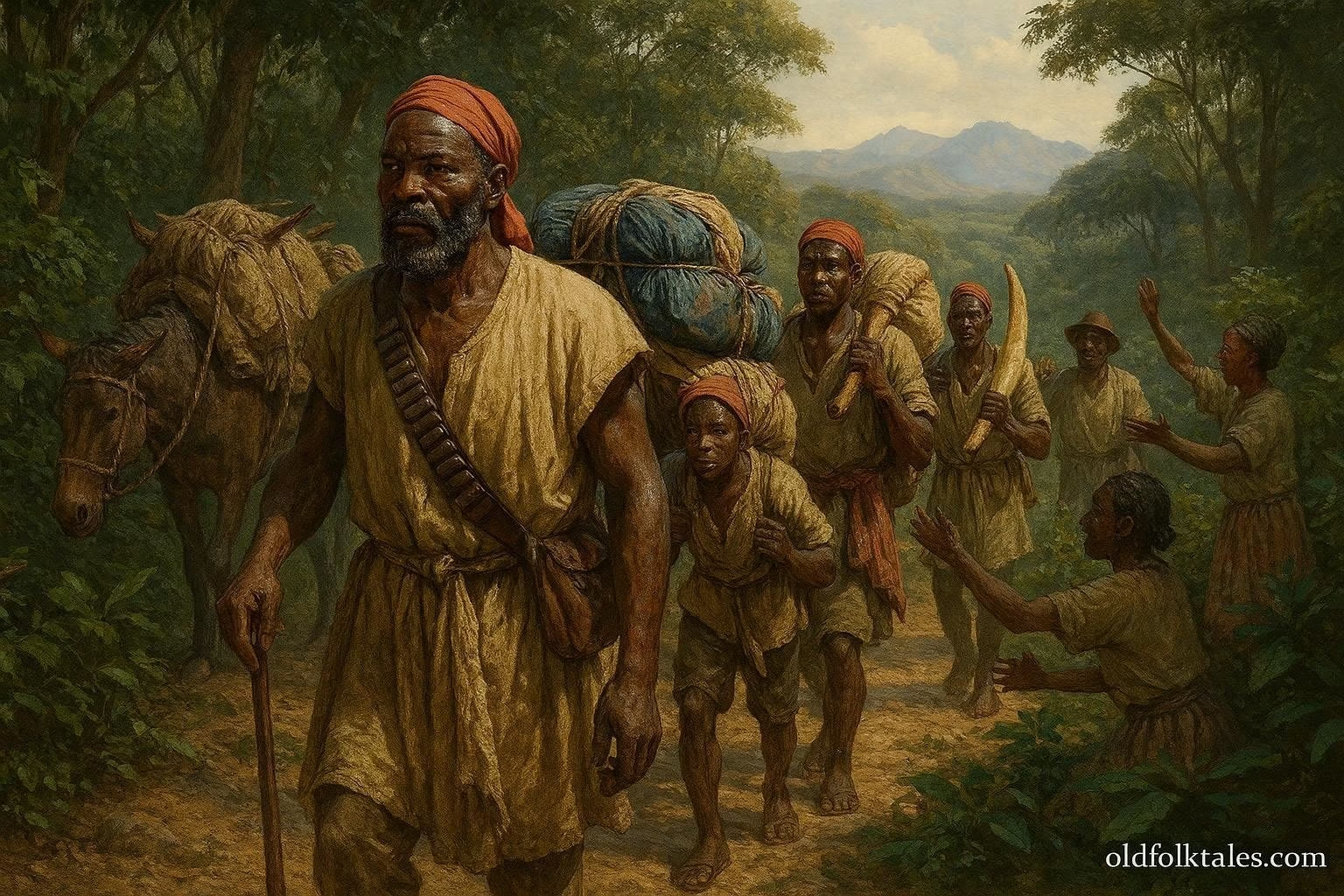
In the highlands of Bié, central Angola, Chivanda dreams of becoming a respected caravan leader. Under the guidance of an experienced trader named Sambu, he learns to plan difficult journeys, negotiate fairly and earn the trust of distant communities. When his teacher finally entrusts him with a caravan of his own, Chivanda must put those lessons into practice. His journey will test his judgement, patience and commitment to the people who depend on him.
Learning the Ways of a Caravan Leader
As a young apprentice, Chivanda travelled with experienced traders across the highlands and along routes connecting distant communities. He soon discovered that successful trading required more than knowing the value of merchandise. A caravan leader needed to organise supplies, understand the terrain, recognise danger and make decisions that protected the entire group.
His teacher, Sambu, had spent years learning the demands of long-distance travel. He understood that a poorly planned journey could leave travellers without food, while an unfair bargain could destroy a relationship that had taken years to build.
Whenever the apprentices became too eager to discuss profits, Sambu reminded them that their character mattered as much as their cargo.
“A caravan may carry ivory, cloth, salt or copper,” he would say, “but if its leader carries dishonesty, its wealth will mean little.”
Chivanda never forgot those words.
Every expedition offered another lesson. Heavy rain could turn a familiar path into a dangerous crossing. Rocky slopes demanded patience, while unfamiliar settlements required travellers to approach local people with care.
Sambu taught his apprentices to seek permission before entering a community and to learn the customs expected of visitors. They observed how experienced traders exchanged greetings, discussed their intentions and negotiated agreements without treating every encounter as a contest.
Chivanda paid close attention. He learnt to estimate the distance between stopping places, recognise changes in the weather and help organise supplies before departure. He also discovered the importance of listening. Experienced guides often knew details about a route that a younger traveller could easily overlook.
When disagreements arose among the traders, Chivanda listened to the people involved before offering his opinion. He understood that a leader who ignored the concerns of his companions could lose their confidence.
Years passed, and he became one of Sambu’s most dependable assistants. He could organise provisions, remember important routes and remain calm when circumstances changed.
Eventually, Sambu decided that his apprentice was ready to take on greater responsibility.
The Elders’ Advice
The announcement that Chivanda would lead his own caravan filled him with pride, but he also understood the seriousness of the task. Several dozen travellers would depend on his decisions, and merchants had entrusted valuable goods to his care.
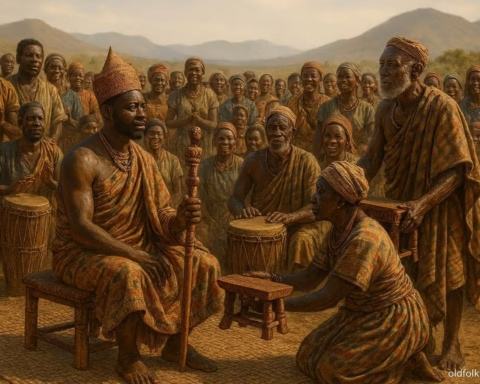
Before the expedition departed, elders gathered beneath a large tree in Bié to offer their advice. They reminded the young leader that his behaviour would influence how others regarded the traders who came from his homeland.
The oldest elder addressed him.
“You will carry many valuable things on your journey, Chivanda. Remember that the reputation of our people is worth more than every bundle your caravan can transport.”
Chivanda bowed respectfully.
He knew that a successful expedition required more than personal courage. Every traveller had to contribute, every load had to be managed carefully, and every decision had to account for the welfare of the group.
Explore more stories from our Angolan Folktales Collections archive.
Preparations occupied several weeks. Cloth was packed securely, salt was protected from moisture, and iron tools were inspected before being loaded. Food supplies were measured according to the expected length of the journey, with additional provisions set aside where possible.
Each traveller received specific responsibilities. Some helped manage the merchandise, while others assisted with supplies and the daily organisation of the camp. Experienced guides advised Chivanda about the route and the places where the group could rest.
He encouraged everyone to speak up if they noticed a problem. A damaged package, a shortage of food or a concern about the route could become a serious difficulty if no one reported it in time.
At sunrise on the appointed day, the caravan departed from Bié. Families watched from the settlement, offering encouragement to the travellers as they disappeared beyond the hills.
Chivanda looked towards the road ahead. He had spent years learning from others. Now he would have to prove that he could put their wisdom into practice.
A Village in Need
The first weeks passed without major difficulties. The caravan crossed rivers, stopped at settlements along its route and exchanged goods through negotiation. Each evening, Chivanda reviewed the day’s progress with his companions.
He checked their supplies, listened to reports from the guides and asked whether anyone had noticed a problem. He preferred to resolve small difficulties early rather than allow them to grow.
One afternoon, the caravan reached a village where poor harvests had left many families struggling. Food was scarce, and the villagers possessed little merchandise to offer in exchange.
Some members of Chivanda’s caravan wanted to continue without stopping.
“Our own supplies must last for months,” one trader argued. “If we share what we have, we may find ourselves in difficulty later.”
Chivanda understood the concern. A leader could not give away everything his people needed, no matter how deserving another community might be. He considered the remaining provisions and discussed the situation with his companions.
After careful calculation, he decided that the caravan could spare a portion of its food without putting the expedition at risk.
The villagers received the provisions gratefully. In return, they shared their knowledge of the surrounding area and warned the travellers about a low-lying route that could become dangerous after heavy rain. They recommended a safer alternative.
Chivanda thanked them and consulted his guides before changing the planned route.
Several days later, heavy rain swept across the region. The low ground became difficult to cross, confirming the villagers’ warning. Because the caravan had followed the alternative route, the travellers avoided a potentially serious delay.
That evening, the group discussed what had happened. Some traders admitted that they had considered only the immediate cost of sharing their food. They had overlooked the value of the knowledge and goodwill that respectful dealings could create.
Chivanda, however, did not claim that kindness always guaranteed a reward. He reminded his companions that they had helped the village because its people were in need and because the caravan could reasonably afford to assist them.
The experience strengthened his belief that good leadership required both generosity and sound judgement. Helping others mattered, but so did ensuring that the people under his care remained safe.
The Mystery of the Missing Bundles
As the journey continued, Chivanda encountered merchants from distant communities. Their customs and expectations sometimes differed, so he took time to understand the people with whom he traded.
Some preferred lengthy discussions before agreeing on a price. Others wanted to settle the terms quickly. Chivanda adapted his approach without abandoning his principles.
He made sure that both parties understood the quantities, quality and prices involved in each exchange. He avoided promises he could not keep and expected his companions to do the same.
His reputation gradually spread along the trading routes. Merchants began to recognise him as someone who valued fair dealings and honoured agreements.
One evening, the caravan stopped beside a broad river. As the travellers prepared their camp, they discovered that several valuable bundles were missing.
Concern spread quickly. The merchandise represented a considerable investment, and losing it could undermine the success of the expedition.
Some traders suspected strangers who had visited the camp earlier that afternoon. Others wanted to search the surrounding area immediately.
Chivanda understood their anxiety, but he refused to accuse anyone without evidence.
Instead, he gathered the travellers and asked them to describe what they had done during the afternoon. He listened carefully as each person explained where they had worked and which supplies they had handled.
At first, nobody could account for the missing goods. Then a young apprentice hesitantly admitted that he had moved several bundles to protect them from the approaching rain. In the confusion of the evening preparations, he had forgotten to inform the others.
The travellers searched the place he described and soon recovered the merchandise.
Relief replaced suspicion. The apprentice apologised for failing to report the move, and Chivanda accepted his explanation while reminding him that everyone needed to know where important supplies were kept.
He also addressed the wider lesson. Had the caravan acted on suspicion alone, its members might have accused innocent visitors and damaged relationships with neighbouring communities.
The traders agreed to improve their arrangements. Anyone moving valuable goods would inform the person responsible for keeping the records, and the supplies would be checked before the group settled for the night.
Chivanda had recovered the missing merchandise, but he had also helped his companions understand the importance of patience, communication and fair judgement.
An Honest Trader in a Busy Marketplace
Months into the expedition, the caravan reached one of the busiest trading centres on its route. Merchants from several regions had gathered to exchange goods, and the marketplace offered opportunities for substantial profit.
Cloth, beads, copper, salt, pottery and iron tools filled the stalls. Traders examined merchandise, compared prices and negotiated from morning until evening.
Chivanda approached each transaction carefully. He checked measurements, inspected the goods and made certain that the terms were understood before agreeing to an exchange.
On one occasion, he noticed that a calculation favoured his caravan because the other merchant had made a mistake. Although he could have accepted the advantage without saying anything, Chivanda pointed out the error and allowed the figures to be corrected.
Some competitors laughed at his decision. They believed that a trader should take every opportunity to increase his profits, even when another person’s mistake made the bargain unfair.
One merchant questioned Chivanda directly.
“Why give up an advantage when the goods could be yours for less?”
Chivanda answered calmly.
“A bargain is worth more when both sides understand what they have agreed. If I gain through another person’s mistake today, why should that person trust me tomorrow?”
The merchant offered no immediate reply.
Chivanda knew that honesty did not mean accepting every price or surrendering every advantage. Negotiation required judgement, and both parties had the right to seek a fair return. His principle was simpler: he would not deliberately deceive another trader to increase his own wealth.
As the days passed, more merchants sought his company. They knew that he would discuss terms openly, explain his expectations and honour the agreements he made.
His reputation did not eliminate every disagreement, nor did it guarantee that every transaction would be profitable. It did, however, give other traders a reason to deal with him again.
Chivanda began to understand that trust could be an asset in its own right. Merchandise might be sold or exchanged, but a good reputation could support many future journeys.
He carried that understanding with him as the caravan prepared to return home.
The Difficult Journey Home
The return journey brought challenges of its own. The travellers had spent months on the road, and fatigue began to affect the group. Several members became ill, forcing the caravan to reduce its pace.
Some traders worried about the delay. They feared that a late return might disappoint their families or affect the value of their merchandise.
Chivanda considered their concerns, but he refused to place the cargo above the people carrying it. He arranged additional rest stops and redistributed tasks so that healthier travellers could assist those who were struggling.
The changes required patience. The caravan could not travel as quickly as before, and every extra stop placed further demands on its provisions.
Chivanda discussed the situation with his guides and kept the group informed about their progress. He explained that continuing too quickly could put the weaker travellers at greater risk and leave the entire caravan vulnerable.
His companions gradually adjusted to the new arrangements. Those who remained well helped with shared responsibilities, while others watched over the ill and made sure they had opportunities to rest.
The return journey became a collective effort. Instead of allowing the strongest travellers to determine the pace for everyone, Chivanda encouraged the group to consider what would enable all its members to reach home safely.
Eventually, the caravan arrived in Bié. Families and fellow traders welcomed the travellers, relieved to see them return after so many months away.
The expedition had taken longer than expected, but Chivanda had brought the group home safely. The merchandise was important, yet the safe return of the travellers was an achievement in itself.
A Welcome Worth More Than Wealth
The elders gathered to hear the caravan’s report. They wanted to know what the traders had exchanged, which routes they had travelled and what difficulties they had encountered.
Chivanda described the journey honestly. He spoke about the goods sold and acquired, but he also shared the lessons he had learnt. He explained how a village’s warning had helped the caravan avoid dangerous ground and how careful questioning had resolved the mystery of the missing bundles.
He told the elders about merchants who had valued fair negotiation and travellers who had shared responsibilities when illness slowed the group.
The oldest elder listened with satisfaction.
“You have returned with more than goods,” he said. “You have returned with honour.”
Chivanda accepted the praise humbly. He knew that his achievements had depended on Sambu’s instruction, the cooperation of his companions and the help of people they had met along the way.
The elders recognised that he had taken his responsibilities seriously. He had protected the caravan’s supplies without allowing profit to become his only concern. He had also shown that patience and fair judgement could prevent difficulties from becoming greater problems.
For Chivanda, the welcome marked the end of his first expedition as a leader, but it was not the end of his education.
Passing Wisdom to the Next Generation
In the years that followed, Chivanda trained young apprentices just as Sambu had once trained him. He taught them to prepare carefully, listen to experienced guides and understand the responsibilities that came with leading a caravan.
He explained how to organise supplies, monitor merchandise and plan for unexpected delays. He encouraged the apprentices to learn from people who knew the routes and to approach unfamiliar communities with respect.
However, he never allowed them to believe that trading skill consisted only of calculations and bargaining.
When a young trader became impatient during a negotiation, Chivanda reminded him to listen before speaking. When another wanted to blame a companion for a mistake, he encouraged him to establish the facts first.
He also taught them to consider the people affected by their decisions. A careless leader could endanger travellers, waste valuable provisions or damage a relationship between communities. A thoughtful decision could help preserve the trust on which future journeys depended.
Chivanda did not promise that honesty would make every expedition easy or that generosity would always be repaid. Instead, he explained that integrity gave people a sound foundation on which to build their relationships.
His apprentices learnt that cooperation required effort from everyone. The person responsible for the supplies mattered as much as the guide who knew the road. The trader negotiating an exchange depended on the people who had packed, transported and protected the goods.
As the apprentices grew older, they carried these lessons into their own journeys. They learnt to measure success not only by the merchandise they brought home but also by the responsibilities they had fulfilled and the agreements they had honoured.
The historical caravan trade of Bié connected communities across central Africa through networks of exchange and travel. These routes carried merchandise, but they also linked people who exchanged information, developed commercial relationships and negotiated access across different territories.
The history of this trade was complex and included exploitation, particularly through the slave trade that formed part of some long-distance commercial networks. Yet the wider history also reveals the importance of the people who organised journeys, negotiated agreements and sustained connections between distant regions.
Chivanda and Sambu represent the values explored in this contemporary adaptation. Their story offers a reminder that the way people conduct their affairs matters as much as the rewards they seek.
A successful journey requires preparation, but difficult moments demand patience and judgement. Fairness can help build relationships that last beyond a single exchange, while cooperation allows people to face challenges they might struggle to overcome alone.
Chivanda’s greatest achievement was not simply returning to Bié with valuable goods. It was learning to lead with responsibility and passing that wisdom to those who followed him.
His journey reminds us that wealth can be counted, but trust must be earned.
Explore our complete Africa Folktales
Moral Lesson
Honesty, patience and cooperation are essential to responsible leadership. Lasting success comes not only from what we gain, but also from how fairly we treat others and how faithfully we fulfil our responsibilities.
Knowledge Check
1. Why did Chivanda spend years learning from Sambu before leading his own caravan?
He needed to learn how to plan journeys, organise supplies, negotiate fairly and make responsible decisions.
2. What advice did the elders give Chivanda before his departure?
They reminded him that the reputation of his people was worth more than the goods his caravan carried.
3. Why did Chivanda share food with the struggling village?
He recognised the villagers’ hardship and decided that the caravan could spare some provisions without endangering its own journey.
4. How did Chivanda resolve the disappearance of the bundles?
He questioned the travellers calmly rather than accusing anyone without evidence. An apprentice eventually explained that he had moved the bundles to protect them from rain.
5. Why did merchants value trading with Chivanda?
They trusted him to negotiate honestly, correct mistakes fairly and honour his agreements.
6. What is the main lesson of the story?
Responsible leadership depends on honesty, sound judgement, cooperation and respect for others.
Source
A contemporary adaptation inspired by the documented history of Ovimbundu long-distance caravan trade centred on Bié, including Jan Vansina’s “Long-Distance Trade-Routes in Central Africa,” published in The Journal of African History in 1962. Chivanda, Sambu and the specific events in this story are fictional.
Explore More Angolan Folktales
- The Hidden Storehouse: An Angolan Folktale of Famine and Greed
- The Eagle and the Candimba: A Shocking Betrayal
- The Bangão Crocodile: A Fearless Fight for Justice
- Sudika-Mbambi: The Invincible Hero
- The River Spirit’s Three Questions
- The Cave of the Sleeping Ancestors
- The First Soba’s Staff
- Sona: The Sand Drawings of Wisdom