Agni emerges from the earliest layers of Vedic tradition, described throughout the Rig Veda as a radiant, ever-renewing deity. He is born “every dawn,” kindled in ritual hearths, yet also eternal in the cosmic order. As the divine fire that consumes the offerings of yajña (sacred rites), Agni is both messenger and mediator, the one who brings humans into the presence of the gods. His importance spans thousands of years of Hindu religious practice, making him one of the oldest and most enduring deities in Indo-Aryan culture.
Agni is the god of fire in all its forms: the flame on the altar, the heat of the sun, the spark of lightning, and the internal fire that sustains life. He is invoked as pure, radiant, sharp-tongued, and many-limbed, with golden teeth, smoke-darkened robes, and flames that leap like living serpents. In the Vedas, he is said to have two births, one divine, one earthly, because he appears both as a cosmic principle and as the fire kindled by human hands.
He is the mouth of the gods, consuming offerings and carrying them upward. He is guardian of the home, purifier, protector of travelers, and witness to oaths. Agni is the presence that makes ritual effective, sanctifying intention and illuminating truth.
THE STORY OF AGNI:The Ever-Living Flame and the Path of the Gods
The priests say that fire is not merely a thing that burns, but a person who listens.
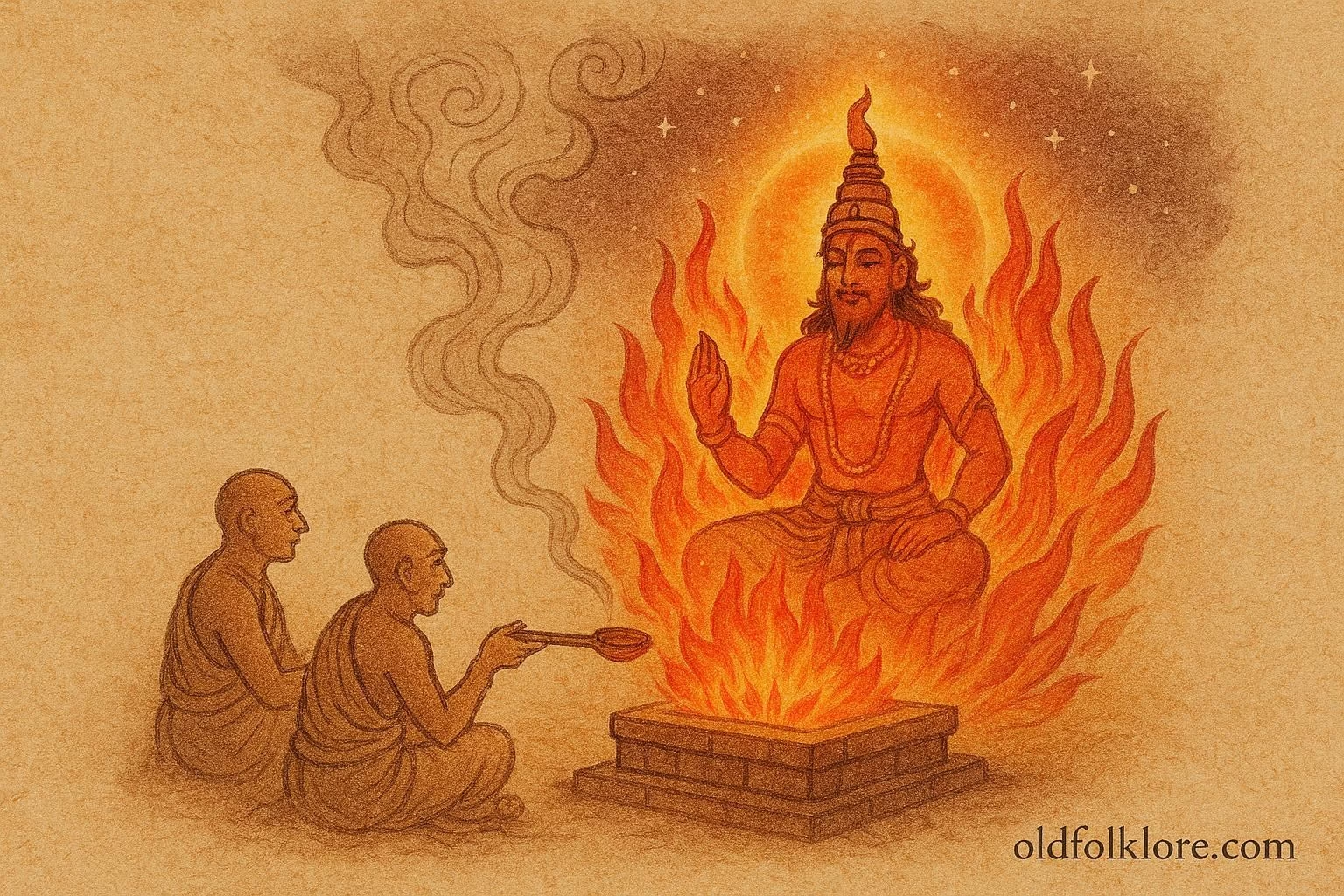
Long before dawn, when the sky is still a deep blue bowl and the world holds its breath, the priests gather in silence. They bring dried grass, fragrant wood, clarified butter, and hymns older than memory. They build the altar with careful hands, for every line of it must echo the order of creation. And at the heart of it all is the place where Agni will awaken.
The first spark is small, a shy, trembling glow. But the priests chant softly, calling him by childhood names, coaxing the flame like a beloved guest returning after a long journey. Soon the fire stirs, stretches, and lifts itself upward as though remembering its true form.
They say Agni is born every morning, yet he is never truly young. He carries the knowledge of ancient fires: the first blaze that warmed humanity, the flames that crowned the sun, and the lightning that split the skies when the world was new. Each time he is kindled, it is not rebirth but re-appearance, as if a traveler steps through a familiar door.
As Agni rises, the priests offer ghee. The fire bends toward it eagerly, its tongues drinking the golden butter with crackling delight. Then the hymns grow stronger. The priests chant the verses that describe Agni not as a creature of earth, but as the pathway to heaven, the one who leads prayers upward like smoke rising through the vault of the sky.
To mortals he appears as warmth and light. But in the unseen world, he takes another form: a swift, glowing messenger racing along the road of the gods. By Agni, the devas know what humans ask, for rain, for strength, for children, for peace. Without him, the gods would not hear, and the world of humans would drift in silence, forgotten.
Yet Agni is not only a messenger; he is also a protector.
In an older time, when darkness covered the forests and spirits wandered freely, Agni walked beside travelers at night. Flames flickered in a circle around camps, and the crackling of wood was not just sound but speech, a reminder that a divine guardian kept watch. Even today, the hearth fire is sacred. It remembers the ancient task: to shield, to purify, to reveal truth and expose deceit.
There is a tale that Agni once hid himself. Burdened by constant invocation, he withdrew from both gods and humans, slipping into oceans, rivers, herbs, and stones. Without fire, the world grew cold. Sacrifice ceased. Even the gods felt hunger.
Desperate, they searched for him, not with weapons, but with praise. Each hymn was a lantern cast into darkness. At last they found him hidden in a lotus stem, glowing faintly as though reluctant to return. The gods approached him with humility, promising that though he would be called upon day after day, he would be honored as one of the greatest, cherished in every home, every village, every sacred rite.
Moved, Agni agreed. He rose once more, radiance spreading like dawn across the world. From that day forward, he was not only divine fire but also the willing heart of sacrifice, the flame that accepts burdens so the world may remain in harmony.
Thus the priests chant:
“O Agni, you who know all paths, lead us on the righteous one.”
For Agni is more than heat. He is the force that transforms, the purifier who burns away the false, the lamp that guides the soul after death. Even ancestors rely on him; through funeral rites, Agni carries the departed toward the next realm. He is present at birth, marriage, death, at every doorway of human life.
And so, when the fire burns steady and strong, the priests lift their voices in gratitude. The flames dance. The smoke spirals upward. And through Agni, radiant, eternal, ever-renewing, the bond between heaven and earth is restored once again.
AUTHOR’S NOTE
This narrative draws strictly from Vedic hymns and long-standing ritual traditions, presenting Agni as messenger, protector, and cosmic presence, without adding fictional events or invented mythology.
KNOWLEDGE CHECK
1. What is Agni the god of?
Fire, sacrifice, purification, and divine communication.
2. Why is Agni called “the mouth of the gods”?
Because he consumes offerings and delivers them to the deities.
3. What does Agni’s “two births” refer to?
His cosmic existence and his earthly manifestation as ritual fire.
4. Why is Agni essential in Vedic ritual?
He connects humans and gods, making prayers effective.
5. How does Agni protect travelers?
Vedic tradition sees fire as a guardian spirit against dangers at night.
6. What role does Agni play in funeral rites?
He guides the soul toward its next realm.
Source: Drawn from Vedic hymns, traditional ritual texts, and long-standing Hindu fire theology.
Source Origin: India (Vedic Tradition)