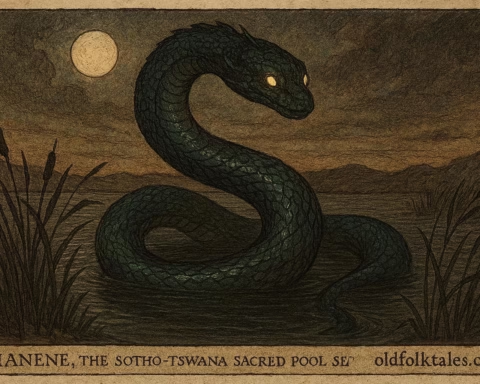
Ala Muki is described in older Polynesian myth compendia as a river dragon, a serpentine goddess whose long, sinuous body moves through freshwater the way the great mo‘o move through the ponds of Hawai‘i or the taniwha coil in the rivers of Aotearoa. Though not universally attested across all island groups, her figure appears as a composite river-spirit, known for guarding borderlands, places where freshwater meets mangrove roots, where canoe routes vanish into narrow channels, or where rites of passage were once held.
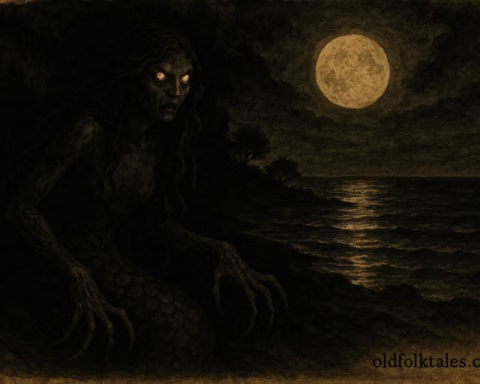
In these accounts, Ala Muki’s body is said to shimmer like polished basalt, dark and glossy, with streaks of blue-green iridescence that mimic deep pools. Her eyes shine like phosphorescent river algae, luminous and unblinking, and many versions describe her with a crown of horn-like ridges that resemble the spines of reef eels. Sometimes she has limbs, clawed and webbed, but more often she moves like a great serpent, churning the water yet leaving no wake.
She carries an aura of stillness and patience, the motionless surface of a river masking deadly currents below. However, she is not purely malevolent. Ala Muki can be protector, punisher, guide, or devourer, depending on one’s respect for river places and the unseen forces within them.
Powers
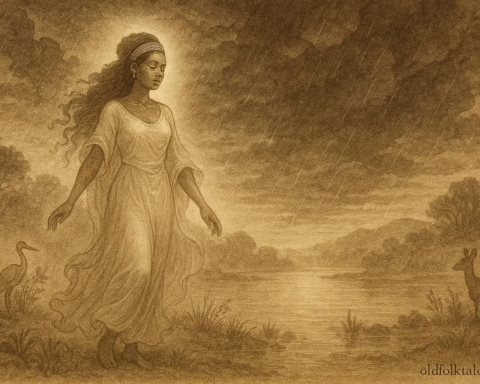
- Shapeshifting: Some traditions say she can take the form of a woman near riverbanks, tall, hair wet and gleaming, voice soft as flowing water.
• Water mastery: She controls floods, whirlpools, currents, and the sudden deepening of shallow streams.
• Illusion: Travelers might see warm firelight over the water or hear familiar voices. Those who follow without caution disappear into her domain.
• Guardianship: To those who honor her, Ala Muki can grant safe passage, freshwater abundance, or warnings of storms.
Behavior
Ala Muki behaves like many water-spirits across Oceania, territorial, mysterious, morally reactive. She punishes the arrogant and protects the humble, especially fishermen, navigators, and young people performing rites near rivers. Her wrath is often described as silent: a canoe slipping beneath the water without a splash, a sudden vine curling around an ankle, a traveler vanishing into reeds.
But her blessings are equally subtle: a safe ford across a swollen river, an unexpected shoal of freshwater fish, or a protective dream warning of danger.
Myths & Beliefs Surrounding Ala Muki
A central story, often summarized in myth compendia, tells of a young warrior who entered Ala Muki’s forbidden river to prove his bravery. He insulted the goddess, boasting that no creature of the freshwater world could harm him. Ala Muki rose in her full serpentine glory, swirling the river into a vortex. She dragged him beneath, not to kill him but to teach humility. When he returned, gasping on the muddy bank, his hair had turned white, and he became a storyteller who traveled from village to village teaching respect for the spirits of water.
Another tale portrays her as a guardian of women, aiding those who flee danger by parting reeds or hiding them beneath the river surface where no harm can reach them. She becomes a kind of ancestral mother, fierce yet nurturing.
Some island traditions describe Ala Muki as the enemy of fire-spirits, battling volcanic entities that threaten freshwater sanctuaries. Their clashes explain why certain rivers turn warm or why stones found in riverbeds appear burnt.
In a few accounts, Ala Muki’s daughters, lesser serpents, act as her messengers, guiding healers or priests to medicinal plants that grow only in marshlands. They embody the concept that nourishment and danger coexist in nature.
Cultural Role & Symbolism
Ala Muki symbolizes the eternal balance between safety and peril in river environments. To Polynesian communities whose survival relied on navigating waterways, she represents:
- Respect for Nature’s Thresholds: Rivers are entrances to other worlds, ecological, spiritual, ancestral. Ala Muki enforces the rules of these liminal places.
- The Hidden Depths of Knowledge: Just as she lures or protects, knowledge can be healing or destructive depending on intention.
- Feminine Power & Water Sovereignty: She embodies the authority of women who guard sacred spaces, representing fertility, secrecy, intuition, and resilience.
- The Consequences of Disrespect: Ala Muki’s wrath mirrors the natural dangers of rivers, floods, drownings, shifting currents, reminders that mastery of nature is never absolute.
- Renewal & Cleansing: Water is rebirth; Ala Muki’s domain cleanses and transforms. Her myths reflect rites of purification, mourning, or maturity.
Encounter dragons, spirits, and beasts that roamed the myths of every civilization
Author’s Note
Ala Muki’s presence in mythological literature highlights how many Oceanic river spirits share overlapping motifs, serpent forms, feminine guardianship, liminal dangers, and the morality of respect. While sources vary and some accounts are fragmentary, the figure of Ala Muki serves as a window into how Polynesian cultures conceptualized freshwater as both life-giving and spiritually charged. Her mythology resonates across Oceania’s broader serpent-water traditions, making her a meaningful character despite limited direct documentation.
Knowledge Check
- What type of deity is Ala Muki?
A river-serpent goddess who rules freshwater domains. - Is she benevolent or malevolent?
Both, she punishes disrespect but protects those who honor river spirits. - What symbolic concept does she represent?
The balance of danger and nourishment found in natural freshwater environments. - How does she move in most stories?
Like a giant serpent, silently coiling through rivers and marsh channels. - What human behaviors does she react to?
Arrogance, disrespect, or carelessness near sacred water sites. - Which natural phenomena are associated with her?
Floods, whirlpools, sudden deep pools, and mysterious river sounds.
Source: Anthropological myth compendia (e.g., The Mythology of Oceania)
Origin: Polynesia, traditional river and water-spirit folklore