
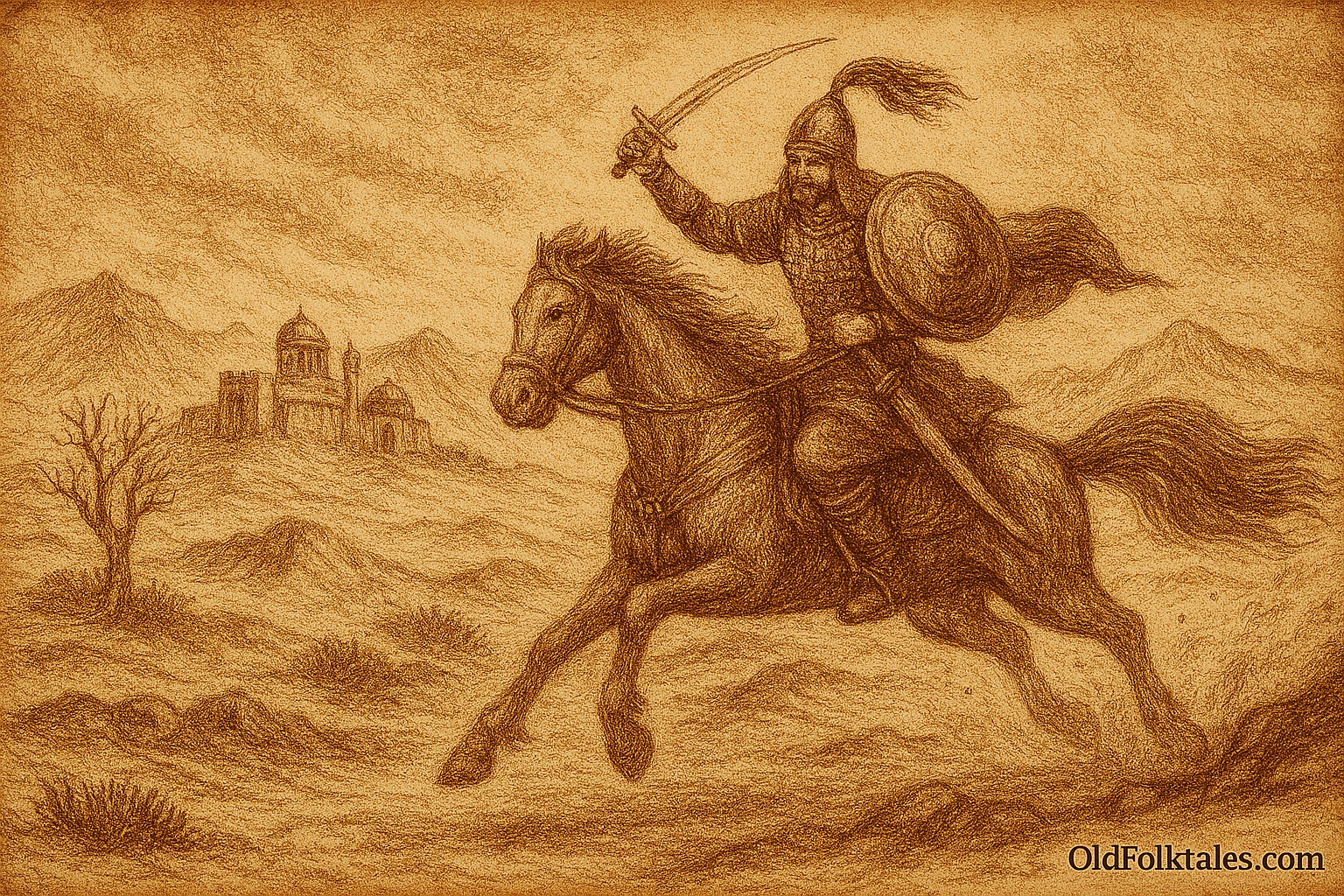
In the golden age of the Turkic peoples, when the steppes stretched endless beneath boundless skies and nomadic tribes moved with the seasons like the migrations of great birds, there lived a warrior whose name would become immortal. His story would be sung by poets for generations, passed from elder to child around countless fires, until his deeds became the very embodiment of what it meant to be a hero. This is the tale of Alpamish, the greatest champion of the Kongrat tribe.
Alpamish was born under auspicious stars, the son of a noble khan named Baysun. From his first breath, it was clear that destiny had marked him for greatness. As a child, he grew faster and stronger than other boys, his laughter ringing across the encampments like thunder promising rain. By the time he reached manhood, he stood tall as a pine, his shoulders broad enough to carry the hopes of his people, his eyes sharp as an eagle’s gaze, his hands capable of both tender kindness and devastating strength.
But physical prowess alone does not make a hero. What set Alpamish apart was his heart a heart that burned with fierce loyalty, unwavering courage, and a love so deep it would be tested by the very limits of endurance.
Click to read all Myths & Legends – timeless stories of creation, fate, and the divine across every culture and continent
That love had a name: Barchin.
She was the daughter of Baysari Khan, beautiful as dawn breaking over mountains, wise beyond her years, and possessed of a spirit that matched Alpamish’s own. From their youth, they had been inseparable, their souls recognizing each other as two halves of a perfect whole. When they were old enough, they pledged themselves to one another, and the entire tribe celebrated the union of two noble hearts destined to walk life’s path together.
But fate, which had granted Alpamish so much, would also test him in ways that would forge his legend.
On the very eve of their wedding celebration, when the drums were beating and the fires burning bright, disaster struck. A rival khan named Ultantaz, whose heart was as black as his ambitions were vast, had long coveted Barchin for himself. Unable to bear the thought of her marrying another, he assembled a force of warriors and launched a surprise attack on the Kongrat camp.
The battle was fierce and sudden. Alpamish fought like a lion defending its pride, his sword flashing in the firelight, each strike felling an enemy. But he was outnumbered, and worse, he had been separated from Barchin in the chaos. When the dust settled and the attackers retreated, Alpamish discovered the terrible truth Barchin had been taken, kidnapped by Ultantaz’s men and carried away into the night like a treasure stolen from its rightful place.
The young warrior’s anguish was boundless. He fell to his knees, his powerful hands clenching the earth as if he could squeeze from it the location of his beloved. But grief is a luxury that heroes cannot long afford, and Alpamish transformed his sorrow into iron determination. He would find Barchin. He would bring her home. And any who stood in his way would face the full fury of his wrath.
Thus began Alpamish’s great journey a quest that would take him across mountains and deserts, through lands both familiar and strange, testing every aspect of his character and pushing him to the very edges of what a mortal man could endure.
His first challenge came in the form of giants who dwelt in the mountain passes. These were not men but monstrous creatures of legend, beings of immense size and strength who devoured travelers and hoarded treasures. When Alpamish encountered them, they laughed at this lone warrior who dared enter their domain. Their laughter died when Alpamish drew his sword and challenged them to combat.
The battle shook the mountains themselves. The giants wielded clubs the size of trees, and their blows could shatter boulders. But Alpamish was swift where they were ponderous, clever where they were brutish. He dodged their crushing attacks and struck at vulnerable points with precision and power. One by one, the giants fell, until their leader faced Alpamish alone and, seeing the futility of continued combat, yielded and granted the warrior safe passage.
Beyond the mountains, Alpamish’s journey led him through trackless deserts where the sun burned mercilessly and water was more precious than gold. He endured sandstorms that could flay flesh from bone, navigated by stars when landmarks disappeared beneath shifting dunes, and survived on determination alone when his provisions ran out. The desert tried to break him, but Alpamish’s will was stronger than any physical hardship.
In the cities and settlements, he passed through, Alpamish encountered rival khans who sought to test this legendary warrior or recruit him to their own causes. Some challenged him to contests of strength wrestling matches, archery competitions, sword duels. Alpamish bested them all, not out of pride but because any delay in his quest was unacceptable. Others tried to bribe him with wealth or power, offering him positions of authority if he would abandon his search. These offers Alpamish rejected without hesitation. No treasure in the world could compare to Barchin, and no throne held any appeal when the one he loved remained in captivity.
The most dangerous challenges, however, came from treacherous foes who used cunning rather than strength. There were those who tried to trick Alpamish with false information, sending him on paths that led nowhere while they secretly served Ultantaz. There were assassins hired to kill him in the night, creeping into his camps with poisoned blades. There were supposed allies who plotted betrayal, hoping to claim glory by defeating the famous warrior themselves.
But Alpamish had inherited not only his father’s strength but also his wisdom. He learned to trust his instincts, to see through deception, to sleep lightly and strike quickly. He made true friends along his journey warriors who recognized his noble cause and joined him, wise elders who offered guidance, and common people whose lives he touched with kindness despite his single-minded quest. These companions became like brothers to him, their loyalty freely given to a man who inspired it through deed rather than demand.
After months of searching, fighting, and enduring, Alpamish finally discovered where Ultantaz had taken Barchin, a fortified stronghold in a remote region, surrounded by the rival khan’s army and defended by the most skilled warrior’s money and fear could command. Any reasonable man would have called it impregnable, but Alpamish had not come this far to be deterred by walls and warriors.
The assault on Ultantaz’s fortress became the stuff of legend. Alpamish led his small band of companions against overwhelming odds, his battle cry echoing across the valley like the roar of dragons from ancient times. He fought with the fury of a storm and the precision of a master craftsman, each movement purposeful, each strike devastating. His enemies fell before him like wheat before the scythe, and those who witnessed his prowess spoke of it with awe for the rest of their lives.
When Alpamish finally reached the chamber where Barchin was held, he found her changed by her ordeal yet unbroken. Though she had endured captivity and the unwanted attentions of Ultantaz, her spirit remained as fierce as ever. Their reunion was marked not by tears alone but by renewed determination together, they would escape this place and return home.
The final confrontation with Ultantaz was inevitable. The rival khan, seeing his fortress falling and his prize slipping away, challenged Alpamish to single combat. It was a battle that lasted until both men were exhausted, their weapons notched and bloodied, their bodies bearing the marks of fierce struggle. But in the end, justice prevailed. Alpamish’s superior skill and righteous cause triumphed over Ultantaz’s jealousy and cruelty.
With Barchin at his side and his companions around him, Alpamish began the long journey home. The return was no less arduous than the quest had been, but it was made bearable by the knowledge that his beloved was safe, that his loyalty had been rewarded, and that his courage had proven equal to every test.
When they finally reached the lands of the Kongrat tribe, the celebration that greeted them lasted for days. The wedding that had been interrupted by violence and kidnapping was completed at last, uniting two souls who had proven their devotion through the harshest trials imaginable. Alpamish’s story became the treasure of his people, sung by poets and told by elders as the perfect example of what loyalty, courage, and love could accomplish.
The Moral Lesson
The epic of Alpamish teaches us that true heroism combines physical courage with unwavering loyalty and moral integrity. Alpamish’s journey demonstrates that love worth having is love worth fighting for, no matter how impossible the obstacles may seem. The story emphasizes that real strength lies not just in defeating enemies but in remaining true to one’s principles when tested by hardship, deception, and temptation. It shows us that loyalty to those we love and to our own values is the foundation of honor, and that such loyalty will ultimately triumph over cruelty and selfishness. Finally, the legend reminds us that heroes are defined not by avoiding challenges but by facing them with determination, wisdom, and an unbreakable spirit.
Knowledge Check
Q1: Who is Alpamish in Uzbek cultural tradition?
A1: Alpamish is the legendary hero of Uzbekistan’s national epic, a powerful warrior of the Kongrat tribe who embodies the ideals of Turkic nomadic culture including courage, loyalty, honor, and unwavering devotion to love and justice.
Q2: What was the central quest that drove Alpamish’s epic journey?
A2: Alpamish’s quest was to rescue his beloved Barchin, who was kidnapped by the rival khan Ultantaz on their wedding eve. This quest took him across dangerous lands where he faced giants, rival khans, treacherous foes, and countless challenges.
Q3: What challenges did Alpamish face during his journey to rescue Barchin?
A3: Alpamish faced mountain giants, treacherous desert crossings, rival khans seeking to test or recruit him, assassins and betrayers, deception and false information, and finally the assault on Ultantaz’s fortified stronghold defended by a large army.
Q4: What qualities made Alpamish a true hero beyond his physical strength?
A4: Beyond physical prowess, Alpamish demonstrated unwavering loyalty, wisdom to see through deception, kindness to common people, the ability to inspire true friendship, refusal to be corrupted by wealth or power, and absolute devotion to his beloved and his principles.
Q5: How does the Alpamish epic represent Uzbek national identity?
A5: The Alpamish epic embodies core values of Uzbek and Turkic culture including honor, loyalty, courage, justice, and the nomadic warrior tradition. Recognized by UNESCO, it serves as a cultural cornerstone that defines ideals and virtues central to Uzbek identity.
Q6: What is the significance of Alpamish’s victory over Ultantaz?
A6: Alpamish’s victory represents the triumph of justice and righteous love over jealousy and cruelty. It demonstrates that evil obtained through force and deception cannot prevail against virtue combined with courage, symbolizing moral order prevailing in the universe.
Source: Adapted from the traditional oral epic “Alpamish,” recognized by UNESCO as Intangible Cultural Heritage of Humanity, and preserved in the Uzbek Academy of Sciences Folklore Archive.
Cultural Origin: Uzbek People, Uzbekistan (Turkic Nomadic Tradition)






