
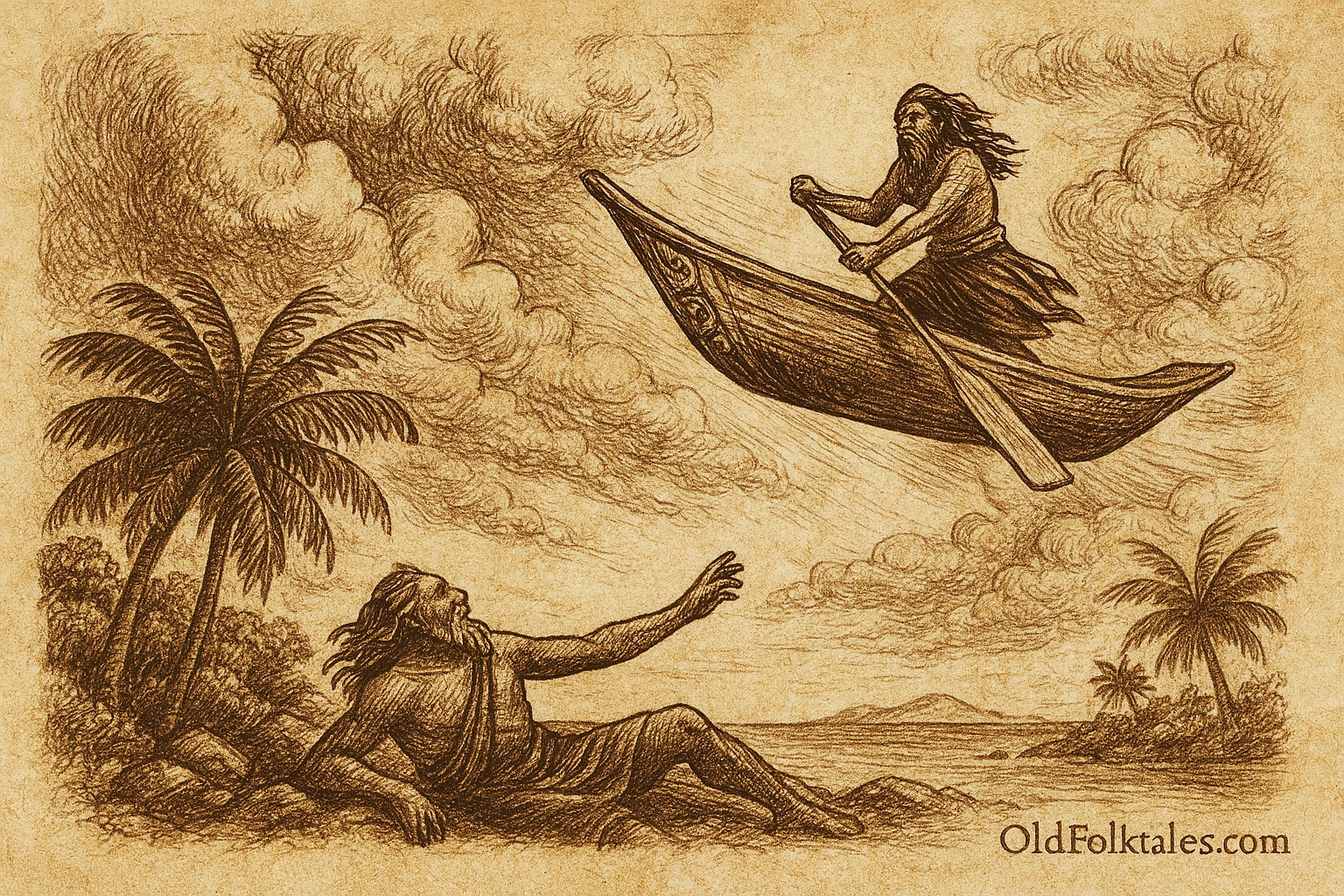
In the time when the boundary between the possible and impossible was less firmly drawn, when magic flowed through the world as naturally as trade winds across the Pacific, there lived a master navigator named Anagumang on the island of Yap. He was not merely skilled at reading the stars or understanding the ocean’s moods, though he possessed these abilities beyond measure. Anagumang carried within him something deeper: an intuitive connection to the very spirit of voyaging itself, a knowledge that seemed to come from both ancestral memory and divine inspiration.
Yap itself was a place of ancient stone and sacred tradition. The island rose from the western Pacific like a jewel, its lush green interior crowned with thick forests, its coastline marked by mangrove swamps and protected lagoons. But what made Yap truly remarkable were the great stone money discs massive rai stones transported from distant islands by ancestral navigators standing as testament to generations of seafaring mastery. Here, the art of navigation was more than a practical skill; it was a sacred trust, a knowledge passed down through carefully chosen lineages, a connection to the stars and ancestors who guided canoes across trackless waters.
Anagumang had learned the navigator’s art from his grandfather and his grandfather’s father, absorbing knowledge that stretched back through time like a rope woven from countless individual fibers. He could read the stars with perfect accuracy, using constellations as a map written across the night sky. He understood how to read the waves how swells bent and curved around distant islands that lay beyond the horizon, creating patterns that told a knowing eye exactly where land could be found. He could interpret the flight of seabirds, the color of clouds, the feel of currents against his hand trailing in the water.
But Anagumang dreamed of something more. He envisioned a canoe that would transcend the normal limitations of wood and sail, a vessel that could carry not just people and cargo but the very essence of navigational wisdom itself. This dream consumed him, filling his days and haunting his nights, until he knew he must attempt to bring it into reality.
He chose his materials with meticulous care, seeking wood from specific trees that had been blessed by the ancestors. He selected a breadfruit tree that grew in a sacred grove, one that elder spirits visited in the form of wind and rain. The wood had to be cut at precisely the right time, during a phase of the moon when the veil between worlds was thinnest. Every cut of his adze, every stroke of his tools, was accompanied by prayers and chants passed down through generations.
For months, Anagumang worked on his canoe, carving it with a precision that bordered on obsession. He shaped the hull with curves that seemed to capture the very motion of waves, creating lines so perfect they appeared to have been formed by ocean and wind rather than human hands. The outrigger was balanced with mathematical exactness, achieving an equilibrium that felt almost supernatural. Every joint, every lashing, every detail received his complete attention and reverence.
But the physical craftsmanship was only part of the creation. As Anagumang worked, he infused the canoe with ritual magic, speaking over it the secret names of navigation words that invoked the stars, the currents, the winds, and the ancient pathfinders who had first crossed these waters. He called upon his ancestors, asking them to bless this vessel and imbue it with their power and wisdom. He made offerings to the spirits of the sea, requesting their permission and protection for what he was attempting to create.
When the canoe was finally complete, it was a thing of extraordinary beauty. The wood gleamed with an inner light, as if the sun itself had been captured in the grain. The entire vessel seemed to hum with potential energy, vibrating at a frequency just below the threshold of hearing. When Anagumang placed his hand on the hull, he could feel power flowing through it like blood through veins.
The first time he pushed the canoe into the water, witnesses expected to see it float and indeed it did, riding the waves with perfect grace and balance. But then Anagumang spoke a word of power, a command taught to him in a dream by his ancestors, and the impossible happened. The canoe rose from the water’s surface, lifting into the air as smoothly as a frigate bird catching an updraft. Water streamed from its hull as it ascended, and Anagumang stood within it, paddle in hand, steering through the sky as effortlessly as he had once steered across the lagoon.
The flying canoe became legendary across the islands. People would look up at unexpected moments and see Anagumang passing overhead, his vessel cutting through clouds as ordinary canoes cut through waves. When the canoe flew by, it made a distinctive sound like wind rushing through palm fronds, a whisper of movement that announced his presence before he came into view. Children would point and shout with excitement, and elders would nod with satisfaction, knowing that the old powers had not abandoned their people.
Anagumang used his miraculous vessel not for personal glory but to serve the scattered communities of the Pacific. He traveled from island to island, from atoll to atoll, covering in hours distances that would take ordinary canoes days or weeks to traverse. Wherever he went, he shared his knowledge generously, teaching the art of navigation to any who showed aptitude and dedication.
He taught people how to read the star paths those invisible highways across the sky that guided navigators from one island to another. He showed them how different stars rose and set at specific points on the horizon, creating a celestial compass that never failed. He explained the wave patterns, how to feel the subtle differences between swells generated by distant storms and those deflected by hidden islands. He demonstrated how to build canoes with the proper proportions and balance, sharing techniques that had been revealed to him through visions and ancestral guidance.
In village after village, Anagumang would land his flying canoe on the beach, and people would gather to receive his teaching. Young navigators sat at his feet for hours, memorizing the chants that encoded navigational knowledge, learning to read signs in nature that others passed by without noticing. He taught them about currents how they flowed in great circles around the ocean, how they could carry a canoe far off course or, if properly understood, speed a journey by days.
Years passed, and Anagumang’s reputation grew until his name was spoken with reverence across Micronesia. But as he aged, he began to feel a pull toward something beyond the mortal world. The ancestors who had blessed his canoe were calling him home, inviting him to join them in the realm of spirits where the greatest navigators dwelled after their earthly voyages ended.
Anagumang knew his time among the living was drawing to a close, and he prepared for his final voyage with the same meticulous care he had brought to every journey. He gathered his most dedicated students and spent days imparting every last piece of knowledge he possessed. He taught them secret techniques for predicting weather, methods for finding fresh water on barren atolls, and ways to survive when storms drove them far from their intended course.
He showed them how to construct mental maps of the entire ocean, holding in their minds the positions of hundreds of islands, the patterns of currents and winds, the seasonal changes that affected every aspect of voyaging. He taught them to navigate not just with tools and techniques but with their entire being to become one with their canoe, the ocean, and the sky, so that finding their way became as natural as breathing.
When he had shared everything he could, Anagumang prepared his flying canoe for its final journey. He loaded it with offerings for the ancestors woven mats, shell ornaments, and precious gifts that would honor those who had guided him throughout his life. As dawn broke over the eastern horizon, painting the sky in shades of pink and gold, he pushed his canoe into the air one last time.
The people of Yap gathered on the beaches to watch him go, their faces turned skyward, tears streaming down their cheeks. The canoe rose higher and higher, spiraling upward in a graceful pattern that seemed to trace invisible currents in the air. The familiar sound of wind through palm fronds grew gradually fainter as Anagumang ascended toward the realm of spirits, toward the land beyond the horizon where the greatest navigators waited to welcome him home.
Some say he reached the edge of the sky itself, where the dome of heaven meets the distant ocean. Others claim he sailed beyond the stars, following paths that only the dead can navigate. But all agree that at the moment of his departure, the winds across all of Micronesia carried his voice one final time, repeating the essential teachings, ensuring they would never be forgotten.
The knowledge Anagumang shared did not disappear with his ascent to the spirit realm. It lived on in the students he had trained, who taught their own children and grandchildren. The techniques of traditional navigation reading stars, waves, currents, and natural signs became the foundation of Yapese seafaring culture. Even today, traditional navigators on Yap practice the methods Anagumang taught, keeping alive a connection to their ancestors that stretches back through countless generations.
When master navigators train their apprentices in the ancient ways, they invoke Anagumang’s name, asking for his spirit to guide both teacher and student. When canoes set out on long voyages across the open ocean, navigators whisper prayers that include words Anagumang first spoke. And sometimes, on very quiet nights when the stars shine with particular brightness, old sailors claim they can still hear the sound of wind rushing through palm fronds high overhead the unmistakable signature of the flying canoe, still traveling the pathways between worlds.
The Moral Lesson
The legend of Anagumang and his flying canoe teaches us that true mastery comes from combining technical skill with spiritual dedication and selfless service to others. Anagumang’s achievement was remarkable not just because he built a magical vessel, but because he used his extraordinary gift to benefit entire communities rather than seeking personal glory. The story reminds us that knowledge gains its greatest value when shared generously with those who come after us.
Knowledge Check
Q1: Who was Anagumang and what made him a master navigator? A: Anagumang was a legendary navigator from Yap who possessed extraordinary abilities beyond normal seafaring skills. He had an intuitive connection to the spirit of voyaging itself, combining knowledge passed down through generations with what seemed like divine inspiration. He could read stars with perfect accuracy, interpret wave patterns, understand currents, and predict weather through natural signs that others couldn’t perceive.
Q2: How did Anagumang create his flying canoe and what made it magical? A: Anagumang built the canoe with meticulous care using wood from a sacred breadfruit tree, cut at the perfect lunar phase. He carved it with supernatural precision, creating perfect curves and balance. Beyond physical craftsmanship, he infused it with ritual magic through prayers, chants, secret navigational names, and blessings from ancestors and sea spirits. The combination of perfect construction and spiritual power allowed the canoe to fly through the sky.
Q3: What did the flying canoe sound like and what did Anagumang use it for? A: When the flying canoe passed overhead, it made a distinctive sound like wind rushing through palm fronds a whisper of movement that announced Anagumang’s presence. Rather than using this miraculous vessel for personal glory, Anagumang used it to travel rapidly between islands, teaching navigation skills, sharing knowledge of star paths, wave reading, canoe building, and wayfinding techniques to communities across Micronesia.
Q4: What specific navigation techniques did Anagumang teach to his students? A: Anagumang taught comprehensive navigation methods including reading star paths (celestial highways across the sky), interpreting wave patterns created by distant islands, understanding ocean currents and their circular flows, predicting weather, finding fresh water on barren atolls, constructing mental maps of hundreds of islands, and building properly balanced canoes. He taught students to navigate with their entire being, becoming one with their vessel, ocean, and sky.
Q5: Where did Anagumang go on his final voyage and why? A: Anagumang’s final voyage took him to the land of the spirits, the realm where the greatest navigators dwell after death. As he aged, he felt the ancestors who had blessed his canoe calling him home. Before departing, he ensured all his knowledge was passed to his students, then ascended into the sky at dawn, spiraling upward toward the spirit realm beyond the stars, following paths only the dead can navigate.
Q6: How does Anagumang’s legacy continue in Yapese culture today? A: The navigational knowledge Anagumang shared remains the foundation of traditional Yapese seafaring culture. Modern traditional navigators on Yap still practice the methods he taught reading stars, waves, currents, and natural signs. Master navigators invoke his name when training apprentices, and sailors whisper prayers containing his words before long voyages. His teachings have been preserved across generations, maintaining a living connection to ancestral wisdom and cultural identity.
Cultural Origin: Indigenous Yapese mythology, Yap State, Federated States of Micronesia, Western Pacific






