In the age when the world still trembled beneath the tread of gods and mortals, there arose a king whose destiny was whispered by rishis long before his birth. From the royal lineage of the Haihayas was born Arjuna Kartavirya, a child marked by omens of radiant fire, a sign that divine forces had stitched themselves into his fate. His mother dreamt of a wheel of blazing sun; his father beheld a vision of a cowherd sage granting infinite hands to an infant wrapped in light. And so it was foretold: the child would rise as a force none on earth could ignore.
Growing into youth, Arjuna displayed strength that bent iron and a mind that sought truth and discipline above luxury. Yet even he sensed a limit pressing upon his spirit, a boundary he wished to transcend. Desiring a power that could secure dharma, he undertook a terrible austerity, standing unmoving beneath the scorching sun for years, fasting until his bones shone, breathing only the morning wind.
Moved by his resolve, the Three-Formed Lord, Dattatreya, born of Brahma, Vishnu, and Shiva, descended before him, radiating serenity.
“Arjuna of the Haihayas,” the deity spoke, “your hunger is not of the belly but of the soul. What seek you?”
Arjuna bowed. “O Lord of the Yogic Path, grant me strength not for pride, but for order. Make me the arm of justice.”
Dattatreya smiled, seeing truth in him, and laid a hand upon his brow.
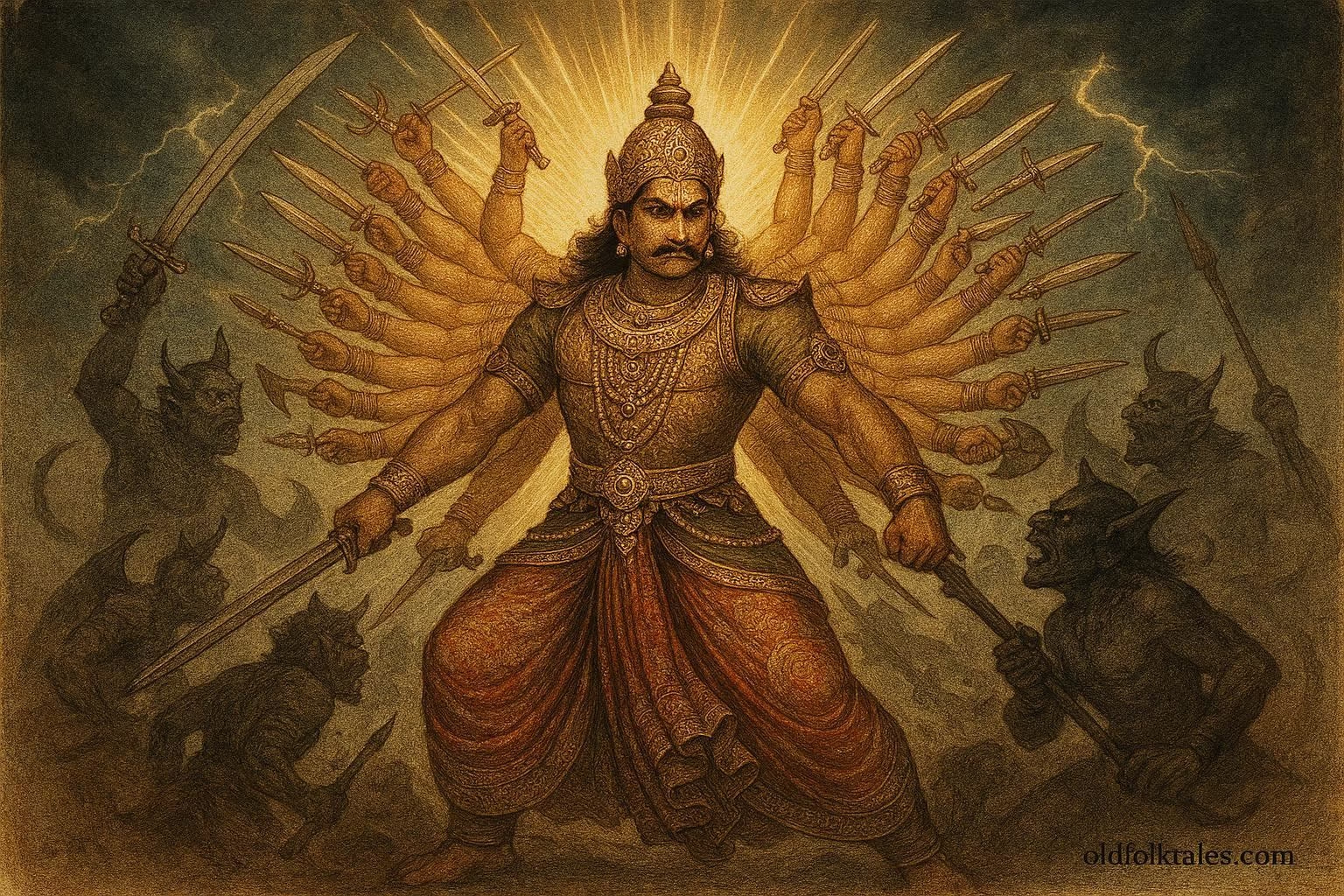
In that instant, a thousand arms blossomed from Arjuna’s form, each radiant with divine power. Strength surged through him like a river breaking its dam; understanding flooded him like dawn over the horizon.
“Bear this gift with humility,” Dattatreya warned. “For many arms can uphold the world, or crush it.”
Arjuna Kartavirya returned to his kingdom transformed. Under his reign, highways flourished, thieves fled like dust before storm winds, and the suffering found refuge. With his many hands he could do the work of countless men, holding court, consecrating temples, commanding armies, and tending to the poor all at once. His fame spread to the peaks of the Himalayas and the far coasts of the southern sea.
Yet greatness draws challenge.
From the forests emerged demons who had long evaded the eye of dharma. Among them was the mighty Jambha, a rakshasa who feasted on warriors. Jambha mocked the thousand-armed king, saying, “Let us see if your many limbs can shield you from death.” The battle that followed thundered across plains, Arjuna striking with a whirlwind of arms, every movement a storm of divine power. Jambha’s roars shook mountains, but the king’s relentless strikes shattered the demon’s illusions and armor. With one final blow, delivered by a hundred fists at once, Arjuna Kartavirya felled him, restoring peace to the frontier.
Victories multiplied, but with them grew the whispers of envy from rival kingdoms. Some called him protector; others called him too mighty for mortal realms. And within Arjuna himself, a shadow began to stir, a subtle pride blooming like a poisonous flower. Where once he saw himself as the servant of dharma, he now saw dharma as the servant of his will.
It was then that fate delivered its sternest trial.
Arjuna Kartavirya visited the hermitage of Rishi Jamadagni, who offered him hospitality. Within the sage’s possession was the divine cow Kamadhenu, whose presence sustained the hermitage. In a moment of swelling ambition, Arjuna, believing such a wondrous being belonged in a king’s treasury, ordered that the cow be seized.
Jamadagni protested, saying, “Power does not grant ownership of the sacred.”
But pride, once awakened, speaks louder than conscience.
The king’s men took Kamadhenu by force.
This act, small in a world of wars yet vast in its moral weight, set in motion a tragedy destined to be carved into epic memory. For Jamadagni’s son was Parashurama, the axe-wielding warrior-sage and avatar of Vishnu, born to restore balance when kings faltered.
When Parashurama returned and saw the sacrilege, fury ignited within him, not the fire of vengeance alone, but the divine flame of cosmic correction. Bearing his terrible axe, he stormed Arjuna Kartavirya’s court.
The thousand-armed king welcomed him with the confidence of one who had never met defeat. The battlefield quaked beneath their duel, Arjuna’s myriad arms flashing like a wall of wind, Parashurama’s axe cutting arcs of divine wrath. For the first time, Arjuna felt strain; for the first time, his confidence trembled.
“Arjuna,” Parashurama thundered, “divine gifts do not shield a heart corrupted by pride.”
Blow after blow wore down the king’s strength. Arms that once seemed infinite felt suddenly heavy. In a single, destiny-marked strike, Parashurama severed the thousand arms, shattering the gift that had become burden. Arjuna Kartavirya fell, not as a tyrant crushed, but as a tragic hero undone by the very power he once wielded for good.
As his breath faded, Arjuna whispered to the heavens, “Dattatreya… may this be my lesson. Let future kings remember me not in fear, but in warning.”
And so his story endures, half splendor, half sorrow, like sunlight seen through storm clouds.
Author’s Note
Arjuna Kartavirya stands as one of India’s most paradoxical epic figures, glorious in strength, righteous in early reign, yet ultimately undone when divine blessing met human pride. His story warns that power is sacred only when anchored to humility, and that dharma bends not even for kings with a thousand arms. His legacy remains a study in the fragile balance between greatness and downfall.
Knowledge Check
-
Who granted Arjuna Kartavirya his thousand arms?
-
What was Arjuna’s main intention when he first sought divine power?
-
Which demon did Arjuna defeat in a major battle of the epic?
-
What sacred being did the king take from Rishi Jamadagni?
-
Who confronted Arjuna to restore cosmic balance?
-
What moral failing led to Arjuna Kartavirya’s downfall?
Cultural Origin: Indian (Sanskrit Epic Traditions, Mahabharata and Puranic Legends)
Source: Accounts from the Mahabharata and the Puranas, especially the Vayu Purana.