Long before the clash of armies shook the plains of Kurukshetra, destiny shaped the soul of Arjuna. Born to Queen Kunti by the blessing of Indra, the celestial king and lord of thunder, Arjuna entered the world not as a simple prince, but as a warrior ordained by divine lineage. The winds whispered of his coming, and sages foretold that his arrows would carry the weight of dharma itself. Among the five sons of Pandu, he alone possessed the calm precision, fierce discipline, and radiant humility that mirrored the heavens.
From childhood, Arjuna’s mastery of the bow astonished even the gods. Under Guru Drona’s austere training, he learned to strike a target by moonlight, hear the flight of an arrow in rain, and see with the stillness of the inner spirit. Yet it was not skill alone that set him apart, it was the clarity of intention within his heart. He wielded weapons not for conquest, but for justice. He fought not for pride, but to uphold the sacred order that bound heaven and earth.
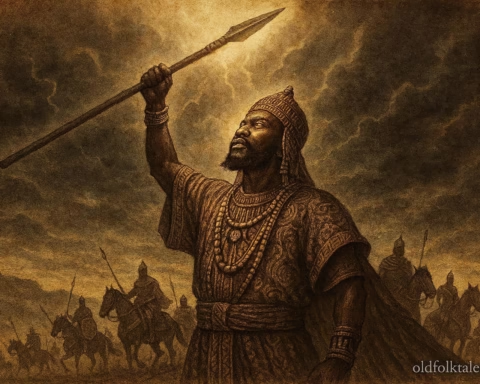
His bow, Gandiva, gifted from the gods, sang in his hands with divine resonance. His chariot bore the banner of Hanuman. And yet none of these celestial signs equaled the presence of Krishna, his charioteer, his friend, and the incarnation of the Divine who walked among men.
Thus Arjuna’s life became a path threaded with sacred duty. Yet no divine gift could shield him from the storm of grief and doubt that awaited him at Kurukshetra.
When the drums of war thundered across the field, Arjuna stood at the heart of a world torn asunder. The Kauravas, his cousins and sworn rivals, faced him, warriors he had played with as a child, elders he had bowed to, teachers who had shaped him. The battlefield shimmered with the armor of kin, the shadows of loyalty, and the haunting echo of familial ties.
His breath faltered. His hands trembled. His bow slipped.
“How can I raise my weapon,” he whispered, “against my own blood? Against my teachers? Against those who shaped my life?”
Gandiva fell from his grasp.
He, the greatest archer in all the realms, felt the weight of the world press upon him. The thunder of Indra’s lineage could not silence the storm of his conscience. Arjuna sank into his chariot, sorrow burning like a fire without flame.
It was then that Krishna, serene, radiant, timeless, turned to him.
“Arjuna,” he said, “why does weakness come upon you in this hour?”
Arjuna looked upon the battlefield, eyes dimmed by despair. “Better to lay down my arms than to slay those I honor. What victory is worth such blood? What kingdom is worth such sorrow?”
Krishna’s gaze was deep as creation itself.
“You sorrow for those beyond sorrow,” he said. “You grieve for bodies, but the Self is deathless. These forms pass, but the eternal spirit does not die.”
Arjuna shook his head. “But how shall I act? How shall I live through this battle without staining my soul?”
And thus unfolded the divine dialogue that would echo for millennia, the teaching of dharma, the path of action without attachment, the understanding of duty as a sacred offering.
“Your task,” Krishna said, “is not to cling to the fruits of your actions, but to act in harmony with the law of the universe. You are a warrior. Your duty is to protect righteousness. In performing your dharma without desire, you walk the path of liberation.”
Arjuna felt the universe stir within him. He glimpsed Krishna’s true form, a cosmic vision blazing with infinite worlds, creation and destruction held in a single breath, the divine radiance from which all beings arise and to which all must return. Before this boundless form, Arjuna trembled, awakening to a truth beyond fear.
Krishna spoke again, his voice a calm river carrying the wisdom of the ages.
“Rise, Arjuna. Take up your bow. Let your actions be guided not by sorrow, but by clarity. Let righteousness, not emotion, be your compass.”
The fog of despair receded. The warrior prince straightened his spine, lifted his gaze, and reclaimed Gandiva with steady hands. Not because he desired victory. Not because he burned with wrath.
But because he understood.
His life, his skill, his very breath, all were instruments of dharma. To retreat from duty was to retreat from truth.
With newfound resolve, Arjuna signaled his readiness. Krishna guided the chariot forward. Their banner fluttered like a promise to the heavens. And as battle erupted, the world bore witness to a warrior transformed, not merely by divine power, but by divine understanding.
The outcome of the war would be carved into history, but Arjuna’s true victory lay within: he had conquered the turmoil of the self. His arrows did not merely cut through armor, they pierced illusion, fear, and doubt. Through him, dharma breathed again.
And thus Arjuna, son of Indra, guided by Krishna, became more than a hero. He became a symbol of the eternal human struggle: to act with integrity when the heart wavers, to choose duty over despair, and to see the divine thread woven through all moments of life.
Author’s Note
Arjuna’s legacy endures as one of humanity’s greatest explorations of moral courage. His story, rooted deeply in Indian epic tradition, reveals a universal truth: every person must face their own Kurukshetra, their own inner battlefield. His awakening through Krishna’s guidance offers not only spiritual insight but a timeless path toward clarity, purpose, and disciplined action.
Knowledge Check
-
What divine lineage grants Arjuna his celestial gifts?
-
Why does Arjuna hesitate at the start of the battle of Kurukshetra?
-
What is Krishna’s central teaching about the nature of the Self?
-
How does Krishna redefine Arjuna’s understanding of duty (dharma)?
-
What transformation occurs in Arjuna after witnessing Krishna’s cosmic form?
-
What symbolic victory does Arjuna achieve beyond the battlefield outcome?
Source: Mahābhārata; Bhagavad Gita, trans. Eknath Easwaran (Nilgiri Press, 2007).
Cultural Origin: Ancient Indian epic tradition.