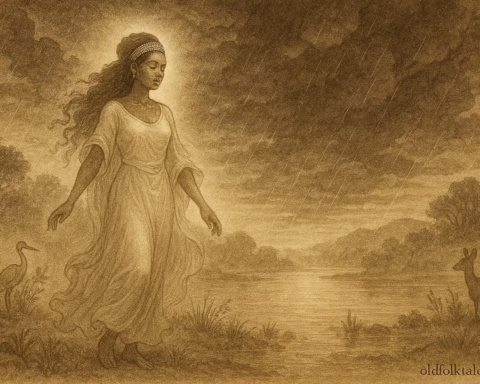
In the mist-shrouded valleys of the Eastern Highlands of Papua New Guinea, where mountains pierce the clouds and rivers carve ancient paths through emerald forests, there lies a village whose people discovered that survival sometimes requires becoming something otherworldly. This is the story of the Asaro clan, and how terror, mud, and ancestral cunning transformed them into the legendary Mudmen of Goroka.
Long ago, in a time when clan rivalries painted the highlands red with conflict, the Asaro people found themselves facing an enemy far greater in number and ferocity. War cries echoed through the valleys as hostile warriors descended upon their village with weapons raised and vengeance burning in their hearts. The Asaro fighters were brave, but they were not foolish. They knew that standing their ground against such overwhelming force would mean certain death for every man, woman, and child in their clan.
The elders made a swift decision. “We must flee,” they commanded. “Live to fight another day, when the spirits favor us.”
And so the Asaro people ran. They abandoned their homes, their gardens, their carefully tended sweet potato fields, and fled into the wild embrace of the surrounding jungle. Behind them, they could hear the thundering footsteps of their pursuers, the shouts growing closer with each passing moment. The enemy was relentless, determined to wipe the Asaro from the face of the earth.
Panic seized the fleeing clan as they realized the warriors were gaining ground. Children stumbled over roots, elderly men gasped for breath, and the strongest among them knew they could not outrun their fate much longer. Then, as if guided by the ancestors themselves, they discovered it a river cutting through a deep ravine, its banks thick with grey clay and mud that had accumulated over countless rainy seasons.
“Into the river!” someone shouted. “Hide in the mud pits!”
Without hesitation, the Asaro people plunged into the murky water and burrowed themselves into the riverbank’s soft, clinging clay. They submerged themselves completely, packing the thick grey mud over their bodies, covering every inch of exposed skin. Some fashioned crude masks from the clay to cover their faces, molding eye holes so they could see while remaining hidden. They pressed themselves against the muddy banks and waited, their hearts pounding like drums, their breaths shallow and silent.
Time stretched endlessly as they lay concealed. The grey clay was cold and heavy, but it held them like the earth’s own embrace. Above, they could hear the enemy warriors crashing through the undergrowth, searching for their prey. Footsteps pounded past the riverbank. Frustrated voices called out to one another. But the Asaro remained as still as stones, becoming one with the mud that concealed them.
Hours passed. The sun began its descent toward the horizon, casting long shadows through the valley. The pursuing warriors, exhausted and bewildered by their quarry’s disappearance, began to lose their fervor. Where had the Asaro gone? Had they been swallowed by the jungle itself? Had the spirits intervened?
As twilight descended and the world took on the grey-blue hue of approaching night, the Asaro elders decided it was time. They could not remain in the mud pit forever. Slowly, cautiously, they began to emerge from their hiding place.
What happened next would become legend.
The enemy warriors, who had been preparing to make camp nearby, turned at the sound of movement near the river. What they saw froze the blood in their veins. Rising from the muddy banks were figures unlike anything they had ever witnessed grey, ghostly beings covered entirely in thick clay, their faces obscured by eerie masks with hollow, staring eyes. These creatures moved slowly, deliberately, as if they had climbed directly from the spirit world itself.
In the fading light, the mud-covered Asaro appeared not as humans, but as ancestral ghosts, as spirits of the dead returned to exact vengeance on the living. In the highlands culture, where the boundary between the physical and spiritual worlds was thin, and where spirits were feared above all else, this sight was more terrifying than any army of warriors.
The enemy warriors’ courage shattered like clay pots dropped on stone. Screams of terror erupted from their throats. “Ghosts! Spirits of the dead! The ancestors have risen against us!” They dropped their weapons and fled in absolute panic, stumbling over one another in their desperate scramble to escape. Some fell in their haste, picked themselves up, and ran even faster. Others abandoned their supplies, their dignity, their very composure, driven by pure, primal fear.
The Asaro people, still covered in their grey clay armor, stood in stunned silence as they watched their enemies vanish into the darkening jungle. What had begun as a desperate act of hiding had transformed into an unexpected triumph. They had not defeated their enemies through strength of arms or superior numbers. They had defeated them through fear by becoming something beyond human understanding.
When the last enemy warrior had disappeared from sight, the Asaro people looked at one another and began to laugh. It started as nervous chuckles, then grew into full-throated laughter that echoed through the valley. They had survived. They had won. And they had discovered something profound: sometimes the greatest weapon is not the sharpest spear, but the power of perception and the fear of the unknown.
The clan returned to their village victorious, carrying with them not just their lives, but a powerful new tradition. From that day forward, the Asaro people would honor this moment of ancestral cleverness. They would fashion elaborate masks from clay and mud, painting them to enhance their ghostly appearance. They would cover their bodies in the same grey clay that had saved them, and they would perform ceremonial dances that reenacted that fateful day when they became the Mudmen.
The tradition spread throughout the Eastern Highlands and beyond. The Asaro Mudmen became famous, their image synonymous with the ingenuity and resilience of Papua New Guinea’s highland peoples. Warriors from other clans would come to witness the mud dances, to learn the story, to understand that victory comes in many forms.
To this day, when you visit the region around Goroka, you may see the Asaro Mudmen performing their ancestral dance. Their grey clay-covered bodies move in rhythm to ancient drums, their masks both haunting and beautiful, their movements telling a story that has been passed down through countless generations. They are living proof that sometimes salvation comes not from fighting harder, but from thinking differently—from becoming, for a brief moment, something that transcends the ordinary and touches the realm of the spirits.
Click to read all Myths & Legends – timeless stories of creation, fate, and the divine across every culture and continent
The Moral Lesson
The story of the Asaro Mudmen teaches us that survival often requires creativity, adaptability, and the courage to think beyond conventional solutions. When direct confrontation would have led to destruction, the Asaro people found salvation in transformation and the power of perception. The legend reminds us that sometimes our greatest strengths emerge from moments of vulnerability, and that cultural wisdom often comes from turning desperate circumstances into lasting traditions. It also illustrates how fear of the unknown can be more powerful than physical force, and how a community’s shared experience of overcoming adversity becomes the foundation for enduring cultural identity.
Knowledge Check
Q1: Who were the Asaro Mudmen of Papua New Guinea?
A1: The Asaro Mudmen are a clan from the Eastern Highlands near Goroka, Papua New Guinea, who became famous for covering themselves in grey river clay and wearing mud masks. This tradition originated from an ancestral event when they hid in a river mud pit to escape enemies and emerged looking like ghosts.
Q2: How did the Asaro people escape their enemies in the legend?
A2: The Asaro people fled from superior enemy forces and hid in a river mud pit, covering themselves completely in thick grey clay. When they emerged at twilight, their mud-covered appearance made them look like ancestral spirits or ghosts, causing their terrified enemies to flee in panic.
Q3: Why did the enemy warriors flee when they saw the mud-covered Asaro?
A3: The enemy warriors believed the mud-covered figures were ancestral ghosts or spirits of the dead rising from the earth. In highland culture, spirits are deeply feared, and the grey, otherworldly appearance of the clay-covered Asaro in the twilight was more terrifying than any human army.
Q4: What does the mud symbolize in Asaro Mudmen tradition?
A4: In Asaro tradition, the mud symbolizes transformation, protection, and the connection between the physical and spirit worlds. It represents how the earth itself provided sanctuary and how adopting a ghostly appearance became both a survival strategy and a sacred cultural practice.
Q5: Where in Papua New Guinea did the Asaro Mudmen tradition originate?
A5: The Asaro Mudmen tradition originated in the Eastern Highlands of Papua New Guinea, specifically in the Goroka region. This mountainous area is known for its deep valleys, rivers with clay-rich banks, and strong traditions of ancestral storytelling.
Q6: What cultural lesson does the Asaro Mudmen story teach about problem-solving?
A6: The story teaches that creative thinking and adaptability can overcome seemingly impossible odds. Instead of fighting a superior force directly, the Asaro people used their environment, cultural knowledge of spirit beliefs, and quick thinking to transform vulnerability into strength, demonstrating that unconventional solutions can be more effective than brute force.
Source: Adapted from Papua New Guinea National Museum Anthropology Records.
Cultural Origin: Asaro Valley, Eastern Highlands, Goroka Region, Papua New Guinea