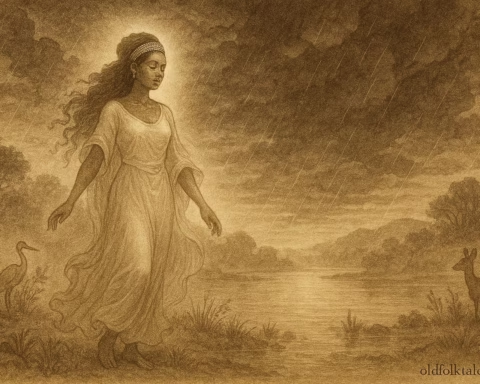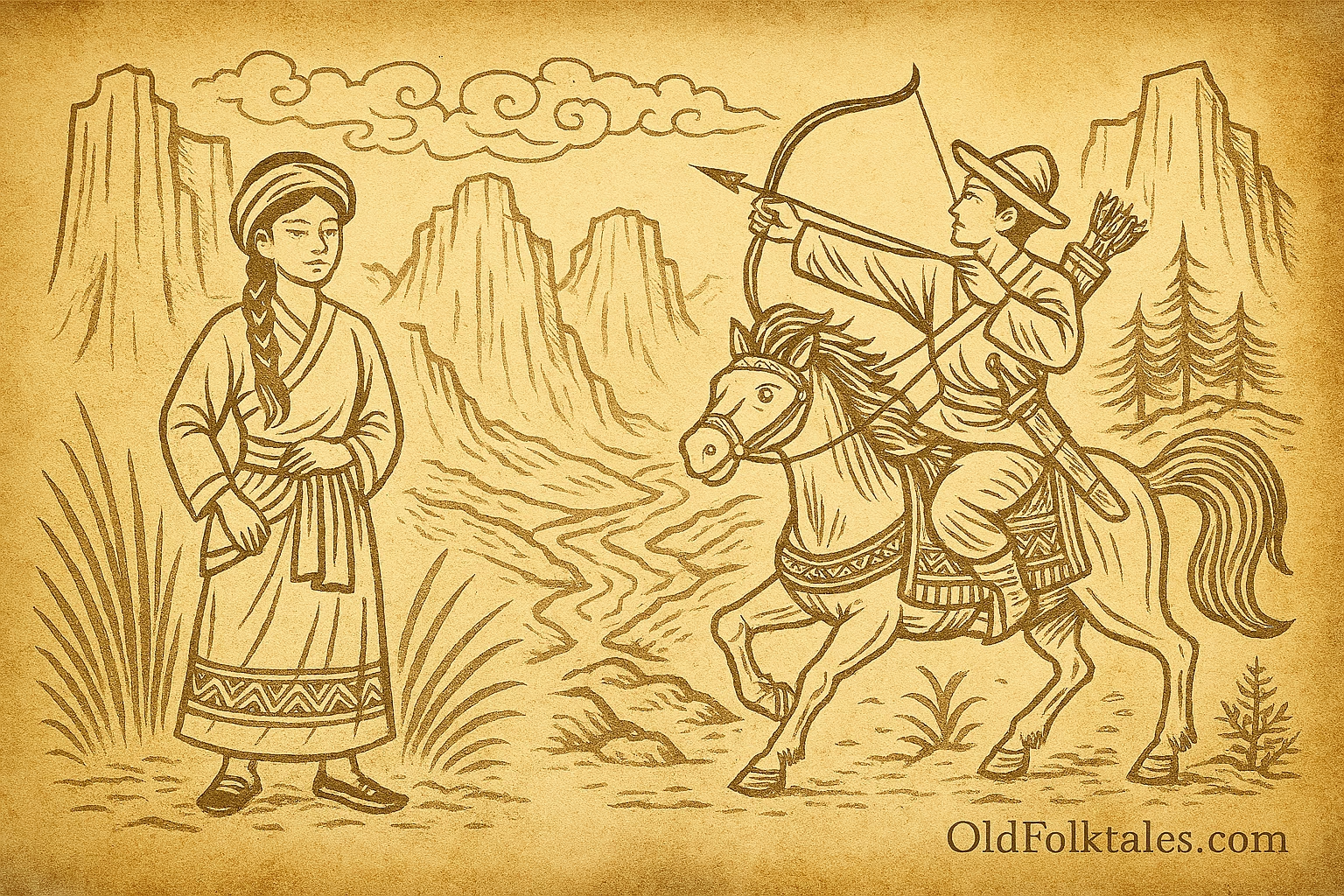
In the ancient land of the Yi people, where stone forests rose like petrified dreams and mountains touched the clouds, there lived a girl whose beauty was matched only by her courage. Her name was Ashima, and she moved through the world with grace and determination, her spirit as untamable as the wild rivers that carved through the limestone valleys.
Ashima had a brother named A-Hei, a young man skilled in archery and herding, who loved his sister dearly and protected her as the mountains protect the villages nestled in their shadow. Together they lived simply but happily, their days following the ancient rhythms of their people tending flocks, singing songs, and honoring the spirits of the land.
Click to read all Myths & Legends – timeless stories of creation, fate, and the divine across every culture and continent
One fateful day, as Ashima hurried through the bustling streets of the village, she caught the eye of A-Zhi, the spoiled son of Rebubala, the wealthiest and most powerful landlord in A-Zhaodi. A-Zhi was accustomed to getting whatever he desired, and the moment he saw Ashima, he decided he must have her as his wife. Her beauty captivated him, but he knew nothing of her heart or spirit he saw only a possession to acquire.
A-Zhi rushed home to his father, pleading with Rebubala to arrange the marriage immediately. The old landlord, eager to indulge his son, summoned Hai Re, the most powerful and influential matchmaker in the region, whose silver tongue had brokered countless marriages for the wealthy and powerful.
The matchmaker first approached Ashima with honeyed words, painting pictures of luxury and comfort in Rebubala’s great house. “Think of the silks you would wear,” he cooed. “Think of the servants who would attend you. You would want for nothing as the wife of A-Zhi.”
But Ashima’s eyes flashed with defiance. “I do not want silks or servants,” she said firmly. “I will not marry A-Zhi.”
The matchmaker’s tone changed. He tried threats, speaking of the power of the Rebubala family, of how they could make life difficult for those who refused them. He offered bribes, promising gold and jewels. But nothing moved Ashima. Her answer remained the same: she would not marry A-Zhi.
As autumn arrived, painting the mountains in shades of amber and rust, the grass in A-Zhaodi dried and the sheep could no longer find sufficient grazing. A-Hei had no choice but to bid his sister a reluctant farewell and drive the flock south to Dian Nan, where the pastures remained green. He hated to leave Ashima, but the survival of their livelihood depended on it.
“I will return as soon as I can,” he promised, embracing his sister. Ashima watched him disappear into the distance, her heart heavy with foreboding she could not name.
Rebubala had been waiting for precisely this moment. With A-Hei gone, there was no one to protect Ashima. The landlord dispatched hired thugs and his household servants to capture the girl and drag her to his estate. They bound her hands and forced her through the gates, throwing her before A-Zhi.
“Now you will marry my son,” Rebubala declared, his voice thick with arrogance.
But Ashima, even captive, refused. “I will never marry him,” she said, her voice steady despite her fear. “From beginning to end, my answer is no.”
Rebubala’s face turned purple with humiliated rage. How dare this peasant girl refuse his family! He ordered his servants to flog Ashima with whips, the lashes falling across her back like fire. Still she would not relent. Finally, in furious frustration, he commanded that she be thrown into a dark prison cell, where she would have time to reconsider her foolish pride.
In that cold, lightless prison, Ashima endured suffering that would have broken lesser spirits. But through it all, she held fast to one unshakable belief: A-Hei would come. Her brother would find a way to save her.
Far away in Dian Nan, A-Hei was grazing the sheep when a town crier from A-Zhaodi found him, breathless from his journey. “Your sister!” the man gasped. “Ashima has been captured by Rebubala. He holds her prisoner, trying to force her to marry his son!”
A-Hei’s blood turned to ice, then to fire. Without a moment’s hesitation, he leaped onto his horse and spurred it into a gallop. He rode day and night without stopping, the landscape blurring past him, his heart pounding with desperate urgency. He had to reach Ashima before it was too late.
When he arrived at Rebubala’s estate, he found the main gate locked and barred. A-Zhi appeared on the upstairs balcony, sneering down at him. “So, you’ve come for your sister,” he called mockingly. “Very well. But you must earn the right to enter. Let us have a singing duel. If you can defeat me, I will let you pass.”
A-Zhi sat above the gate like a lord passing judgment, while A-Hei positioned himself beneath a tree in the courtyard. The duel began. For three days and three nights, they sang, their voices carrying across the estate one voice arrogant and increasingly strained, the other clear and strong with righteous purpose.
A-Zhi, who had little talent and less knowledge, quickly ran out of verses. His face grew red with anger and embarrassment. His voice became harsh and unpleasant, cracking with frustration. But A-Hei, talented and knowledgeable, sang with growing energy. His face shone with confidence, his voice rang out strong and clear, filled with the ancient wisdom and poetry of his people.
At last, defeated and humiliated, A-Zhi had no choice but to allow A-Hei through the gate. But the spoiled young man was not finished making difficulties. “Now we must compete in other skills,” he announced. “Chopping trees, catching trees, planting seeds. Win all three, and you may have your sister.”
These were skills A-Hei had mastered since childhood. He excelled at every task, his movements efficient and practiced, while A-Zhi fumbled and failed repeatedly. The landlord’s son was no match for someone who had spent his life working the land.
Rebubala, watching his son’s repeated defeats, flew into a rage. In his fury, he ordered his servants to release three fierce tigers from their cages. The great cats bounded toward A-Hei, their roars shaking the air, their teeth bared for the kill.
But A-Hei was as skilled with the bow as he was with his hands. In one fluid motion, he drew three arrows and fired whoosh, whoosh, whoosh three shots in rapid succession. All three tigers fell dead before they could reach him. Without pausing, A-Hei rushed into the prison, broke down the door, and gathered his sister into his arms.
“Come, Ashima,” he said. “We’re going home.”
Rebubala and A-Zhi watched in helpless fury as the siblings rode away together. But their hearts were black with vengeance, and they hatched one final, heartless plan. They knew the path home led past the twelve great cliffs, where a small river wound through the valley. Rebubala had connections with the cliff spirits dark beings who could be persuaded to do evil for the right price.
The father and son, along with their servants, raced ahead and arrived at the river before A-Hei and Ashima. They pushed aside the stones that normally allowed safe crossing and called upon the cliff spirits to transform the gentle stream into a raging torrent. The water obeyed, swelling and surging with supernatural fury.
When A-Hei and Ashima reached the riverbank, they found not the peaceful crossing they expected but a violent flood, its waters churning and roaring. Before they could react, the current seized Ashima, pulling her into a whirlpool’s deadly embrace. She disappeared beneath the surface, swallowed by the angry water.
“Ashima!” A-Hei screamed, struggling to reach the bank. He searched frantically along the shore, diving again and again into the treacherous waters. He searched until the flood subsided back to a small river but found no trace of his sister.
His cries echoed through the valley: “Ashima! Ashima!” And from the twelve cliff tops came an answer: “Ashima! Ashima!”
What A-Hei did not know was that high above, a girl named Ying Shan’ge had witnessed everything. When she saw Ashima pulled into the whirlpool, this brave mountain girl dove from the cliff into the raging waters and rescued Ashima, pulling her to safety in a cave beneath the cliffs.
But Ashima, having endured so much suffering and survived the flood’s fury, was transformed by her ordeal. She became Shou Pai Shen the Echo Goddess her spirit merging with the ancient stone forest itself. She chose to remain among the cliffs, her voice forever presents in the mountains she loved.
From that day forward, whatever you shout to the stone forest, Ashima answers back. Her voice echoes endlessly through the limestone pillars and hidden valleys, a reminder of her courage, her refusal to be broken, and her eternal presence watching over the Yi people.
The Moral Lesson
The legend of Ashima teaches the power of unwavering courage and integrity in the face of oppression. Despite torture, imprisonment, and threats from the wealthy and powerful, Ashima never compromised her principles or surrendered her freedom to choose her own path. Her transformation into the Echo Goddess symbolizes how a strong spirit cannot truly be destroyed it lives on, inspiring future generations. The story celebrates resistance against injustice, the strength found in staying true to oneself, and the bonds of love between siblings. It reminds us that those who stand firm against tyranny become immortal in memory and spirit.
Knowledge Check
Q1: Who was Ashima in Yi people’s folklore? A: Ashima was a beautiful and courageous Yi girl who lived with her brother A-Hei in ancient Yunnan. She became legendary for her refusal to marry A-Zhi, the spoiled son of wealthy landlord Rebubala, despite imprisonment and torture. After surviving a supernatural flood, she transformed into Shou Pai Shen, the Echo Goddess of the stone forest.
Q2: How did A-Hei rescue Ashima from Rebubala’s estate? A: A-Hei first defeated A-Zhi in a three-day singing duel, then won competitions in chopping trees, catching trees, and planting seeds. When Rebubala released three tigers to attack him, A-Hei shot all three dead with his bow and arrows, then broke into the prison to free his sister.
Q3: What role did the matchmaker Hai Re play in the story? A: Hai Re was a powerful and influential matchmaker hired by Rebubala to persuade Ashima to marry A-Zhi. He first used sweet words and promises of luxury, then resorted to threats and bribes, but Ashima refused all his attempts, demonstrating her unshakable will.
Q4: How did Rebubala and A-Zhi try to kill A-Hei and Ashima? A: Knowing the siblings would pass by the twelve cliffs on their way home, Rebubala and A-Zhi collaborated with cliff spirits to transform a small crossing river into a raging flood. They removed the stepping stones and released the waters, hoping to drown both A-Hei and Ashima in the torrent.
Q5: Who was Ying Shan’ge and what did she do? A: Ying Shan’ge was a brave girl who lived on top of the twelve cliffs. When she witnessed Ashima being swept away by the flood, she dove from the cliff into the whirlpool and rescued Ashima, bringing her to safety under the cliffs where Ashima would become the Echo Goddess.
Q6: What is the cultural significance of Ashima becoming the Echo Goddess? A: Ashima’s transformation into Shou Pai Shen (Echo Goddess) symbolizes how courageous spirits can never be destroyed they become eternal. Her voice echoing through Yunnan’s stone forest represents her immortal presence, inspiring the Yi people with her example of resistance against oppression and unwavering integrity. She became a cultural symbol of freedom and female strength.
Source: Adapted from Ethnic Minorities of Southwest China by Colin Mackerras (Western Washington University, 1995).
Cultural Origin: Yi ethnic minority, Stone Forest region of Yunnan Province, Southwest China