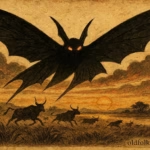
In the rugged mesas and canyon lands of Zuni territory, elders tell of Átahsaia, a terrifying cannibal giant whose presence embodies deception, hunger, and the spiritual dangers that lurk beyond the safety of the village. His name evokes fear even today, not because he is merely a monster, but because he represents a moral and metaphysical threat: the consequences of ignoring caution, wisdom, and community guidance.
Appearance
Átahsaia is described as immense, so vast that he cannot stand fully inside his own cave. His body is sheathed in thick, rough, stone-like skin, impervious to normal weapons. Ethnographer Frank Hamilton Cushing noted that storytellers emphasized his bulging, fiery eyes, long razor-like talons, and a twisted mouth filled with fang-like teeth. Some versions also portray him with scaled patches or a leathery hide, reminiscent of both monster and primordial spirit.
Learn the moral wisdom of ancient civilizations through proverbs that shaped cultural values
His movements are heavy, shaking the ground, and his breath is foul with the stench of death. The combination of giant size, animal traits, and spirit-world danger aligns him with other Pueblo demon giants, but Átahsaia is unique in his cunning.
Behavior and Powers
Átahsaia is not simply a brute; he is a deceptive hunter. Unlike many giants who rely on brute strength, he uses trickery, false hospitality, and illusion to lure victims, typically young women, into his cave. He can disguise his intent behind friendly words, but his true nature reveals itself when the victims are trapped with him in the dark.
His powers include:
- Superhuman strength: able to lift boulders and tear down trees
- Spiritual resilience: ordinary weapons cannot kill him; only divine or heroic power can
- Deception and lure: he creates false narratives to draw people into danger
- Cannibal hunger: he feasts on humans, especially children and maidens
One of the most famous tales recounts how Átahsaia invited two young women into his cavern, promising warmth and shelter. Once inside, they discovered he was preparing a soup made from human children. Their escape required both cleverness and sacred assistance, the Zuni twin war gods (Ahayuta and Matsailéma) ultimately intervened.
Habitat
Átahsaia lives in remote, rocky caves high on Zuni mesas, places intentionally isolated from human settlements. This remoteness symbolizes spiritual separation from community and ritual order. His cave is often associated with bones, remnants of past victims, and the smell of smoke from the cooking hearth where he prepares human flesh.
Role in Story Cycles
Átahsaia appears in multiple Zuni narrative cycles:
- Youth-warning tales (to teach maidens to avoid strangers or dangerous situations)
- War-God hero cycles (where the divine twins defeat monstrous beings)
- Moral tales on wisdom, discernment, and community safety
In every version, Átahsaia’s downfall is not merely a physical defeat, it is a reaffirmation of Zuni spiritual order and communal integrity.
Cultural Role (Symbolism & Meaning)
- Symbol of Deception and Spiritual Danger: Átahsaia embodies the dangers of trusting strangers, ignoring intuition, or wandering into spiritually unsafe places. For the Zuni, personal safety is deeply tied to community teachings; ignoring them invites harm from forces like Átahsaia. His deceptive hospitality is a warning that not everything appearing friendly is safe.
- Cannibalism as the Ultimate Violation: Cannibalism is one of the gravest cultural taboos in Pueblo traditions, symbolizing a complete break from humanity, morality, and communal life. Átahsaia’s consumption of humans signals his total separation from the Zuni moral universe. He exists outside society and threatens to drag others into that spiritual exile.
- A Force Balanced by Sacred Heroes: The Zuni twin war gods, Ahayuta and Matsailéma, represent spiritual protection, balance, and courage. Their defeat of Átahsaia reinforces that communal ritual power is stronger than selfish violence. In some variants, the twins outwit him; in others, they slay him with supernatural weapons.
This dynamic symbolizes the victory of cultural order over chaos.
- A Lesson in Cunning and Survival: The young women who escape Átahsaia use cleverness, not strength. This reflects a key Zuni value: survival often depends on intelligence, patience, and listening to ancestral teachings. Átahsaia’s stories are thus moral tools, reminders that wisdom prevents danger.
- Boundary Guardian of the Wilderness: Átahsaia also symbolizes the wilderness itself: untamed, dangerous, and requiring respect. To walk far from the village without purpose or preparation invites spiritual threats. His presence reminds listeners that humans survive by honoring boundaries, not by testing them recklessly.
Explore the mysterious creatures of legend, from guardians of the sacred to bringers of chaos
Author’s Note
Átahsaia is one of the most striking figures in Pueblo mythology because he blends terrifying physical power with psychological danger. Unlike the simple “giant” archetype, he manipulates, deceives, and preys on the vulnerable, a reflection of real-world dangers faced by young community members. What makes the story enduring is not the giant himself, but what defeats him: wisdom, community bonds, and sacred protection. Through Átahsaia, the Zuni demonstrate how storytelling preserves survival knowledge across generations.
Knowledge Check (Q&A)
- What kind of creature is Átahsaia?
A cannibal giant and dangerous demon-like figure in Zuni mythology. - How does Átahsaia lure his victims?
Through deception and false hospitality, often inviting young women into his cave. - What key taboo does Átahsaia embody?
Cannibalism, representing complete spiritual and social corruption. - Who defeats Átahsaia in many stories?
The Zuni twin war gods, Ahayuta and Matsailéma. - What symbolic role does Átahsaia serve?
He warns against wandering, trusting strangers, or ignoring community teachings. - Where does Átahsaia live?
In remote caves on mesas and canyons far from Zuni villages.
Source: Based on Zuni oral tradition as recorded by Frank Hamilton Cushing in Zuñi Folk Tales (1931), alongside folkloric summaries and comparative Pueblo demon narratives.
Origin: Zuni (A:shiwi) People, Pueblo culture of the American Southwest