Long ago, before the mountains knew their shadows and before the rivers learned their names, the Sun and the Moon walked together upon the earth. They were not distant lights hanging in the heavens as they are now, but living beings who breathed the same air as the Atayal people, who felt the grass beneath their feet, and who loved each other with a devotion as deep as the valleys that carved through the green heart of Taiwan.
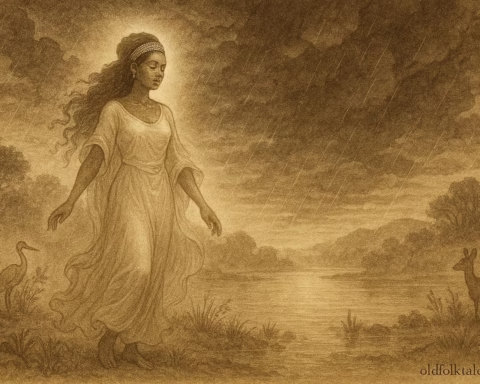
The Sun was radiant and strong, his presence filling every corner of the world with warmth and golden light. When he smiled, flowers bloomed in an instant. When he laughed, the air itself seemed to dance with joy. The Moon was gentle and luminous, her silver glow soft as morning mist. She moved with grace, her voice like water over smooth stones, and wherever she walked, peace followed.
The Atayal people watched these two lovers with wonder and gratitude. In those early days, the Sun and Moon brought light to the world together, side by side. Children played under their combined radiance, elders told stories beneath their glow, and hunters tracked game through forests bathed in their mingled light.
But as time passed, a terrible problem emerged. The Sun’s heat, so beautiful and life-giving from a distance, became unbearable when he walked among the people. His intense warmth scorched the earth where he stepped. Crops withered before they could be harvested. Rivers began to shrink, their waters evaporating into nothing. The people, once grateful for his presence, now suffered under the relentless burning. They grew weak and weary, seeking shade wherever they could find it, but there was no escape from the Sun’s overwhelming power.
The Moon saw the suffering of the Atayal people, and her heart ached with sorrow. She loved the Sun with all her being, but she also loved the people who had welcomed them both. Night after night, she lay beside the Sun, feeling the conflict tear at her spirit. How could she choose between her beloved and the welfare of so many innocent lives?
Finally, she made her decision. One morning, as the Sun awoke and stretched his golden arms across the horizon, the Moon took his hands in hers. Her eyes glistened with tears that caught his light and scattered it like diamonds.
“My love,” she said, her voice trembling with emotion, “you must rise into the sky. Your heat is too great for this world. The people are suffering, the land is dying. If you remain here, there will be nothing left but ash and memory.”
The Sun looked at her, devastation written across his brilliant face. “But if I go,” he said, “I will be alone. How can I shine without you beside me?”
“You will never be alone,” the Moon promised. “I will follow you. Wherever you go, I will come. We will be together in the heavens as we have been together on earth.”
And so, with a heavy heart, the Sun began his ascent. He rose slowly at first, reluctant to leave the ground where he had walked with his beloved. But as he climbed higher and higher into the vast blue expanse above, his heat began to spread more evenly across the land. The scorching intensity faded. The earth cooled. Rain fell again. The people emerged from their shelters, their faces turned upward in relief and wonder.
The Sun reached his place in the heavens and turned back, calling down to his love. “Come,” he urged. “Come and join me. Keep your promise.”
The Moon, true to her word, began her own journey upward. She rose from the earth gracefully, her silver light trailing behind her like a wedding veil. The people watched in reverent silence as she ascended, following the path her beloved had taken.
But something unexpected happened. As the Moon climbed higher and higher, her light began to dim. The brilliant silver glow that had illuminated her form grew softer, fainter. By the time she reached the heavens, her radiance had transformed into something gentler, cooler—beautiful but no longer bright enough to share the sky with the Sun’s overwhelming brilliance.
When she finally arrived at the celestial realm, the Sun reached for her with desperate longing. But the laws of the universe, mysterious and unchangeable, had already set their fate. The Sun’s light was too powerful, the Moon’s too gentle. They could not occupy the same space at the same time without one overwhelming the other.
And so they were separated not by choice, not by lack of love, but by necessity. The Sun would rule the day, bringing warmth and light to the world below. The Moon would govern the night, offering cool comfort and soft illumination to those who walked in darkness. They would pass each other in the eternal rotation of time, forever reaching, forever loving, but never again able to hold each other as they once had on earth.
The Atayal people, witnessing this great sacrifice, understood the gift they had been given. The Sun and Moon had loved them enough to give up their greatest happiness each other’s constant company so that the world might thrive. From that day forward, the people honored both celestial beings, telling their story to each new generation, ensuring that the sacrifice of the eternal lovers would never be forgotten.
Even now, on rare occasions when the paths of Sun and Moon cross during an eclipse, the people say it is a brief reunion a stolen moment when the lovers can touch once more before continuing their endless journey through the sky.
The Moral Lesson
This sacred Atayal tale teaches us that true love sometimes requires sacrifice for the greater good. The Moon and Sun demonstrate that the deepest form of love is not possession but selflessness choosing what is right even when it costs us dearly. Their story reminds us that difficult decisions made with compassion can bring balance to the world, and that separation does not diminish love. Some sacrifices echo through eternity, inspiring others to act with courage and grace when faced with impossible choices.
Knowledge Check
Q1: Who are the main characters in this Atayal folktale from Taiwan?
A1: The main characters are the Sun and the Moon, who were once lovers living on earth together before ascending to the heavens to protect the Atayal people from harm.
Q2: Why did the Moon urge the Sun to leave the earth?
A2: The Moon urged the Sun to ascend to the sky because his intense heat was scorching the earth, causing crops to wither, rivers to dry up, and the Atayal people to suffer greatly.
Q3: What happened to the Moon’s light when she ascended to the sky?
A3: As the Moon climbed higher into the sky, her light gradually dimmed and became softer, transforming into the gentle, cool glow we see at night rather than the brilliant radiance she once had on earth.
Q4: What does the separation of the Sun and Moon symbolize in Atayal culture?
A4: The separation symbolizes ultimate sacrifice for the greater good, demonstrating that true love sometimes requires giving up personal happiness to protect and serve the community and maintain balance in the world.
Q5: Why can’t the Sun and Moon appear together in the sky according to this legend?
A5: According to the legend, the Sun’s light is too powerful and the Moon’s too gentle for them to occupy the same space simultaneously without one overwhelming the other, forcing them to take turns illuminating the world.
Q6: What is the cultural significance of eclipses in this Atayal story?
A6: Eclipses are seen as rare, precious moments when the Sun and Moon’s paths cross, allowing the eternal lovers to briefly reunite and touch before continuing their separate journeys through the sky.
Source: Adapted from “The Myths of the Atayal People” (Academia Sinica, Taiwan)
Cultural Origin: Atayal People, Indigenous Taiwan