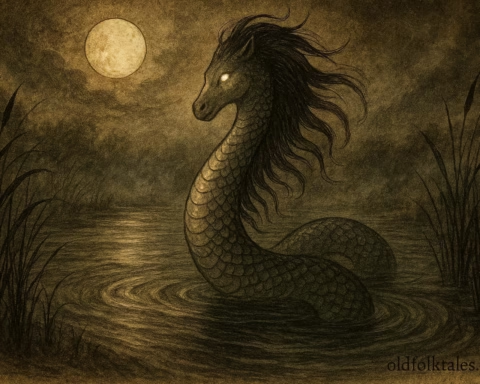
Bai Ze (白泽), literally the “White Marsh Spirit”, is one of the most revered knowledge-beasts in the landscape of early Chinese mythology. Often portrayed as a hybrid creature with the face of a tiger, the body of a scaled dragon, multiple horns, and a flowing red or fiery mane, Bai Ze occupies a unique place in the Chinese imagination: neither a divine beast like the qilin nor a monstrous threat like the taotie, but a sage-like being whose purpose is the cataloging of the unseen world.
The most famous legend describes how Bai Ze appeared before the Yellow Emperor (Huangdi) during one of his journeys near a remote marshland, traditionally called the White Marsh (白泽之泽). Unlike most encounters with powerful beasts, this was not a confrontation but a meeting of mutual recognition. Bai Ze approached the emperor willingly, speaking with clarity and without malice. What followed, according to later reconstructions, became one of the most important mythic acts in early Chinese lore.
The Knowledge of Ten Thousand Spirits
Bai Ze is said to possess perfect knowledge of all supernatural beings, demons (鬼怪), spirits (神灵), specters (魅魍), mountain monsters (山怪), and all manner of shapeshifting entities inhabiting the mythic geography of ancient China. Bai Ze described to the Yellow Emperor more than 11,000 spirits, detailing their origins, appearances, habits, powers, weaknesses, and methods of protection.
This body of knowledge became the Bai Ze Zhuan (白泽传), “the Treatise of Bai Ze”, a mythical catalog that supposedly guided emperors, physicians, shamans, and exorcists. Although no full text survives today, fragments, references, and derivative works appear across centuries of mythological compilations, medical manuals, and geomantic writings. Through them, Bai Ze became a cultural anchor for understanding China’s vast supernatural ecology.
Appearance
Descriptions vary between dynasties and artistic traditions, but a composite picture emerges:
- Tiger-like face with bright, expressive eyes
- Dragon-like body, muscular and scaled
- Multiple horns (most often three)
- Flowing red or flame-colored mane
- White or pale fur on parts of the body
- Cloven hooves or leonine paws
- A presence described as majestic, calm, and luminous
Many depictions show Bai Ze standing beside the Yellow Emperor, mouth open as if speaking, suggesting a creature of wisdom rather than aggression.
Behavior and Mythic Traits
The Bai Ze is unique among Chinese mythical creatures in several ways:
- It voluntarily approaches humans.: Unlike many spirits that must be summoned or confronted, Bai Ze chooses when to appear, always to the worthy or wise.
- It speaks in human language.: This ability marks it as a sage-beast akin to the qilin, but with a more specialized domain: supernatural knowledge.
- It is neither harmful nor predatory.: Bai Ze does not attack, trick, or test humans. Its power lies in knowledge, not combat.
- It is linked to revelation, not prophecy.: Bai Ze does not predict the future; it reveals the hidden structure of the world, especially the unseen and the spiritual.
- Its presence indicates the ruler’s virtue.: An encounter with Bai Ze is interpreted as a cosmic confirmation of the ruler’s moral quality and heavenly mandate.
Relationship to Mythological Geography
Chinese mythological texts such as the Shanhaijing (“Classic of Mountains and Seas”) describe an enormous world populated by strange spirits, geography spirits, and animal-monsters. Bai Ze stands apart as the one who knows and names them all, functioning almost like a mythic librarian of the cosmos.
Later bestiaries, Tang, Song, and Ming dynasty collections, borrow from the Bai Ze tradition, using its authority to validate catalog entries of ghosts, anomalies, and auspicious beasts.
The Lost Text
Scholars note that no original Bai Ze Zhuan survives. What remains are:
- Later quotations
- Fragmentary notes in demonology texts
- Visual representations in scrolls and talismans
This absence adds a layer of mystique: the greatest supernatural catalog of ancient China may have existed only in fragments or oral transmission.
Cultural Role and Symbolism
- Symbol of Supreme Knowledge: Bai Ze embodies comprehensive understanding, knowledge of the entire unseen cosmos. It represents wisdom that transcends human perception.
- A Bridge Between Worlds: While many Chinese myths warn about the dangers of interacting with spirits, Bai Ze stands as a peaceful intermediary, helping humans navigate spiritual dangers with clarity and method.
- Guardian of the Righteous Ruler: Its appearance to the Yellow Emperor symbolizes the approval of Heaven. Only a ruler of great virtue, harmony, and cosmic alignment could receive such knowledge.
- Blueprint for Demonology: Because Bai Ze details the nature and weaknesses of supernatural beings, it effectively functions as the mythic foundation for Chinese demonology, protective rituals, and esoteric practices.
- Symbol of Order Over Chaos: In providing a catalog of spirits, Bai Ze transforms the chaotic world of strange beings into a structured, understandable system, reflecting one of the central aims of Chinese cosmology.
- Wisdom Without Violence: Unlike dragons or qilin, whose power can be destructive or awe-inspiring, Bai Ze’s power is peaceful. It is a sage-animal, representing intellectual mastery, restraint, and discernment.
Author’s Note
Bai Ze is a fascinating example of how Chinese mythology blends cosmology, statecraft, and spiritual tradition into a single symbol. Though the Bai Ze Zhuan is lost, the creature’s legacy persists through countless references, ensuring its role as one of the great catalogers of the supernatural world. In studying Bai Ze, we glimpse not only a mythical beast but the ancient Chinese effort to understand and classify the unseen forces shaping human life.
Knowledge Check
- Who did Bai Ze reveal supernatural knowledge to?
The Yellow Emperor (Huangdi). - What kind of creature is Bai Ze?
A horned, tiger-faced, dragon-bodied knowledge beast. - What is its primary symbolic role?
A master cataloger of spirits, demons, and supernatural beings. - What text is attributed to Bai Ze?
The Bai Ze Zhuan (白泽传), a treatise on spirits. - Does Bai Ze harm humans?
No, its role is peaceful and instructional. - Why is Bai Ze associated with righteous rulers?
Only a virtuous ruler is worthy of receiving its knowledge.
Source: Early Chinese Mythology / Mythological Geography
Origin: China (mythic encounters near the “White Marsh”)