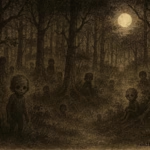
In Anishinaabe sacred storytelling tradition (aadizookaan), Bakaak, often known by the more widely quoted spelling Baykok, is a gaunt, skeletal forest spirit whose presence blurs the line between the living and the dead. His very name carries connotations of dryness, thinness, and a body wasted away, and many elders explain that he embodies a form so consumed by death that even the wind seems to pass through him. Across narratives preserved in archival collections and linguistic notes, Bakaak is described as thin to the point of translucence, with taut skin stretched over bone and hollow, glowing eyes that shine like cold embers in the dark.
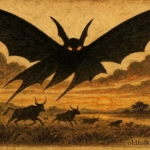
He moves silently through northern forests, flying or gliding in a manner that is unnatural, some stories say he travels as the wind; others say he swoops like a hunting bird of prey. His voice is shrill, piercing, and inhuman, a cry that chills warriors and hunters who wander too far into lonely woodland places.
One of his most feared attributes is his invisible arrows, spiritual projectiles that strike without warning or sound. A warrior may walk beneath the pines and collapse without ever seeing what killed him. In other tales, Bakaak waits until nightfall, approaching sleeping victims and slicing open their chests with talon-like hands. He removes and devours their livers, a detail repeated in multiple regional accounts, symbolically representing the taking of life-force and courage. The liver, in traditional worldview, is associated with vitality; its consumption asserts Bakaak’s mastery over a victim’s inner strength.
No regular weapon harms him easily. Spears and arrows pass through him as though he is made of smoke and bone. Only spiritual protection, correct ritual knowledge, or sacred power, teachings carried by medicine people and ceremonial leaders, can repel him.
Across dialects and communities, he is known by variant spellings: Bakaak, Bakaakadwengwe, and others. Some versions heighten his skeletal nature; others emphasize his hunter-like cunning. But all agree: Bakaak is a death-spirit, not a mere monster, and his realm is the deep forest where breath meets silence.
Cultural Role
The Bakaak is not meant to be understood as a simple bogeyman. His place in Anishinaabe worldview is layered with spiritual, moral, and ecological meaning. As a figure found in aadizookaan, traditional sacred narratives, he carries teachings about respectful conduct, bravery, humility, and the dangers that arise when warriors lose balance within themselves.
- A Caution to Warriors: Many stories describe Bakaak as a hunter of proud or careless warriors. He targets those who wander alone, boast loudly of their strength, or fail to observe spiritual etiquette before entering another realm of life. His attacks teach listeners that physical strength alone is not enough; the spiritual world must be approached with respect, humility, and awareness. Bravery without wisdom becomes a danger to oneself.
In this sense, Bakaak symbolizes the price of arrogance. He reminds warriors to maintain self-discipline, to honor ceremonial practices, and to know that forces exist in the world that cannot be defeated by muscle or weaponry.
- A Personification of the Hungry, Devouring Force of Death: In many Anishinaabe cosmological systems, death is not a single event but a power, a presence with its own appetites. Bakaak represents the devouring aspect of death, an entity that consumes vitality and life-force. His skeletal body mirrors the wastes of starvation or illness, serving as a visual lesson about the fragile nature of life in the northern woodlands.
His functions echo themes shared across Indigenous North American cosmologies: beings who guide certain spirits, beings who embody natural dangers, or beings whose presence warns that boundaries between worlds are thin.
- A Guardian of Forest Space: Some interpretations, particularly among modern cultural scholars, suggest that Bakaak also symbolizes the uncertainty and hidden dangers of the boreal forest. The Great Lakes region contains dense, ancient woodlands, places where a person can vanish in an instant. Bakaak’s ability to strike without sound or warning resonates with real ecological hazards: harsh winters, predatory animals, disorientation, and exhaustion. He is a spiritualized reminder that the forest must be entered with preparedness and respect.
- A Lesson in Spiritual Vulnerability: Because he can kill silently and cannot be stopped by physical weapons, Bakaak reminds listeners that spiritual vulnerability is just as real as physical vulnerability. Stories of him often accompany teachings about tobacco offerings, protective rituals, honoring ancestors, and approaching sacred spaces with a proper heart and mind.
- Not Evil, but a Necessary Force: Traditional stories do not frame him as “evil” in a Western moral sense. Instead, he is one of the many beings who occupy the Anishinaabe universe, dangerous, yes, but purposeful. His existence helps maintain balance by enforcing humility and respect. Like winter storms, drowning waters, or wild animals, he is a force one must learn to live with, not a creature to demonize.
Author’s Note
This entry draws on multiple folkloric, linguistic, and ethnographic references, but it is important to note that aadizookaan are living traditions, held by communities whose relationship to these stories involves ceremony, language, and lineage. This description is therefore respectful and descriptive, not interpretive or definitive. Whenever possible, readers should consult Anishinaabe cultural educators, language keepers, and oral historians for deeper teachings.
Knowledge Check
- What does Bakaak’s skeletal form symbolize?
It reflects the devouring force of death and the fragility of life, reminding listeners of spiritual vulnerability. - Why does Bakaak target warriors in many stories?
He punishes arrogance, carelessness, and wandering without spiritual preparation. - What weapon is commonly associated with Bakaak?
Invisible arrows that kill silently and suddenly. - How does Bakaak move through the forest?
He flies or glides silently, sometimes riding the wind through dense woodland. - What organ does Bakaak consume from victims, and why is it important?
The liver, symbolizing the consumption of life-force and inner strength. - Are physical weapons effective against him?
No, only spiritual knowledge and ceremonial protection can repel him.
Source: Traditional aadizookaan stories; Native Languages of the Americas; ethnographic folklore archives; linguistic notes on Ojibwe mythology; secondary summaries
Origin: Anishinaabe peoples, Ojibwe, Algonquin, and related Great Lakes nations (pre-colonial oral tradition)