Among the dense forests of the Basque mountains, villagers once whispered of Basajaun, the “Lord of the Woods.” Towering, broad-shouldered, and covered head to foot in long, rust-colored hair, Basajaun was said to stride the shadowy woodland paths with the calm authority of an ancient guardian. His name, Basajaun, from basa (“wild” or “forest”) and jaun (“lord”), reveals his nature: a ruler of the wilderness, protector of the natural order, and intermediary between humans and the spirits of the land.
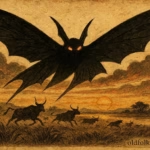
Descriptions gathered from Basque oral traditions portray Basajaun as half-man, half-beast, with human intelligence and supernatural strength. His thick mane and beard merge into his body hair, and his footprints are as wide as a man’s head. Villagers sometimes claimed to hear his booming footsteps echoing through the woods at dusk, or to glimpse his silhouette against the setting sun, massive, stooped, carrying a staff of oak or pine. Yet despite his fearsome appearance, Basajaun was not a monster. In most tales, he was a benevolent giant, guardian of flocks and teacher of ancient wisdom.
Discover the gods, goddesses, and divine spirits who ruled the heavens and shaped human fate
In the shepherding valleys of Navarre, Basajaun was believed to watch over sheepfolds at night. If wolves approached, he would roar and beat his chest to frighten them away. Shepherds who respected the forest, keeping it clean, lighting fires only when necessary, and leaving small offerings of bread or milk, earned Basajaun’s favor. In return, he would whistle warnings of approaching storms, or signal when wild beasts were nearby.
In the mythic imagination, Basajaun represents the ancient intelligence of the wilderness, a being both natural and divine. Some modern ethnographers interpret him as a cultural memory of prehistoric humans or Neanderthals lingering in collective memory. Others see him as a spirit of fertility and craft, linked to the earth’s creative powers.
Myths and Behavior
One widespread Basque legend tells that long ago, humans knew nothing of agriculture. They lived by gathering roots and hunting. But the Basajaunak, dwelling deep in the forest, cultivated wheat and milled grain. One clever human, named San Martiniko in some versions, spied on them from afar. Night after night, he watched as the forest lords reaped their golden fields, storing the grain in hollow logs.
One evening, San Martiniko stole a few ears of wheat. Furious, the Basajaunak chased him, shouting and tearing through the trees. But the human escaped and brought the secret of agriculture to his people. From that time, humans learned to plow, sow, and harvest, and Basajaun, respecting the cleverness of humankind, no longer pursued them. Instead, he became a protector of shepherds and farmers, ensuring that the balance between the wild and the cultivated world remained intact.
In other tales, Basajaun and his female counterpart Basandere (the “Lady of the Woods”) are the builders of ancient megaliths and dolmens that still stand in Basque mountains. These tales suggest that the Basajaunak once ruled before the coming of human civilization, creators of stone monuments and keepers of lost technologies. In some villages, people still point to particular boulders or ancient bridges and say, “Basajaun built this in one night.”
Cultural Role and Symbolism
Basajaun is the embodiment of the wild, sacred forest, a figure of both fear and reverence. To the Basque people, whose culture grew from shepherding and mountain life, he symbolized the living spirit of nature: strong, secretive, but ultimately protective when respected.
His dual nature, civilized yet savage, guardian yet potential threat, reflects the Basque view of the natural world as something to coexist with, not conquer. He represents the moral law of harmony between humans and the land: respect sustains balance; greed or arrogance breaks it.
Culturally, Basajaun also symbolizes the transmission of knowledge from divine or supernatural sources to humankind. By stealing the secret of agriculture, humans gain mastery of sustenance, but the story acknowledges that this wisdom originated with the forest lord. It’s a myth about progress and humility, a reminder that civilization is rooted in the generosity (and patience) of nature itself.
In Christianized versions of Basque folklore, Basajaun sometimes becomes a “wild man” punished for his pride, while others recast him as a remnant of the pre-Christian gods who withdrew into the mountains when churches were built. Yet even within Christian moral framing, the Basajaun remained a symbol of protection, not evil, a sign that older reverence for nature survived conversion.
Modern Basque identity continues to honor him as a mythic ancestor of the land, appearing in local festivals, children’s stories, and regional art. He is often compared to other European “wild man” figures like the Slavic Leshy or the Scottish Brown Man of the Muirs, but his cultural depth and the distinct Basque cosmology surrounding him make Basajaun uniquely indigenous to Euskal Herria.
Encounter dragons, spirits, and beasts that roamed the myths of every civilization
Author’s Note
The Basajaun stands as one of Europe’s most enduring nature spirits—neither demon nor saint, but something profoundly human. When I read Barandiarán’s field reports, what strikes me most is how villagers spoke of him not as myth, but as memory: “He was seen once, long ago.” The Basajaun reminds us that folklore is not frozen in time; it’s a living conversation between people and place. His lessons, respect for nature, humility in knowledge, and harmony with the earth, resonate even more urgently in today’s world of environmental imbalance.
Knowledge Check
- What does the name “Basajaun” mean in Basque?
→ “Lord of the Woods” or “Wild Lord.” - How is Basajaun usually described physically?
→ A tall, hairy, human-like giant with immense strength and intelligence. - What secret did humans learn from Basajaun in the legend of San Martiniko?
→ The secret of agriculture and grain cultivation. - Who is Basajaun’s female counterpart in Basque mythology?
→ Basandere, the Lady of the Woods. - What moral or natural concept does Basajaun symbolize?
→ Harmony between humanity and nature; respect for the wilderness. - Which ethnographer documented most Basajaun tales in the 20th century?
→ José Miguel de Barandiarán.
Source: José Miguel de Barandiarán, Selected Writings on Basque Mythology (field ethnography, 20th century); Euskal Herria cultural archives.
Origin: Basque Country (Navarre, Gipuzkoa, Biscay, Álava), pre-Christian oral tradition recorded 19th–20th century