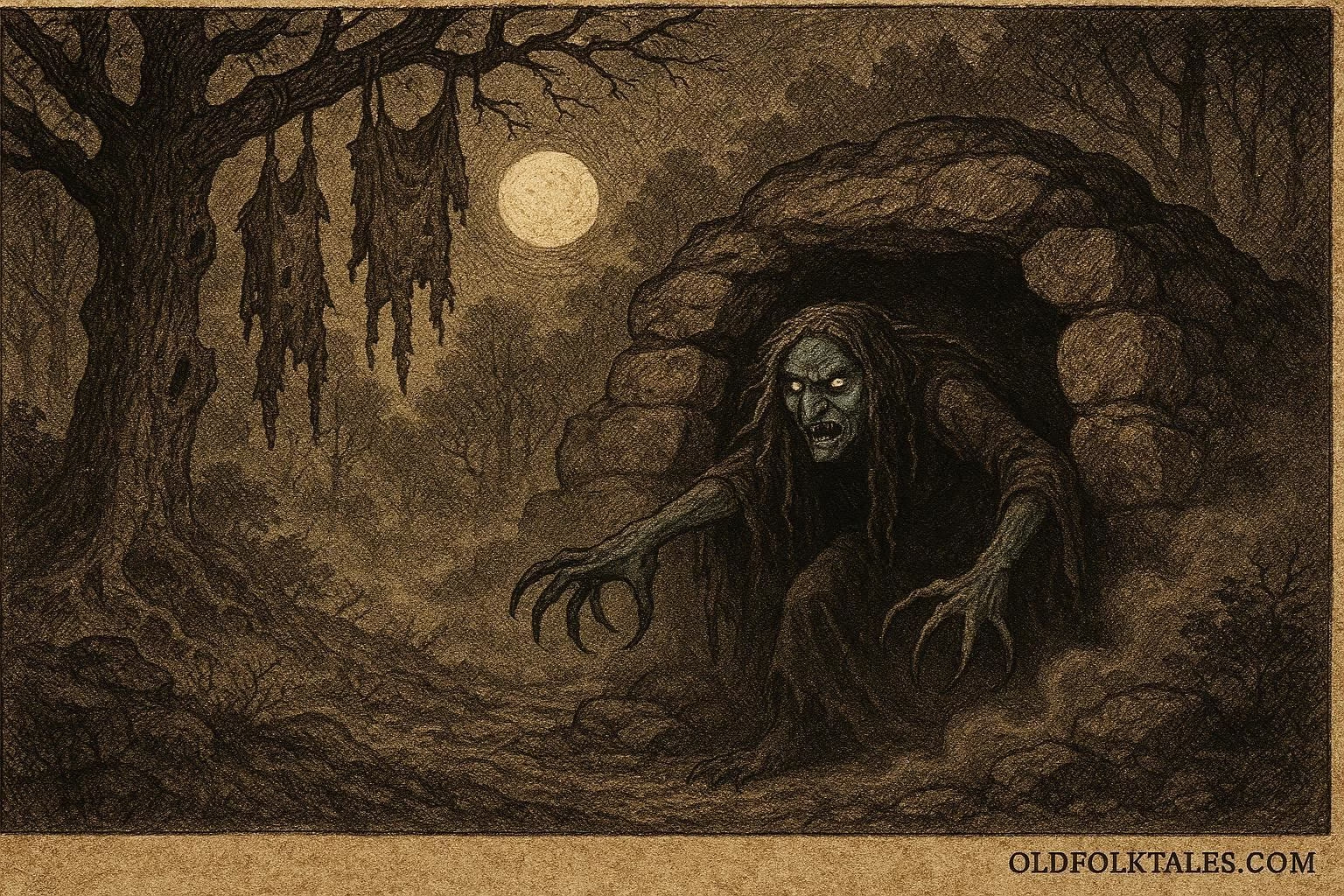
Black Annis, also known in variant forms as Black Anna or Black Agnes, is one of England’s most distinctive regional bogey figures. Rooted deeply in the folklore of Leicestershire, she embodies the unease, moral warnings, and landscape-bound fears woven into rural English tradition. Her legend centers on a dark, twisting area of woodland called Dane Hills, where she was said to dwell in a cave hewn out with her own talons. This cave, known locally as Black Annis’s Bower, once featured prominently in oral tradition and even appeared in historical documents and local poems from the late eighteenth century.
Appearance
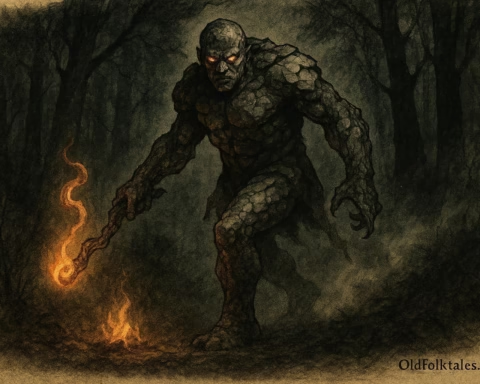
Black Annis is consistently described as a terrifying hag:
- Blue-skinned or blue-faced, a coloration associated in British folklore with death, coldness, and the supernatural.
- Long iron claws, sharp enough to tear raw stone.
- A gaunt face, leathery skin, and wild, coarse hair.
- Fanged or sharpened teeth, used to tear flesh from her victims.
- A body sometimes “as tall as a man and half again,” or conversely, twisted and shriveled like a centuries-old crone.
Her iron claws are especially iconic: these were credited with hollowing out her cave and scoring trees near her lair. Many versions of the legend insist that children walking near Dane Hills could hear the scraping of claws on stone long before they saw her.
Behavior and Abilities
Black Annis is a predatory night-hag, feared primarily for her habit of preying upon:
- Children who wander too far from home
- Lambs and livestock
- Travelers foolish enough to pass near Dane Hills after dusk
In older tales, she was said to creep out at twilight, racing across the heath with supernatural speed. She carried victims back to her bower, where she supposedly flayed their skins and hung them on the oak tree outside her cave to dry in the wind. Afterward, she would wear the dried skins around her waist.
Other abilities appear in variant traditions:
- Enhanced senses, particularly smell, allegedly allowing her to detect human scent on the wind.
- Shape-stretching, in which her arms lengthen unnaturally to grab a victim.
- Tunnel-running, where a hidden tunnel beneath Dane Hills is said to connect her cave to Leicester Castle, allowing her to emerge unexpectedly within the town.
While these details grow more elaborate in later retellings, they reflect a common message: Black Annis is a force of unpredictable, landscape-rooted danger, one that must be respected, avoided, or appeased.
Myths, Beliefs & Practices
Black Annis served an important protective function for families: her legend was used to keep small children from wandering into forests, gulleys, or quarry depressions, places that were genuinely dangerous. Parents would warn:
“Get home before dark, or Annis will come for you.”
In some harvest customs, farmers would leave a small portion of their final crop offering on the field edge, symbolic “food” to keep Annis from sneaking into their barns at night. This ritual was less an act of worship and more an acknowledgment of the wild forces that threatened a rural household’s stability.
Some antiquarians speculated about pagan origins, imagining Black Annis as a survival of ancient goddesses or crone-figures, but modern folklorists caution strongly against retrofitting mythological depth where local oral tradition is far more practical and place-based. Her legend is best understood as regional English folklore, not as a remnant of a codified prehistoric deity.
Cultural Role
At her core, Black Annis represents several intertwined cultural ideas:
- The Danger of the Wild: Dane Hills was once dense, shadowed woodland. Before Leicester expanded, this landscape was a realm of uncertainty. Black Annis symbolized those unknown dangers, wolves, thieves, unstable cliffs, or sinkholes, personified as a monstrous hag.
- Morality and Social Boundaries: She functioned as a behavioral enforcer. Children were warned not to stray, not to disobey parents, and not to approach woods or quarries. The threat of Black Annis was a mnemonic tool to keep the vulnerable safe.
- Nature’s Tooth and Claw: Her preference for lambs and livestock mirrored the ever-present fear of predators and harsh winters. In this sense, she represented the natural world’s capacity to take back what humans labored to build.
- Female Wilderness Archetype: Black Annis belongs to a broader European category of wild women, night hags, crones, and boundary guardians. She is the opposite of domestic stability, an embodiment of everything beyond the hearth’s warmth.
Symbolism
Black Annis symbolically occupies the threshold between:
- Civilization and wilderness
- Childhood safety and external threat
- Order and chaos
Her blue skin may signify both deathliness and winter cold. Her claws represent the claim the landscape has on human life. Her cave is a womb of stone, a dark inversion of maternal shelter, one that consumes rather than protects.
Modern Interpretation
Today, Black Annis appears in local festivals, regional ghost tours, and contemporary fiction. Yet her roots remain firmly in Leicestershire soil. She is a creature of place, shaped by genuine geography and communal memory, not a pan-European goddess, but a living memory of landscape fear preserved through oral storytelling.
Author’s Note
Black Annis is a vivid example of how regional folklore encodes real environmental danger into memorable stories. In researching this entry, I focused on primary evidence, antiquarian references, and local poems, avoiding modern reinterpretations that flatten her into a generic “witch” or demon figure. Her story reminds us that folklore isn’t just entertainment, it is a survival mechanism shaped by land, weather, and community.
Knowledge Check
- Where is Black Annis said to live?
She dwells in Dane Hills near Leicester, in a claw-carved cave called Black Annis’s Bower. - What color is Black Annis traditionally described as?
She is blue-faced or blue-skinned, a signature trait in local accounts. - What victims is she most known for targeting?
Primarily children and lambs, though travelers could be targeted too. - What do farmers traditionally leave as an offering?
A small portion of the last harvest, placed at the field’s edge. - Why is there no medieval manuscript of Black Annis?
Because her origin is local oral folklore, preserved in place-names and poems rather than literary texts. - What moral lesson does her story teach?
To avoid dangerous landscapes, obey boundaries, and respect the wilderness.
Source: Local Leicestershire folklore, antiquarian accounts, 18th–19th-century poems and place-name records
Origin: Dane Hills, Leicester, England