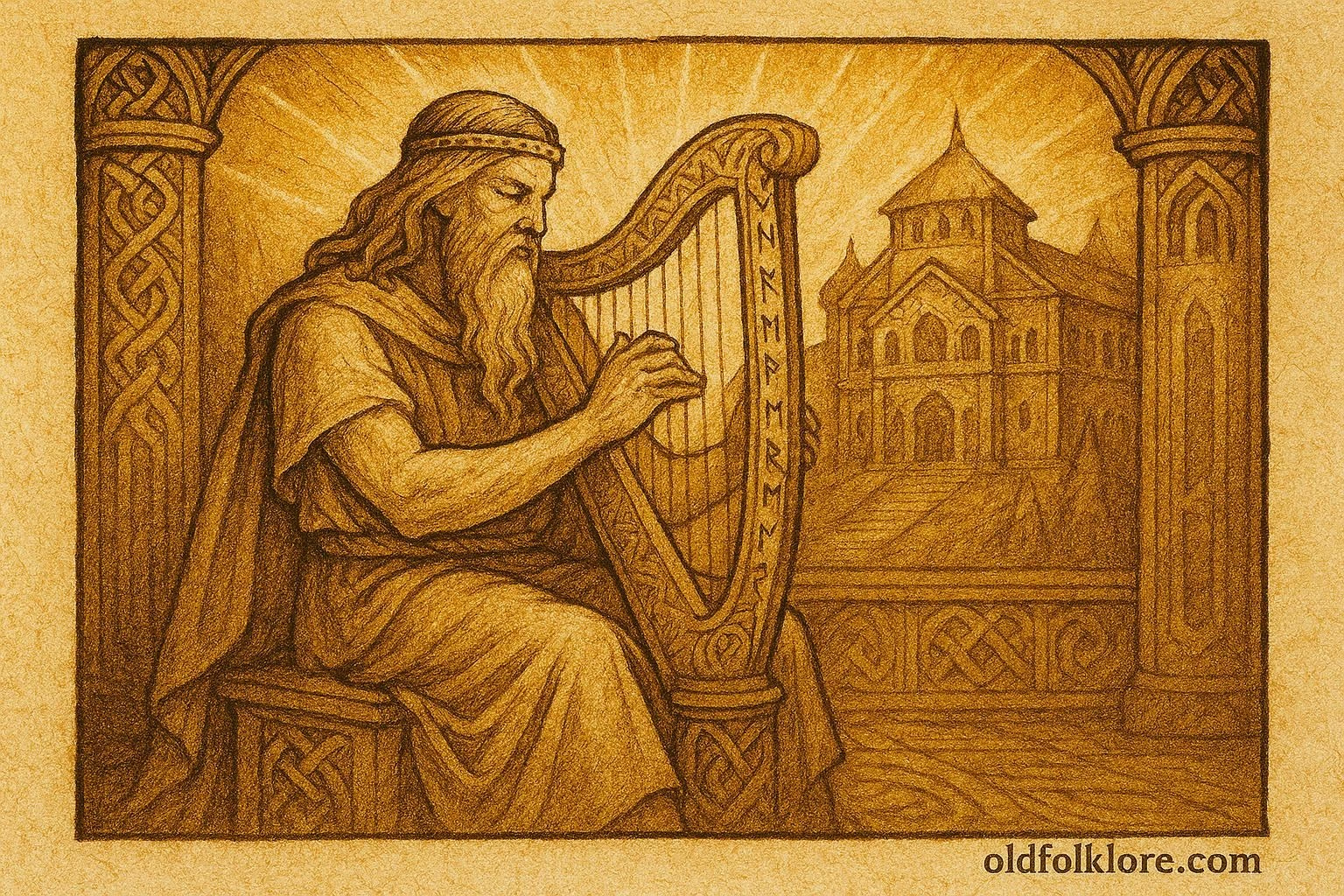
Bragi, in Old Norse mythology, is the radiant god of poetry, eloquence, and the solemn art of remembrance. He is honored as the divine skald whose words flow with the weight of memory and the music of measured verse. Often depicted with a long, wise beard and a calm, knowing presence, Bragi stands among the Æsir as the embodiment of refined speech, poetic craft, and the subtle power of language to bind generations together.
His realm is not the clamor of battle but the stillness in which stories take form. Bragi is most strongly connected with skalds, court poets who carved praise, history, and honor into the living memory of their people through elaborate verse. In the Prose Edda, he holds a place in the hall of the gods, offering counsels shaped not by force but by the clarity of words.
His symbol is often the harp or rune-carved staff, and his power lies in inspired speech, poetic memory, and the ability to turn the deeds of gods and heroes into eternal story. Some traditions describe him as the husband of Iðunn, the keeper of the apples of youth, a symbolic pairing that links poetry with rejuvenation and enduring vitality. He appears especially in Skáldskaparmál, where he speaks with the authority of poetic tradition itself.
Though the sources are fragmentary, Bragi remains one of the clearest examples of a deity shaped not by mythic adventures but by the cultural power of poetry, praise, and the spoken legacy of the North.
Mythic Story
The halls of the gods were often alive with brightness: the clash of shields, the laughter of feasts, the quiet drinking of mead beneath golden rafters. Yet no sound within the realm of the Æsir carried as far, or settled as deeply, as the careful voice of Bragi, the god of poetry, whose words could shape silence as surely as they shaped song.
In the high hall, where light danced across long tables carved with ancient knots, Bragi often sat with the ease of a man who had spent his life in contemplation. His beard flowed long and silvered, and his eyes held the calm of a deep well. When he spoke, even the mightiest warriors, men who had faced thunder, spear, and sea, paused to listen. For Bragi’s gift was not merely the forming of verse, but the weaving of memory.
His tale is not one of battles or divine trials; his story is the story of words themselves.
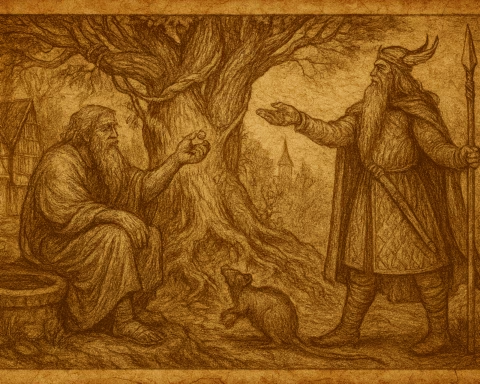
It is told that on a day when the gods gathered to drink the mead of celebration, a wanderer approached the gates of Valhalla. His cloak bore the marks of travel: dust of distant roads, frost of northern winds. The guardian at the door challenged him, for none entered the hall of the slain without rightful purpose.
The wanderer spoke, offering a name the sagas hold uncertain, perhaps a poet, perhaps a spirit of memory, perhaps a disguised mortal seeking honor. What mattered was not the name but the challenge he brought: he asked for entry by right of eloquence, claiming he could speak verses worthy of the gods.
Thus Bragi himself came forth to greet the stranger.
The two stood before the threshold, and the air seemed to still. Bragi spoke first, his voice soft but edged with the authority of centuries:
“Words are a craft, as sacred as the forging of blades. Speak, if you claim the right of poets.”
The wanderer then recited a verse, strong of rhythm, bold of praise, yet lacking the intricate depth that marks true skaldic mastery. Bragi listened without judgment, nodding once. When the stranger finished, the divine poet lifted his hand, and the hall grew quiet so that every soul, living, slain, or divine, could hear.
Then Bragi spoke.
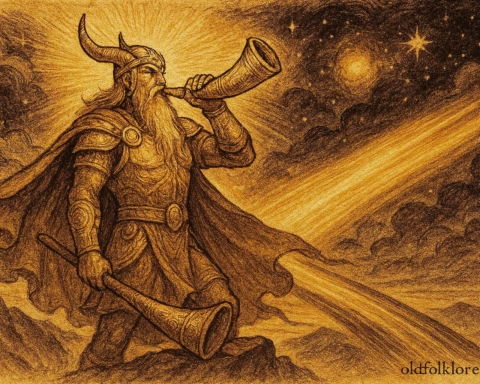
His voice flowed like mead poured from an ancient horn, smooth yet weighted with sweetness and memory. He recited tales of gods and their first rising, of the shaping of worlds from fire and frost. He told of oaths sworn in shadowed groves, of the sorrow carved into fate, of joy rising from the embers of loss. He spoke of heroes whose names were nearly forgotten, drawing them back into life with the precision of a master’s touch.
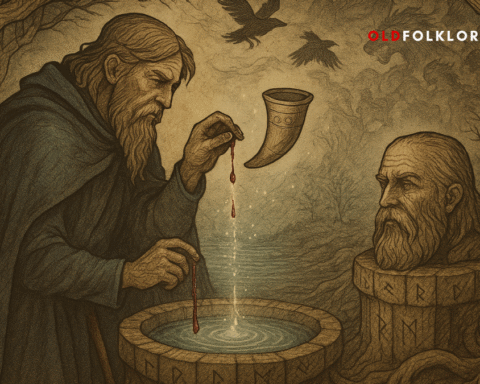
The verses spiraled, intricate as runes on stone. Each stanza held meanings layered like the leaves of Yggdrasil. The hall stirred, even Óðinn, father of poetry through the mead he once won with daring and sacrifice, listened with the hint of a smile.
For Bragi’s poetry was not merely sound; it was memory given breath.
The wanderer bowed his head as Bragi finished. In the face of such mastery, challenge became reverence. The gods welcomed the stranger inside, not for the skill he had brought, but for the humility he had learned.
Skáldskaparmál, the “Language of Poetry,” says that Bragi’s words carry the memory of all things worth preserving. Where other gods wield war or wisdom or winter’s force, Bragi wields the quiet power that keeps stories alive long after the world has changed.
In Icelandic tradition, poets would call upon Bragi’s name before speaking formal verses. His blessing was considered a bridge between the mortal mind and the ancient wellspring of inspiration, the source that shaped skaldic art into one of the most demanding poetic traditions ever created.
Thus the tale endures: Bragi’s greatest myth is not an adventure but a revelation. His gift is the reminder that even in a world of thunder and spear, it is words that outlast the storm.
Author’s Note
Bragi’s story teaches that inspiration is sacred. In Norse culture, poetry was not entertainment, it was memory, honor, and identity preserved in spoken form. Bragi represents the belief that language holds power: to heal, to guide, to immortalize. His presence in myth is a reminder that even among gods of storm and battle, the quiet strength of eloquence shapes the legacy of a people.
Knowledge Check
Q1: What domain does Bragi preside over?
A: Poetry, eloquence, and inspired speech.
Q2: What is Bragi commonly depicted with?
A: A long beard and sometimes a harp or rune-carved staff.
Q3: Where is Bragi most prominently featured in Norse literature?
A: In the Prose Edda, especially Skáldskaparmál.
Q4: Why did poets invoke Bragi’s name historically?
A: To seek inspiration and legitimacy before performing skaldic verse.
Q5: Who is Bragi traditionally associated with as his wife?
A: Iðunn, keeper of the apples of youth.
Q6: What is Bragi’s power in mythic context?
A: The ability to shape memory and immortalize deeds through poetry.
Source: Norse Mythology, Scandinavia.
Source Origin: Scandinavia (Old Norse tradition)