The Bunyip is one of the most enduring and culturally complex beings recorded from the Aboriginal peoples of southeastern Australia. Often described in colonial accounts as a “monster” of swamps and billabongs, the Bunyip is, in Indigenous contexts, far more than a creature: it is a water spirit, a custodian of sacred sites, an enforcer of law, and a teacher of caution.
Its domain includes billabongs, slow-moving creeks, deep waterholes, river bends, and swampy reed beds, especially those known to be dangerous or spiritually charged. Aboriginal narratives vary by region, language group, and ecological terrain, which is why no single “canonical” Bunyip description exists. Instead, the Bunyip is a category of beings, whose specifics shift according to local stories and the teaching purpose of each tale.
Follow the paths of legendary warriors, kings, and demigods who defined ancient honor
Earliest Printed Record
A famous 1845 newspaper note reads:
“The Bunyip… is represented as uniting the characteristics of a bird…”, Geelong Advertiser, 1845.
This snippet reflects how early settlers attempted to make sense of Indigenous descriptions, though often incompletely or through sensationalism.
Indigenous Descriptions
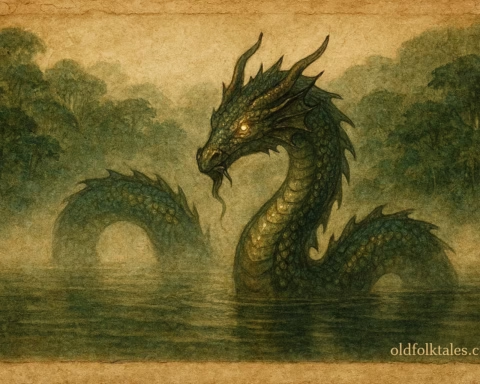
Aboriginal accounts describe the Bunyip in terms that are evocative rather than zoologically precise. Common features include:
- A smooth or shaggy body, sometimes covered in feathers, fur, or eel-like slime
- A long neck or bulbous head
- Large, fearsome eyes that gleam in low light
- Powerful flippers or limbs for striking the water
- A deep bellowing call, heard echoing across wetlands at night
But these physical traits are not the focus of Indigenous storytelling. The Bunyip’s essence is its presence, not its anatomy. It represents something that should not be mocked, disturbed, or carelessly approached.
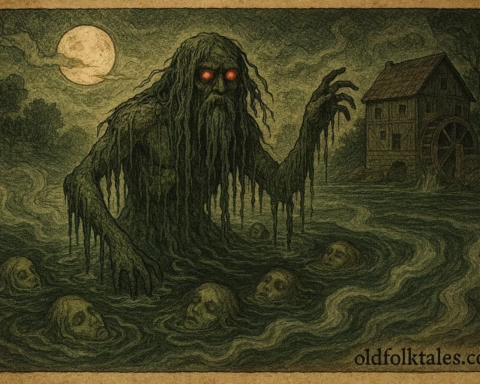
In Aboriginal traditions, the Bunyip typically emerges at night, creating ripples or sudden disturbances in the still water. It may lurk beneath reeds or appear as a dark shape gliding just below the surface. Children are warned never to wander too close to deep waterholes alone, especially at dusk, both for cultural and safety reasons.
Powers and Abilities
The Bunyip’s abilities emphasize its spiritual and moral authority, not monstrous violence:
- Guardian of Water Sites: Protects sacred waterholes from trespass or misuse.
- Punisher of Transgressions: Those who violate taboos, break cultural law, or behave recklessly near water may anger the Bunyip.
- Shape-Shifting: In some regions, the Bunyip is said to change form, appearing as an animal, a shadow, or a human-like silhouette.
- Vocal Power: Its booming cry is a warning, an omen, or a boundary marker.
- Ancestral Role: In some accounts, Bunyips are linked with the Dreaming and may embody ancestral forces or echo the presence of older beings.
Colonial Misinterpretations
By the mid-19th century, settlers circulated exaggerated tales of “Bunyip skulls,” “Bunyip feathers,” and sightings of strange animals. Many of these were fabrications or misidentified fauna. Museums displayed supposed Bunyip remains that were later debunked.
Aboriginal storytellers, however, consistently located the Bunyip in spiritual and moral landscapes, not as a cryptid. Scholars now carefully distinguish Indigenous Bunyip traditions from colonial Bunyip sensationalism.
Regional Variants
Rather than a single creature, the Bunyip is linked to many local names and forms. Its role might be:
- A dangerous water spirit
- A guardian ancestor
- A warning figure for children
- A representation of drowned souls
- An embodiment of the unpredictable nature of wetlands
Because water is sacred in Aboriginal cosmology, source of life, memory, and the Dreaming, the beings associated with it carry immense cultural weight.
Cultural Role and Symbolism
The Bunyip symbolizes a complex range of meanings:
- Moral Enforcement: Waterholes are often sites of ritual significance or strict rules. The Bunyip punishes those who break cultural law, especially those who mock sacred sites, behave recklessly, or disrespect community boundaries.
- Natural Hazard Explanation: Wetlands can be dangerous, deep drop-offs, soft mud, sudden currents. The Bunyip stories teach practical survival while reinforcing respect for nature.
- Spiritual Boundary Marker: Billabongs and rivers are gateways to the Dreaming. The Bunyip guards these portals, ensuring proper conduct when approaching sacred places.
- Ecological Stewardship: By warning against disturbing wetlands, the Bunyip promotes environmental respect. These spaces are rich in life yet fragile; the Bunyip becomes a symbol for conserving water ecosystems.
- Mystery and Awe: The Bunyip embodies the unknown, sounds in the night, ripples with no visible cause, strange animal traces along muddy banks. It reminds communities to remain humble before nature’s mysteries.
Explore the mysterious creatures of legend, from guardians of the sacred to bringers of chaos
Author’s Note
The Bunyip is often misunderstood outside of Aboriginal contexts. It is not a simple monster but a deeply meaningful guardian and moral teacher. Early newspapers and colonial fascination added layers of confusion, but Indigenous oral traditions maintain the Bunyip’s true essence: a spiritual authority tied to place, story, and law. Any modern retelling must acknowledge this cultural complexity and avoid reducing the Bunyip to a cartoonish creature.
Knowledge Check (Q&A)
- Q: Where is the Bunyip traditionally said to live?
A: Billabongs, swamps, riverbeds, and waterholes in southeastern Australia. - Q: What cultural purpose does the Bunyip serve in Aboriginal traditions?
A: It acts as a guardian of water and enforcer of cultural law. - Q: Why are colonial Bunyip descriptions unreliable?
A: They often reflect sensationalism, misunderstandings, or fabricated displays. - Q: What does the Bunyip symbolize?
A: Mystery, spiritual boundaries, moral discipline, and ecological respect. - Q: What is one power attributed to the Bunyip?
A: The ability to punish those who violate taboos around sacred waters. - Q: What was the earliest printed reference to the Bunyip?
A: An 1845 Geelong Advertiser report describing it with “characteristics of a bird.”
Sources:
- Geelong Advertiser, 1845, earliest printed colonial reference
- National Museum of Australia ethnographic summaries
- Scholarly analyses from Aboriginal studies and humanities journals
Origin: Aboriginal Australia; Southeast regions including Wergaia and Wemba-Wemba language groups; oral traditions long pre-colonial. The English word bunyip first appears in print c.1845.