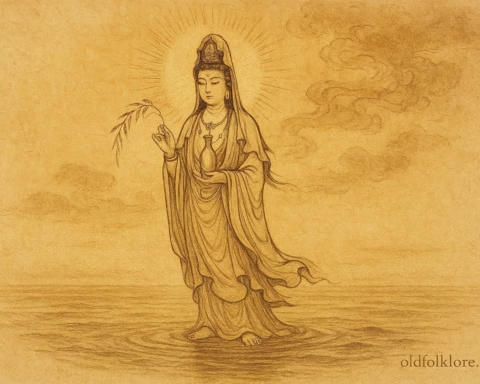
In the celestial realm of Heaven, where immortals dwelled among clouds of jade and gold, there lived a fairy maiden of extraordinary beauty and skill named Zhi Nu, the Weaving Maid. Her fingers moved across her loom with the grace of flowing water, creating clouds that drifted across the sky in layers of breathtaking color. In spring, her clouds blushed pink like peach blossoms. In summer, they gleamed white as fresh snow on distant peaks. Autumn brought clouds of burnished gold, and winter dressed the heavens in silver-grey. The seasons themselves seemed to follow the rhythm of her weaving.
Among the immortals of Heaven lived another celestial being Qian Niu Xing, known as Altair the Cowherd Star. He tended the celestial herds with patience and kindness, and his heart was as pure as mountain springs. When Zhi Nu and Qian Niu Xing met, they discovered they shared a deep understanding, a connection that transcended the ordinary bonds between immortals. They spoke of dreams and duties, of stars and seasons, and slowly, inevitably, they fell in love.
Click to read all Myths & Legends – timeless stories of creation, fate, and the divine across every culture and continent
But the laws of Heaven were strict and unyielding. Immortals were forbidden to love one another without the permission of the Heavenly Mother, Wang Mu, the Queen Mother of the West. When she discovered their attachment, her fury was swift and merciless. She banished Qian Niu Xing from the celestial realm, casting him down to the mortal world below, where he would be reborn and stripped of his divine memories.
Zhi Nu’s grief knew no bounds. Day after day, she sat at her loom, her face washed in endless tears, her eyebrows knotted in worry. Her fingers still moved across the threads, but the clouds she created now reflected her sorrow grey and heavy with unshed rain. The other fairy maidens grew concerned watching their sister fade with longing.
One day, several of the fairy maidens approached Queen Mother Wang Mu with a plea. “Great Mother,” they said, bowing low, “please allow us to take Zhi Nu to the mortal world, to bathe in the Jade Lotus Pond and help drive away her cares.” Wang Mu, perhaps moved by a flicker of compassion, agreed.
Meanwhile, in the world below, Qian Niu Xing had indeed been reborn into a poor peasant family and given the name Niu Lang Cowherd. After his parents died, his older brother and sister-in-law treated him with cruelty, eventually driving him from the family home with nothing but an old cow for company. Niu Lang built a small dwelling with his own hands, cleared a patch of land for farming, and lived a simple, lonely life with only the cow to ease his solitude.
But the old cow was no ordinary beast. In truth, it was the Star of the Celestial Golden Bull, Taurus himself, who had once carried messages between Qian Niu Xing and Zhi Nu in Heaven. He too had been banished for his role in their forbidden love.
One morning, as Niu Lang prepared to work his fields, the old cow suddenly spoke with a human voice. “Niu Lang,” it said, its eyes filled with ancient wisdom, “today the immortal fairy maidens will descend to bathe in Jade Lotus Pond. Go there and hide the red robe of immortality. The fairy who owns it will become your wife.”
Niu Lang stood frozen in amazement. “Brother Cow! You can speak! Is what you say truly possible?”
The cow nodded solemnly, and Niu Lang, his heart pounding with a hope he couldn’t name, hurried to the Jade Lotus Pond. He hid himself among the tall reeds that grew thick along the water’s edge and waited.
Before long, ethereal figures descended from the sky like petals falling from heaven’s garden. The fairy maidens laughed and called to one another, their voices like bells. They removed their robes of immortality and dove into the crystal-clear water, the surface rippling with their joy.
Niu Lang emerged from his hiding place and quietly took the red cloak that lay nearest to him. When the maidens noticed the mortal, they shrieked in surprise, quickly dressed, and flew away like startled birds. All except one Zhi Nu, who could not find her red robe and remained stranded by the pond’s edge.
When Zhi Nu saw the young man holding her cloak, she felt shy and vulnerable. But when Niu Lang stepped forward, speaking with sincere respect and asking if she would honor him by becoming his wife, she looked up into his face and felt something stir deep within her soul. Though she didn’t understand why, she recognized him this was her beloved Qian Niu Xing, the one she had mourned through countless tears. Her heart leaped with joy and surprise, and blushing, she nodded her agreement.
Zhi Nu became Niu Lang’s wife, and their love flourished like flowers after rain. They treated each other with kindness and devotion, building a life of simple happiness. Nine years passed like a beautiful dream. They were blessed with two daughters, and their small homestead rang with laughter and contentment.
One day, Niu Lang returned from the fields with sorrow etched on his face. “The old cow has died,” he told Zhi Nu, his voice breaking. “But before he left this world, he told me to keep his hide. He said if trouble ever comes, I should drape it over my shoulders, and it will carry me to Heaven.”
Zhi Nu felt a chill of premonition but helped Niu Lang preserve the hide and give the faithful cow a proper burial.
Their peace was shattered when a fierce wind suddenly tore through the sky. Celestial soldiers descended like a storm, seizing Zhi Nu without warning or mercy. Queen Mother Wang Mu had discovered that Zhi Nu had married a mortal, and her rage was terrible. The soldiers flew upward, carrying the screaming, struggling Weaving Maid back toward the heavens.
“Niu Lang!” Zhi Nu cried desperately. “Put on the cow’s hide!”
Niu Lang grabbed his two daughters, placed them in wicker baskets hanging from a pole across his shoulders, threw the magical hide over his back, and soared into the sky in pursuit. He flew faster than wind, driven by love and desperation, gaining on the soldiers with every breath.
Just as he was about to reach his wife, Queen Mother Wang Mu pulled the golden hairpin from her elaborate coiffure and drew a line across the sky between them. In that instant, a mighty river appeared vast, churning, impossible to cross. The Milky Way itself now separated the lovers, its celestial waters flowing with the force of eternity.
On opposite banks, Zhi Nu and Niu Lang gazed at each other, their hearts breaking. Tears streamed down their faces as they reached helplessly across the impossible distance. The children wept as if their souls were being torn apart.
Even Queen Mother Wang Mu, watching this scene of utter heartbreak, felt her stern heart soften. “Very well,” she declared. “Niu Lang and the children may remain in Heaven. But you will live on opposite sides of the Heavenly River. Once each year, on the seventh day of the seventh month, you may come together as a family.”
And so it has been ever since. Niu Lang and his daughters live on one side of the Milky Way, gazing across at Zhi Nu on the other. Every year, on the seventh night of the seventh month, thousands upon thousands of magpies fly up from the mortal world, their black wings forming a bridge across the celestial river. The family reunites on that bridge, and if you listen quietly on that night, you can still hear them speaking words of endless love.
The Moral Lesson
The legend of the Cowherd and the Weaver Girl teaches that true love transcends all boundaries even those between Heaven and Earth. Despite divine punishment and cosmic separation, the devotion between Zhi Nu and Niu Lang endures, symbolizing the power of commitment and faithful love. The story also reminds us that even the strictest authorities may be moved by genuine emotion and sacrifice, and that patience and faithfulness are rewarded. This tale celebrates the Qixi Festival (Chinese Valentine’s Day) and emphasizes that love, though it may face impossible obstacles, finds a way to persist and reunite.
Knowledge Check
Q1: Who were Zhi Nu and Qian Niu Xing in Chinese mythology? A: Zhi Nu was the Weaving Maid, a celestial fairy who created the colored clouds of the seasons. Qian Niu Xing was Altair the Cowherd Star who tended celestial herds. They were immortals in Heaven who fell in love, but their romance was forbidden by the Heavenly Mother, leading to their separation and eventual transformation into stars.
Q2: Why was Qian Niu Xing banished to the mortal world? A: He was banished by Queen Mother Wang Mu because immortals in Heaven were forbidden to love one another without permission. When she discovered that Qian Niu Xing and Zhi Nu had fallen in love, she punished him by casting him down to Earth, where he was reborn as the mortal peasant Niu Lang.
Q3: What role did the old cow play in the Cowherd and Weaver Girl legend? A: The old cow was actually the Star of the Celestial Golden Bull (Taurus), who had been banished from Heaven for helping the lovers. He helped Niu Lang find Zhi Nu by telling him to take her red robe at Jade Lotus Pond, and after death, his magical hide allowed Niu Lang to fly to Heaven to pursue his wife.
Q4: How did Queen Mother Wang Mu separate the lovers? A: When Niu Lang flew to Heaven chasing after Zhi Nu, he nearly reached her. Queen Mother Wang Mu pulled out her golden hairpin and drew a line across the sky between them, creating the Milky Way, a vast celestial river that permanently separated the couple on opposite banks.
Q5: What is the significance of the seventh day of the seventh month in this Chinese legend? A: This is the one day each year when Zhi Nu and Niu Lang are allowed to reunite as a family. Thousands of magpies fly up and form a bridge across the Milky Way, allowing the lovers to meet. This day became the Qixi Festival, celebrated as Chinese Valentine’s Day.
Q6: What do the magpies symbolize in the Cowherd and Weaver Girl story? A: The magpies represent compassion, hope, and the power of collective action to overcome impossible obstacles. By forming a bridge with their bodies across the Milky Way, they enable the separated lovers to reunite, symbolizing how nature and kindness can temporarily bridge even cosmic divides created by divine authority.
Source: Adapted from traditional Chinese folklore documented in Chinese Fairy Tales and Fantasies translated by Moss Roberts (Pantheon Books, 1979).
Cultural Origin: Ancient China, with roots in the Han Dynasty (206 BCE – 220 CE); celebrated throughout Chinese-speaking regions as the Qixi Festival