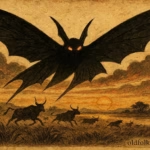
Among the Indigenous peoples of western North America, Coyote is a figure of immense complexity, both revered and ridiculed, wise and foolish, creator and destroyer. In the wide range of stories told about him, Coyote is never simply one thing. He is the trickster, the shapeshifter, the traveler, and sometimes the unwitting bringer of order through chaos.
Across the Southwest, Great Basin, and Plains, his form and name vary. To the Blackfoot, he appears in Grinnell’s collections as a restless wanderer whose curiosity gets him into trouble. Among the Navajo, he is Ma’ii, the crafty coyote-spirit who brings fire to humankind but also scatters death across the world. For the Nez Perce and Ute, Coyote walks the earth in primordial time, shaping rivers, mountains, and the patterns of life through his adventures and misdeeds.
Relive the heroic sagas of every age – stories of triumph, tragedy, and timeless valor
Physically, Coyote resembles the animal that bears his name, a lean, quick, golden-gray hunter of the prairies. Yet in stories, he speaks, laughs, sings, and transforms at will. He can appear as a man, a spirit, or a four-legged creature. His cunning rivals that of the gods, but his flaws are deeply human: greed, vanity, lust, and overconfidence. Through him, people learn not only why the world is the way it is but also how to live in it.
In one well-known Blackfoot tale recorded by Grinnell, Coyote tries to steal fire from the Fire People. His clever plan succeeds, but when he grows proud and careless, he scorches his tail, leaving it black-tipped forever. In another, he attempts to trick the Sun and is blinded by its brilliance. From these mistakes, humanity gains both fire and the lesson of humility.
Behavior and Mythic Role
Coyote’s actions cross the boundaries between sacred and profane. He speaks with the Creator yet mocks divine authority; he steals, lies, and cheats, but his mischief often restores balance or introduces new knowledge. Coyote is the archetypal mediator between the human and spirit worlds, a being who tests the edges of morality so that others may understand them.
In Plains traditions, he is known for testing social norms. Coyote’s greed leads to loss; his lust brings embarrassment; his deception turns upon him. These comic reversals are moral lessons disguised as laughter. Storytellers often begin such tales during winter, when moral reflection and humor keep the community warm and connected.
In the Southwest, Coyote’s mythic role expands. Among the Navajo and neighboring peoples, he is the one who scatters the stars, hurling them into the sky before the constellations could be neatly arranged. He is also blamed for releasing death into the world: when the Holy People debated whether humans should live forever, Coyote threw dust into the air, declaring that people must die so that the earth would not overflow. Thus, Coyote explains not only creation but mortality itself.
In the Plateau and Great Basin, his stories have a distinctly ecological dimension. Coyote’s journeys carve rivers and mountain passes; his clever thefts or mistakes introduce seasons, animals, and customs. In some Nez Perce and Shoshone versions, he steals salmon from greedy spirits, ensuring that fish return to the people each spring, a sacred act of restoration disguised as mischief.
Cultural Role and Symbolism
Coyote’s moral power lies in contradiction. He is both a teacher and a fool, embodying the tension between instinct and wisdom. His tales illustrate how balance arises not from perfection but from learning through error.
- Moral Teacher: Through failure, Coyote models human flaws, greed, pride, lust, and their consequences. Audiences laugh at him but also recognize themselves.
- Cultural Hero: Despite his follies, he gives essential gifts: fire, daylight, fish, song, or storytelling itself. His transgressions lead to creation.
- Boundary Crosser: Coyote moves between life and death, human and divine, animal and spirit. He reveals that boundaries are fluid and transformation is constant.
- Comic Healer: Laughter, a sacred force in many Indigenous traditions, restores balance after hardship. Coyote’s humor transforms fear into understanding.
In Lakota and related Plains cultures, the trickster sometimes appears as Iktomi, the spider figure who fulfills the same role. Both Coyote and Iktomi represent the unpredictable energy that sparks creativity and learning. While Iktomi weaves webs of deceit, Coyote howls across the open world, both remind us that creation is messy, alive, and deeply human.
Because Coyote tales are oral literature, their tone shifts with the teller. Some versions are sacred and reserved for specific seasons; others are playful entertainment. Their adaptability shows the vitality of Indigenous storytelling, how myth remains a living conversation rather than a fixed text.
Author’s Note
Coyote’s stories, first written down in the late 19th century by ethnographers like George Bird Grinnell, were never meant to be read silently on a page. They were performed, told with laughter, mimicry, and rhythm, in smoky lodges or under starry skies. When early collectors transcribed these tales, they often misunderstood their tone, treating them as “primitive fables.” In truth, they are complex philosophical dramas that teach the ethics of survival, community, and humility.
Coyote endures because he is us, clever, flawed, curious, and endlessly adaptable. He breaks every rule but somehow keeps the world turning. His voice, echoing across languages and landscapes, reminds us that wisdom often hides inside foolishness and that the sacred may wear the mask of a clown.
Knowledge Check (Q&A)
- Q: What dual role does Coyote often play in Indigenous mythology?
A: He is both a trickster and a culture-hero, foolish yet creative. - Q: In Navajo stories, what two major world events is Coyote responsible for?
A: Bringing fire to humans and introducing death into the world. - Q: What lesson is commonly taught through Coyote’s mistakes?
A: The importance of humility, balance, and self-restraint. - Q: How do Plains and Southwest Coyote tales differ in focus?
A: Plains stories emphasize social lessons and humor; Southwest tales focus on creation and cosmic order. - Q: Why is laughter considered important in Coyote stories?
A: Humor heals and teaches; it allows people to confront serious truths through laughter. - Q: How does Coyote’s shape-shifting ability reflect his symbolic role?
A: It represents transformation, adaptability, and the blending of spiritual and physical realms.
Sources:
Primary Source: George Bird Grinnell, Blackfeet Indian Stories (Project Gutenberg, public domain)
Secondary Source: Métis Museum Comparative Essays on Trickster Motifs (metismuseum.ca)
Origin: Southwestern, Plains, and Great Basin Nations (Blackfoot, Navajo, Nez Perce, Ute, Chinook, and many others)