Dakuwaqa, also written Dakuwanga / Daku-vakarua in some regional accounts, is one of Fiji’s most powerful and widely recognized shark deities. Across the archipelago, Dakuwaqa is spoken of with a mixture of reverence and caution. He is far more than a monstrous shark; he is a shape-shifting guardian, a ruler of the sea’s thresholds, and a being whose presence protects, tests, and sometimes punishes those who cross the open ocean.
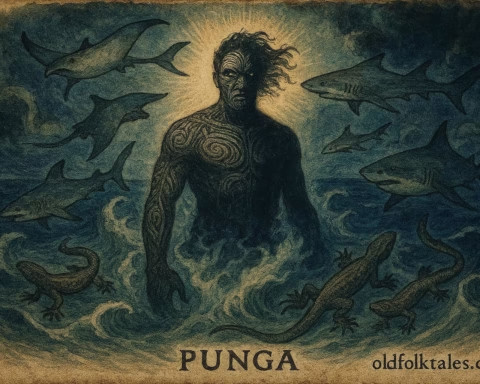
In appearance, Dakuwaqa is described primarily as a massive shark, often a tiger shark or reef shark in local associations, but endowed with supernatural magnitude, eyes bright as torchlight, body vast as a canoe, and teeth described as “white spears.” Some traditions depict him as having a human upper torso and the lower body of a shark when interacting with people, a form that signals both his divine nature and his adaptability.
Follow the paths of legendary warriors, kings, and demigods who defined ancient honor
Although the shark form is dominant, Dakuwaqa is a master of transformation. He can shed his marine shape to appear as a muscular man, usually dripping with seawater, or as an ambiguous humanoid figure with shark-like eyes. In some regional narratives, he also takes the form of sea creatures associated with reef passages, signaling his control over liminal spaces, especially the boundaries between safe lagoon waters and the deeper sea.
A defining trait of Dakuwaqa is his jealous protectiveness. Many early accounts describe him patrolling the entrances of reefs, river mouths, or channels where fishermen pass. Anyone who failed to offer proper respect, through prayer, restraint, or following traditional sea protocols, risked attracting his wrath. His attacks were said to overturn canoes, drag swimmers beneath the waves, or whip up dangerous currents.
Yet this destructive potential exists alongside a deeply protective role. In many villages, Dakuwaqa is regarded not as an enemy but as a guardian deity who shields fishermen, blesses safe journeys, and keeps malevolent sea spirits at bay. Whole clans and coastal communities consider themselves spiritually tied to him, and some elders report ancestral connections to Dakuwaqa’s line.
This dual nature, protector and punisher, situates Dakuwaqa as a being who enforces both natural and spiritual law.
Myths & Behavior
One of the most famous stories describes Dakuwaqa traveling to challenge Degei, a powerful inland serpent deity. On his way, he crossed into the Rewa delta and later pushed toward the mountains, intent on proving his supremacy over all spirits. But when he reached an upland region, he confronted the guardian goddess of fresh waters (in some versions a giant female eel or snake). A fierce battle ensued, a collision of saltwater and freshwater forces.
In many versions, Dakuwaqa was defeated or immobilized. Instead of being destroyed, he was taught humility and bound by a covenant: he could rule the seas, but he must never again attempt to invade the lands of the rivers and mountains. This story explains why shark spirits govern the ocean while inland water guardians protect rivers and springs.
Other tales portray Dakuwaqa chastening fishermen who take more fish than needed, or who spear taboo species. He sometimes tests travelers by appearing in human form, asking for help, respect, or food. Generous responses win protection; disrespect draws misfortune.
A recurring motif involves Dakuwaqa battling rival sea spirits, octopus gods, monstrous eels, or other reef guardians. These encounters often reflect the interactions of real marine species and the power dynamics of Fiji’s waters.
Modern retellings emphasize Dakuwaqa’s role as protector of divers and fishermen. Many elders recount that if a shark circles a canoe without attacking, it is Dakuwaqa inspecting or escorting the travelers.
Through these stories, Dakuwaqa embodies the laws of the sea: take only what is needed, respect the reef, and acknowledge the living spirits that guard the ocean.
Cultural Role & Symbolism
Dakuwaqa symbolizes respect for marine ecology, authority over boundaries, and the spiritual dimension of the ocean. In a world where the sea provides both livelihood and mortal danger, he stands as the embodiment of oceanic power, unpredictable, vast, and morally charged.
- Guardian of Reef Passages: Many communities consider Dakuwaqa a protector of the narrow, dangerous passages between lagoon and open ocean. These are liminal spaces where one shifts from safety to uncertainty,exactly the zones where a guardian spirit is most needed.
- Enforcer of Taboos & Balance: Dakuwaqa’s punishments reflect the belief that humans must act with restraint. His stories teach sustainable fishing, respect for sacred sites, and understanding of seasonal rhythms.
- Symbol of Ancestral Connection: Some clans trace lineage or protective relationships to Dakuwaqa, making him an ancestral guardian. Carved shark-tooth neck pendants, masks, and canoe ornaments often represent him.
- Mediator Between Domains: His defeat by the inland water guardian preserves cosmic balance between river and sea. This division reflects ecological understanding: saltwater and freshwater are distinct realms requiring harmony, not domination.
- Moral Teacher: Dakuwaqa’s shape-shifting tests human compassion, humility, and spiritual awareness. Those who behave with arrogance or greed meet his wrath; those who uphold tradition are protected.
In modern Fiji, Dakuwaqa remains a cultural icon, depicted in art, tattoos, dance, and oral storytelling. His legend reinforces that the sea is alive, conscious, and deserving of deep respect.
Encounter dragons, spirits, and beasts that roamed the myths of every civilization
Author’s Note
This entry synthesizes early mission records, regional ethnographic notes, and modern cultural discussions while emphasizing respect for Fijian custodianship. Dakuwaqa narratives vary greatly by village and region; therefore, this account presents widely attested motifs without flattening local specificity. For site-based or clan-based retellings, consultation with local custodians and cultural authorities is essential.
Knowledge Check
- Q: What is Dakuwaqa’s primary form?
A: A massive shark deity, often tiger-shark associated. - Q: What dual role does Dakuwaqa play?
A: He is both guardian of the reefs and enforcer of marine taboos. - Q: What ability allows Dakuwaqa to test humans?
A: Shape-shifting, often appearing as a human. - Q: Why did Dakuwaqa stop invading inland waterways?
A: He was defeated by a freshwater guardian and bound to rule only the sea. - Q: What moral lesson is central to Dakuwaqa stories?
A: Respect for the sea and sustainable fishing. - Q: What does Dakuwaqa symbolize for many Fijian communities?
A: Protection, ancestral connection, and balance between humans and the ocean.
Source: Fijian oral traditions; early mission notes; ethnographic museum records (e.g., Bishop Museum; Fiji Museum).
Origin: Fiji (coastal and island communities; pre-contact oral tradition).