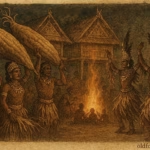
Among the Krobo people of Ghana, Dipo stands as one of West Africa’s most enduring rites of passage, a spiritual, moral, and social initiation that marks the transformation of a girl into a woman. Celebrated each year before the planting season, the Dipo ceremony is both a private education in womanhood and a public affirmation of identity. It renews the bond between generations, affirming the Krobo worldview that true maturity lies not only in age but in knowledge, discipline, and respect for ancestral wisdom.
The ritual unfolds over several days, each stage reflecting moral growth and symbolic purification. Girls, known as Dipo-yo (initiates), are secluded and instructed by elder women, learning traditional virtues, household skills, and codes of conduct. During this seclusion, they are ritually cleansed in sacred water, signifying the washing away of childhood. Priests and priestesses of the Krobo shrines invoke the blessing of the gods to ensure the girls’ fertility, good health, and moral uprightness.
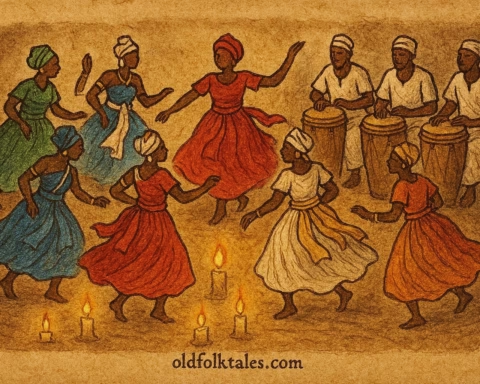
The adornment phase is visually striking. The initiates emerge from seclusion adorned in intricate beadwork, each bead colour and arrangement signifying purity, maturity, and readiness for womanhood. These beads, often passed down through generations, link the girls to their ancestors and lineage. Wrapped in white or patterned ritual cloth, the Dipo-yo perform graceful dances before the gathered community, symbolizing their rebirth into social adulthood.
At the heart of the ceremony is the stone ritual, in which each girl steps onto a sacred stone, declaring her readiness to take on adult responsibilities. This act represents stability and endurance, qualities prized in Krobo womanhood. The final presentation before elders marks the community’s public acknowledgment of the girls as women, capable of marriage, childbearing, and societal contribution.
Though influenced by Christian and modern ideals, the Dipo ritual remains a profound assertion of Krobo identity. While some urban Ghanaians have criticized the rite for perceived anachronism, many Krobo communities defend it as a vital cultural inheritance—an ethical education that modern institutions cannot replace.
Mythic Connection
The spiritual core of Dipo lies in Krobo cosmology and its understanding of womanhood as sacred continuity. According to oral tradition, the first Dipo was revealed by the earth goddess Naa Dipo, who taught the Krobo how to cleanse and prepare their daughters to serve the gods and sustain life. The goddess, embodying fertility and moral purity, instructed that no girl could marry or bear children without undergoing the ritual purification.
Through this mythic origin, Dipo is understood not merely as a social institution but as a covenant between humans and the divine. The Krobo believe that when the ritual is neglected, misfortune, infertility, or social disorder may follow, symbolizing the rupture of cosmic balance. Thus, each performance of Dipo reaffirms the community’s harmony with the gods, the ancestors, and the land.
Even in contemporary times, the rite’s spiritual dimension persists. Priests still pour libations to Naa Dipo, invoking her guidance and protection. The sacred songs sung during the dance recall the ancient covenant, merging past and present in a single rhythm of continuity.
Author’s Note
The Dipo rite stands at the crossroads of tradition and modernity, a vibrant ceremony that has adapted without losing its spiritual essence. More than an initiation, it is a living testament to the Krobo belief that womanhood is both a gift and a responsibility, demanding reverence for life, ancestry, and community order. Through its music, beads, and sacred stone, Dipo continues to weave the moral and spiritual fabric of Krobo society, ensuring that the daughters of today remain connected to the mothers of the past.
Knowledge Check
1. What is the main purpose of the Dipo ritual?
To initiate Krobo girls into womanhood, teaching moral, domestic, and spiritual values that prepare them for adult life.
2. Why is water used during the initiation process?
It symbolizes purification, washing away childhood, and renewing the initiates for their new social role.
3. What is the significance of the beads worn by initiates?
Beads represent lineage, purity, fertility, and continuity with ancestors, each colour and arrangement carrying symbolic meaning.
4. What does stepping onto the sacred stone signify?
It represents readiness, strength, and stability, qualities expected of mature Krobo women.
5. Which deity is associated with the origin of Dipo?
Naa Dipo, the earth goddess who revealed the first rites of womanhood to the Krobo people.
6. How has modernity affected the Dipo ceremony?
While Christian influences have altered its perception, Dipo remains a respected cultural institution preserving Krobo identity and heritage.