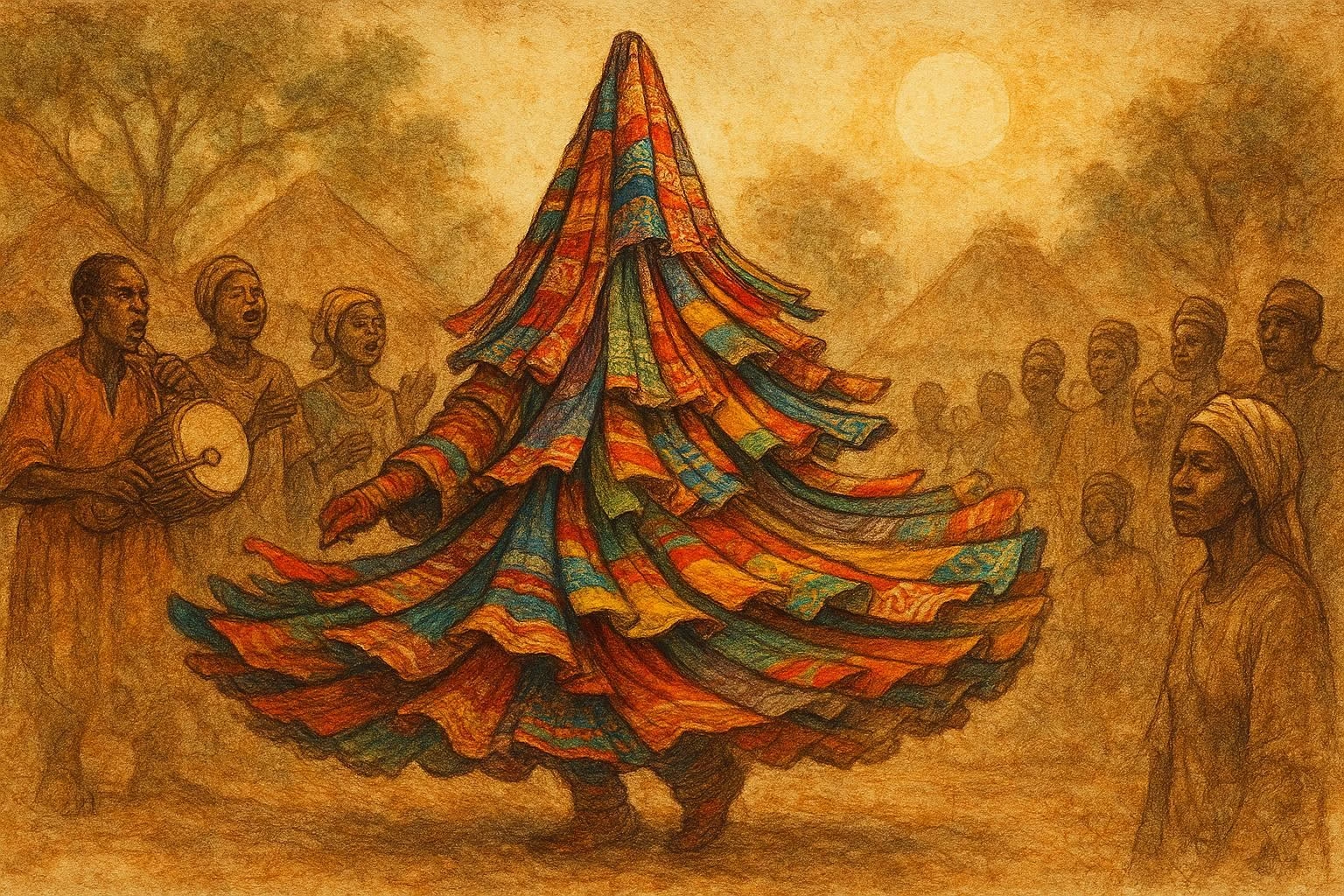
In the heartlands of Yorùbá civilization, where the visible and invisible realms intertwine, the Egúngún masquerade arises each year as a bridge between the living and the dead. To outsiders, it may appear as a spectacle of swirling cloth and drums, but to the Yorùbá, it is something far deeper, the return of the ancestors, embodied in motion, rhythm, and sacred cloth.
The word Egúngún refers both to the masquerade ensemble itself and to the collective spirits of the ancestors who visit their descendants through it. In Yorùbá cosmology, death does not sever belonging; it merely transforms it. The deceased remain part of the lineage, capable of guiding, blessing, or reprimanding the living. Thus, when Egúngún appears, it is not a man in costume but an ancestral presence, a spiritual messenger cloaked in layered fabrics that shimmer with the power of memory.
Each Egúngún costume is a masterpiece of symbolic artistry. Dozens of colourful cloth layers, velvet, brocade, indigo, lace, are stitched together, each representing generations of lineage and the wealth of devotion poured into maintaining ancestral honour. Feathers, mirrors, and charms (known as ẹ̀rù or “medicine”) are often attached, amplifying the costume’s spiritual potency. The mask or veil conceals identity completely, for once the performer dons Egúngún, he ceases to be human and becomes ara orun, a being from the otherworld.
When the Egúngún festival begins, drummers call the spirits with sacred rhythms from the bàtá and dundun drums. Praise-singers chant the genealogies of the lineage, reciting ancestral names in measured poetry called oríkì. The air thickens with incense and anticipation. Then the Egúngún emerges, spinning, twirling, and sweeping its cloth in great arcs, its movement both graceful and fearsome. Dust rises like mist around it, symbolising the thin veil between the world of humans and the world beyond.
The Egúngún blesses children, heals disputes, and warns against moral lapses. It may touch the heads of the devout with its cloth, a gesture of divine favour, or chase wrongdoers from the crowd, reminding all that the ancestors still watch. In this way, the masquerade functions as both ritual and social conscience, a vivid assertion that morality, lineage, and cosmic order remain inseparable.
Mythic Connection
The Egúngún ritual is deeply rooted in Yorùbá religious philosophy, which conceives the universe as a dynamic interplay between the seen (ayé) and the unseen (ọ̀run). The ancestors dwell in Ọ̀run but retain interest in the affairs of Ayé, where their descendants continue the work of life. Egúngún therefore serves as the visible embodiment of that eternal covenant.
According to Yorùbá myth, when humans first learned to honour the dead, Òrúnmìlà, the deity of wisdom and divination, instructed them in the proper ways to maintain communication between both worlds. The ancestors, he taught, could bring blessings or misfortune depending on how they were remembered. The Egúngún festival thus became a formalized act of remembrance and renewal, a way to maintain spiritual equilibrium within the community.
In many towns, Egúngún also recalls the mythic precedent of Obàtálá, the creator deity who clothed the world in beauty. The act of dressing the masquerade, layer upon layer of fabric, each imbued with lineage energy, mirrors Obàtálá’s creative act of forming the human body. Just as he covered the earth with life, so the living cover the spirit with cloth to make it tangible once more.
The movement of the Egúngún carries profound symbolic meaning. Its circular spins mimic the cycles of life and death, the constant turning of souls through rebirth and memory. Its sweeping gestures “collect” the prayers of the people and send them upward. In this sacred choreography, art, morality, and theology fuse seamlessly.
Cultural Reflection
Within Yorùbá society, Egúngún functions as a living moral compass and a reminder of ancestral continuity. Each lineage maintains its own ilé Egúngún (house of ancestors) where costumes are stored, repaired, and ritually consecrated. The hierarchy of masks, from playful minor spirits to imposing elder ones, reflects the social order of the living community.
Egúngún ceremonies often extend over several days, combining solemn invocation with joyous celebration. Women sing lineage songs; elders recite proverbs and recount stories of the departed; children learn, through awe and excitement, the sacred rhythm of belonging. It is a community’s most visible expression of collective memory.
Modern museums such as the Smithsonian and the British Museum preserve Egúngún costumes, but curators and scholars acknowledge that their full meaning exists only within living practice, where drums beat, prayers rise, and the invisible takes form. In the diaspora, particularly in Brazil, Cuba, and the United States, Yorùbá-descended communities continue to honour ancestral spirits through adapted masquerades, keeping the rhythm of Egúngún alive beyond Africa.
The ritual therefore transcends geography; it is a moving theology, the belief that the past is never truly gone and that community thrives only when the living honour those who walked before them.
Author’s Note
The Egúngún masquerade stands among the world’s most profound spiritual performances, a ceremony in which costume, music, and memory converge into living theology. To witness it is to glimpse how a culture unites ethics, art, and faith into a single act of reverence. In the whirling of the Egúngún, the Yorùbá remind us that ancestors do not merely rest in history, they walk among us, clothed in the fabric of devotion, forever binding the living to the sacred.
Knowledge Check
1. What does the Egúngún masquerade represent?
It represents the return of ancestral spirits to bless, guide, and correct the living.
2. Why is the costume composed of many layers of cloth?
Each layer symbolises generations of lineage, memory, and spiritual protection.
3. How does Yorùbá cosmology explain Egúngún’s power?
It bridges ayé (the visible world) and ọ̀run (the invisible world), maintaining harmony between them.
4. What role does drumming and chant play in the ceremony?
They summon the ancestors, identify their lineages, and sustain communication with the spirit realm.
5. How does Egúngún enforce moral order?
By blessing the virtuous and rebuking wrongdoers, reinforcing communal ethics through ancestral authority.
6. How has Egúngún persisted in the modern world?
It continues in Yorùbá towns and diaspora communities, adapted but faithful to its sacred role of remembrance.