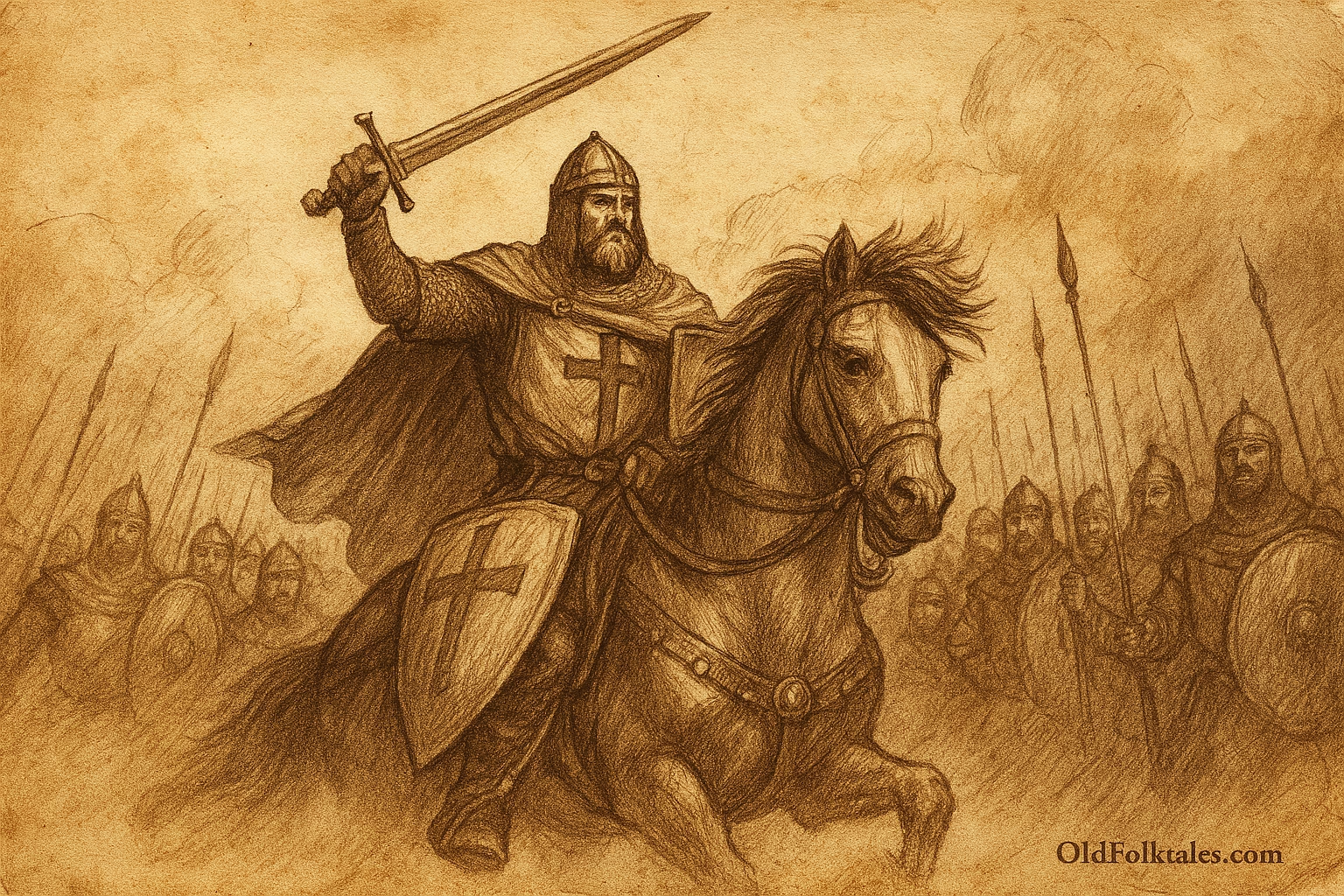
In the scorching heart of medieval Spain, where Christian kingdoms clashed with Moorish caliphates and the dust of countless battles settled over sun-baked plains, there arose a warrior whose name would echo through the centuries. Rodrigo Díaz de Vivar, known to history as El Cid Campeador, the Lord Champion, was a man who walked the razor’s edge between history and legend, his deeds so extraordinary that people could scarcely believe one man could achieve them all.
Born in the eleventh century in the village of Vivar, near Burgos in the kingdom of Castile, Rodrigo grew up during a time when Spain was a patchwork of warring kingdoms, both Christian and Muslim. From his earliest days, he showed exceptional skill with sword and lance, and his strategic mind proved as sharp as any blade. He served King Sancho II of Castile with unwavering loyalty, earning a reputation as an undefeated warrior whose very presence on the battlefield could turn the tide of war.
But fate, as it often does with great men, dealt Rodrigo a cruel hand. When King Alfonso VI ascended to the throne after his brother Sancho’s death, court intrigues and jealous nobles whispered poison into the king’s ear. They painted Rodrigo as too ambitious, too powerful, too independent. Despite his years of faithful service, despite his victories that had expanded Castile’s borders, El Cid found himself exiled from his homeland, cast out like a common criminal with only a handful of loyal followers to accompany him.
The exile could have broken a lesser man, but Rodrigo Díaz was forged of stronger metal. With his faithful wife Doña Jimena and his two beloved daughters left behind for their safety, he rode eastward with his small band of companions. The sun beat down mercilessly on their armor as they crossed the arid plains of Castile, each hoofbeat taking them further from everything they knew and loved. Yet in Rodrigo’s heart burned an unquenchable fire, not of bitterness, but of determination to prove his honor and reclaim his good name.
What followed were years of legendary campaigns that would transform an exiled knight into a mythic hero. El Cid and his growing army fought both for and against Christian and Muslim rulers, his loyalty given not to any religion or kingdom, but to honor itself and to those who treated him justly. Muslims called him “El Cid,” from the Arabic “al-Sayyid,” meaning “the Lord,” a title of deep respect that acknowledged his nobility of character even among his enemies.
His greatest triumph came when he conquered the wealthy city of Valencia on the Mediterranean coast. The siege lasted months, a test of patience and strategy as much as martial prowess. When the city finally fell, Rodrigo did not sack it in revenge or rage, but established himself as its ruler, governing Christians, Muslims, and Jews alike with fairness and wisdom. Valencia became his kingdom, a beacon of relative tolerance in an age of religious warfare, and his court attracted warriors and scholars from across the known world.
The legends surrounding El Cid grew with each passing year. Stories told of how he faced impossible odds and emerged victorious, how his strategic brilliance turned certain defeat into glorious triumph. They spoke of his legendary sword, Tizona, which he won in battle and which seemed to strike with supernatural force. His horse, Babieca, was said to be the finest warhorse in all of Spain, responding to his master’s thoughts as much as to his commands.
But even the greatest of heroes must face mortality. When El Cid fell ill in Valencia, his enemies rejoiced, believing that without their greatest foe, the city would fall easily. The Almoravid forces, a fierce Berber dynasty from North Africa, gathered their armies and prepared to reclaim Valencia. As Rodrigo lay dying, he called his most trusted commanders to his bedside.
What happened next would become the most fantastic element of his legend, the moment where history dissolved completely into myth. According to the tales that spread across Spain like wildfire, El Cid gave his final orders: his body was to be preserved, dressed in full armor, and mounted upon Babieca. When the Almoravid army attacked, his corpse would ride at the head of his forces.
And so it came to pass. When the enemy forces saw El Cid riding forth at the head of his army, mounted on his white warhorse, his banner streaming in the wind, terror seized their hearts. The invincible champion they thought dead appeared before them like an avenging angel. They could not know that his body was held upright by cunning bracing, that his sword was tied to his stiffened hand, that the man they feared was already dwelling in heaven. All they saw was El Cid, unconquerable even in death, and they broke and fled in supernatural dread.
His knights won that final battle, driving the enemy from Valencia’s gates. El Cid had led his men to victory one last time, transcending even death itself to protect the city and people he had sworn to defend. His body was later taken to the monastery of San Pedro de Cardeña, where it was laid to rest with all the honors due to a champion of Christendom.
But El Cid’s true legacy was not his body, which returned to dust like all mortal flesh, but the ideal he represented. In an age of treachery and shifting loyalties, he stood firm in his honor. In a time of religious hatred, he showed respect to worthy opponents regardless of their faith. In the face of unjust exile, he never surrendered to bitterness or despair. He proved that a man’s worth lies not in the favor of kings, but in the strength of his character, the keenness of his wisdom, and the courage of his heart.
The Cantar de Mio Cid, Spain’s oldest epic poem, immortalized his deeds for future generations, blending historical facts with legendary embellishments until the man and the myth became inseparable. To Spaniards, El Cid became more than a warrior; he became the embodiment of the ideal knight, a symbol of honor, courage, and divine justice that would inspire countless generations to come.
Click to read all Myths & Legends – timeless stories of creation, fate, and the divine across every culture and continent
The Lesson
The legend of El Cid teaches us that true honor cannot be taken away by exile, slander, or misfortune. It reminds us that greatness lies not in always receiving fair treatment, but in maintaining integrity when treated unjustly. El Cid’s story shows that respect must be earned through deeds rather than demanded through position, and that a life lived with courage, wisdom, and honor creates a legacy that transcends death itself, inspiring others long after we have passed from this world.
Knowledge Check
Q1: Who was El Cid in Spanish history and legend?
A: El Cid was Rodrigo Díaz de Vivar, an eleventh century Castilian knight who became Spain’s greatest medieval hero. His name “El Cid” comes from the Arabic “al-Sayyid” meaning “the Lord.” He was a brilliant military strategist and warrior who, despite being exiled from Castile, conquered and ruled Valencia, becoming a legendary symbol of honor, courage, and divine justice in Spanish culture.
Q2: Why was El Cid exiled from the kingdom of Castile?
A: El Cid was exiled by King Alfonso VI due to court intrigues and the jealousy of rival nobles who viewed him as too powerful and independent. Despite his years of faithful service and numerous victories for Castile, false accusations and political machinations led to his banishment, forcing him to leave his homeland with only a small group of loyal followers.
Q3: What was significant about El Cid’s rule of Valencia?
A: El Cid’s rule of Valencia was significant because he governed the city with fairness and wisdom, treating Christians, Muslims, and Jews with relative equality in an age of intense religious warfare. His court became a center that attracted warriors and scholars from across the medieval world, and he defended the city successfully against numerous attacks, including the powerful Almoravid forces.
Q4: What is the legendary story of El Cid’s final battle?
A: According to legend, when El Cid died, his body was preserved, dressed in full armor, and mounted on his horse Babieca to lead his forces into one final battle against the Almoravids. When the enemy saw El Cid riding at the head of his army, they believed the unconquerable champion still lived and fled in terror, allowing his knights to win the battle even after his death.
Q5: What does El Cid symbolize in Spanish culture and tradition?
A: El Cid symbolizes the ideal medieval Spanish knight, embodying honor, courage, loyalty, wisdom, and divine justice. He represents the values of maintaining integrity in the face of injustice, showing respect to worthy opponents regardless of religion, and proving that true greatness comes from character rather than royal favor. He became Spain’s national hero and a timeless symbol of Spanish identity.
Q6: Where is the legend of El Cid documented and preserved?
A: The legend of El Cid is documented in the Cantar de Mio Cid, Spain’s oldest surviving epic poem, composed around 1200 AD. This medieval text blends historical facts about the real Rodrigo Díaz with legendary embellishments, creating the mythic hero who has inspired Spanish culture for over eight centuries. The poem remains a cornerstone of Spanish literature and national identity.
Source: Adapted from Cantar de Mio Cid (circa 1200 AD)
Cultural Origin: Spanish Epic Tradition, Medieval Spain