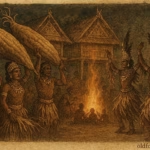
Famadihana, often translated as “the Turning of the Bones,” is one of Madagascar’s most revered ancestral rites. Rooted in the worldview of the Merina and other Highlands groups, the ritual affirms a foundational Malagasy belief: the dead do not vanish. Instead, they continue to accompany and guide the living, shaping fortune, fertility, and the cohesion of the family line. This practice goes beyond mourning or remembrance; it is a celebration of kinship, ancestry, and the cyclical connection between the living world and the realm of the razana, the honored dead.
Description of the Ritual
Famadihana is a secondary-burial ceremony, traditionally held every five to seven years, though timing varies by lineage, economic resources, and regional custom. Families gather from distant towns, ancestral villages, and urban centers, returning to the homeland where their ancestors rest in stone crypts called fasana. These crypts are not viewed as distant tombs but as living houses for the dead, places where the presence of the ancestors can be accessed and honored.
The ceremony begins with prayers, hymns, and offerings that announce the family’s arrival. Elders call the names of ancestors, acknowledging them one by one. Once blessings are requested, the crypt is carefully opened. Inside lie the wrapped remains of family members, preserved in multiple layers of shrouds known as lamba mena (silky red burial cloths) or lamba arindrano, depending on the lineage and local style.
Relatives gently lift the remains and carry them into the open air. The moment is solemn yet joyful. Musicians play highland drums, flutes, and the valiha, while women ululate and men chant ancestral praises. Fresh shrouds are unfurled, and each ancestor is rewrapped with tenderness and respect. Families speak directly to the deceased, updating them on births, marriages, disputes, and achievements since the last ceremony.
As the new shrouds settle around the remains, the celebration intensifies. Families dance with the wrapped ancestors, circling the courtyard or field while singing poetic genealogies. These songs recount the origins of the lineage, heroic acts of forebears, and the sacred land ties that bind them all together. The dance is not symbolic—it is believed to literally warm the ancestors, granting them joy and renewed vitality.
During the feast that follows, food is shared with the community and symbolically with the dead. Rice, Madagascar’s most sacred staple, takes center stage, alongside meat, rum, and offerings specific to the lineage’s tradition. By sunset, the ancestors are gently returned to the crypt, now wrapped anew and honored for the coming years. The crypt is resealed with blessings for prosperity, health, and protection.
Although modern life, Christian influence, public health policies, and changing economic conditions have altered when and how frequently the ritual is performed, Famadihana remains a powerful anchor of Malagasy cultural identity. Even families who cannot perform the full ceremony often contribute financially or visit crypts to maintain ancestral ties.
Mythic and Spiritual Connection
Famadihana is inseparable from Malagasy cosmology, which holds that ancestors, or razana, are intermediaries between the living and the divine. Life and death are not opposite states but parts of one continuous world. When a person dies, their spirit slowly transitions from the personal soul into the collective “ancestral essence,” a process believed to take years. Rewrapping the bones helps guide this transformation.
In traditional belief, ancestors influence weather, fertility, family harmony, and protection from misfortune. Without periodic renewal, the connection between realms weakens. Famadihana restores that connection, allowing the living to reaffirm gratitude, loyalty, and obedience, while the ancestors bless the lineage with stability and prosperity.
The ritual also expresses Madagascar’s deep respect for land and kinship. Ancestral graves mark a family’s rightful claim to territory. To gather around the crypt is to renew the relationship not only with the dead but with the homeland itself. Thus, Famadihana is a spiritual, social, and political act, woven into the very identity of highland Malagasy life.
Author’s Note
Famadihana stands as one of Madagascar’s most profound expressions of ancestral devotion. Rather than viewing the dead as distant, the ritual embodies a worldview where family bonds extend beyond time. The ceremony blends memory, celebration, and renewal, offering a vivid example of how Malagasy spirituality keeps the living and the ancestors in dialogue. It highlights a culture where honoring the dead is inseparable from sustaining the future of the family line.
Knowledge Check
1. What is Famadihana?
A Malagasy secondary-burial ritual where families exhume, rewrap, and celebrate their ancestors.
2. Which Malagasy groups most commonly practice it?
Primarily the Merina and other central Highlands communities.
3. Why are ancestors rewrapped in new shrouds?
To honor them, renew bonds, and aid their spiritual transition into the collective ancestor realm.
4. What role does dance play in the ritual?
It expresses joy, warms the ancestors, and recounts lineage histories.
5. How does Famadihana reinforce social identity?
By bringing extended families together, affirming land connections, and recounting genealogies.
6. What influences have changed the ritual in modern times?
Economic pressures, Christianity, public health regulations, and shifting burial laws.