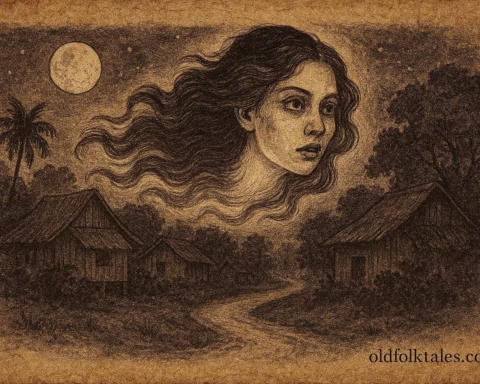
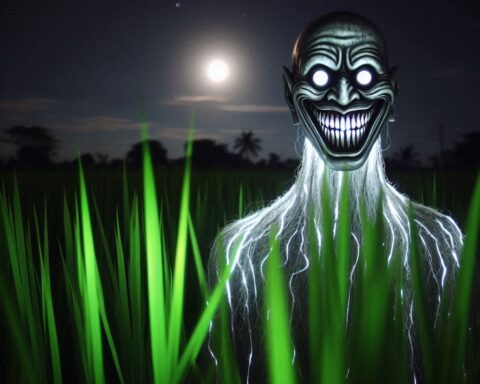
In the villages that curve around the marsh fields of Cambodia and Thailand, people speak in hushed voices about a spirit that glows like a drifting lantern. They call her the Krasue, a woman shaped only from the neck upward, her head floating freely in the night while her shimmering organs follow behind like a ghostly tail. Her presence is not like the shadows that dart behind bamboo fences or the owls that hoot from palm trees. Her glow is soft and fluid, and her movements are slow, as if she swims through the air.
Long ago, there lived a young woman named Chanthrea in a village near the Tonle Sap marsh. She was known for her beauty, but even more for her gentle voice and her talent for weaving. Yet beneath her calm presence lived a fear she kept from others. Her family had fallen into conflict, trust had been broken, and secrets filled the home like smoke. Whispers of deceit had begun to spread. People believed that such disorder attracted restless spirits.
One evening, a wandering spirit practitioner visited the village. He looked upon Chanthrea’s home and paused for a long moment. The air around it shivered. He warned the family that their quarrels had stirred the attention of something ancient. They dismissed him, saying they were simply going through difficult times and needed no spirit talk to burden their minds.
But the marshes had already noticed.
That same night, Chanthrea dreamt of a glowing figure outside her window. The figure was a woman, her hair long and floating as if underwater. Her eyes were full of sadness, not rage. Her head hovered above the ground, and behind her, organs glistened like jewels caught in moonlight. Chanthrea woke trembling but told no one. Dreams, she believed, were simply mirrors of worry.
Follow the paths of legendary warriors, kings, and demigods who defined ancient honor
The next evening, the villagers preparing rice in their homes felt a strange warmth moving through the night. It was not the heat of summer nor the breath of fire. Farmers who were late returning from the fields claimed they saw a floating light tracing the water edges. Some swore they heard a soft cry that was neither human nor animal.
As the nights passed, the light grew brighter. People began to avoid the marsh paths. Cattle refused to graze near the reeds. Children were brought indoors before the sun fully set. Fear sat among the people like an unwelcome guest.
One night, Chanthrea stepped quietly to the water to wash her weaving tools. The moon was high and still. As she bent to rinse the cloth, the surface of the water rippled without wind. A pale glow rose from the reeds.
The Krasue appeared.
Her face was sorrowful, not monstrous. Her hair drifted like black silk around her floating head. Her eyes held a deep longing, as if she searched for something she had lost. The organs that trailed behind her pulsed with faint light. She hovered only a few paces away.
Chanthrea froze. The Krasue did not approach her. Instead she circled slowly, as if reading the air around Chanthrea’s family home. The spirit’s glow reflected upon the water like a trembling lantern. Chanthrea felt no urge to run, for something about the spirit’s presence seemed mournful rather than violent.
The Krasue spoke without moving her lips. Her voice rose like a memory.
There is disorder in your home. There is betrayal left unspoken. There is pain that has not been confessed. Where such things grow, I appear.
Chanthrea fell to her knees. She understood then that the spirit was not hunting her but responding to something deeper. The spirit was a sign. A warning. A mirror of the moral fractures that had pulled her family apart.
The Krasue drifted closer to the marsh water, bathing the night in soft red light. Her eyes, filled with sorrow, seemed to ask a question Chanthrea could not answer. Then she faded into the reeds, leaving behind silence so deep it felt like another world.
The next morning, Chanthrea gathered her family. She spoke of hidden resentments, of wrongs that had never been admitted, and of wounds that had never been healed. Her voice trembled as she encouraged them to speak honestly, to restore the trust that had crumbled between them.
The conversations were painful, but they cleansed the home. For the first time in many months, the air felt lighter.
When night returned, the marshes were quiet. No glow drifted between the reeds. No strange warmth moved across the fields. The Krasue had vanished.
Villagers later said that the spirit appeared only where moral shadows grew. She was not merely a creature of fear but a sign that something had gone wrong in the hearts of people. When harmony returned, her sad glow faded from the world.
Chanthrea continued her weaving, her family healed, and the marsh fields breathed calmly once more. Yet on nights when mist rises and the wind falls silent, some still claim they see a faint light drifting across the water. They say it is the Krasue watching, waiting, and reminding people that deceit leaves a trail brighter than fire.
Author’s Note
This story reflects Southeast Asian beliefs in spirits that respond to moral disorder rather than random cruelty. The Krasue is feared but also understood as a symbol of the consequences that arise when trust and purity are broken.
Knowledge Check
-
What form does the Krasue take at night?
She appears as a floating female head with trailing organs. -
Why does the Krasue approach Chanthrea’s village?
She is drawn to the moral disorder within the household. -
How do the villagers react to the glowing presence near the marsh?
They become fearful and avoid the marsh paths at night. -
What does Chanthrea realize during her encounter with the spirit?
She realizes the spirit reflects the broken harmony within her family. -
What happens after the family resolves their conflicts?
The Krasue no longer appears in the marshes. -
What does the Krasue symbolize in the story?
She symbolizes the consequences of deceit and moral imbalance.