In the vast cosmos of Hindu mythology, Garuda, whose name derives from the Sanskrit root gṛ (“to swallow” or “devour”), soars above as the king of birds, the mount (vāhana) of Lord Viṣṇu, and the eternal enemy of the Nāgas, the serpent race.
The Mahābhārata describes his birth as both miraculous and catastrophic: a radiant bird hatched from a colossal egg laid by Vinata, the wife of the sage Kaśyapa, whose second wife Kadrū gave birth to the serpents. When Vinata was tricked into servitude by her sister, Garuda vowed to free her. The text recounts that “Garuda sprang forth as a mighty bird sworn to free his mother; he devoured serpents and sought the Amṛta.” (Mahābhārata I.29, paraphrased from Ganguli trans.).
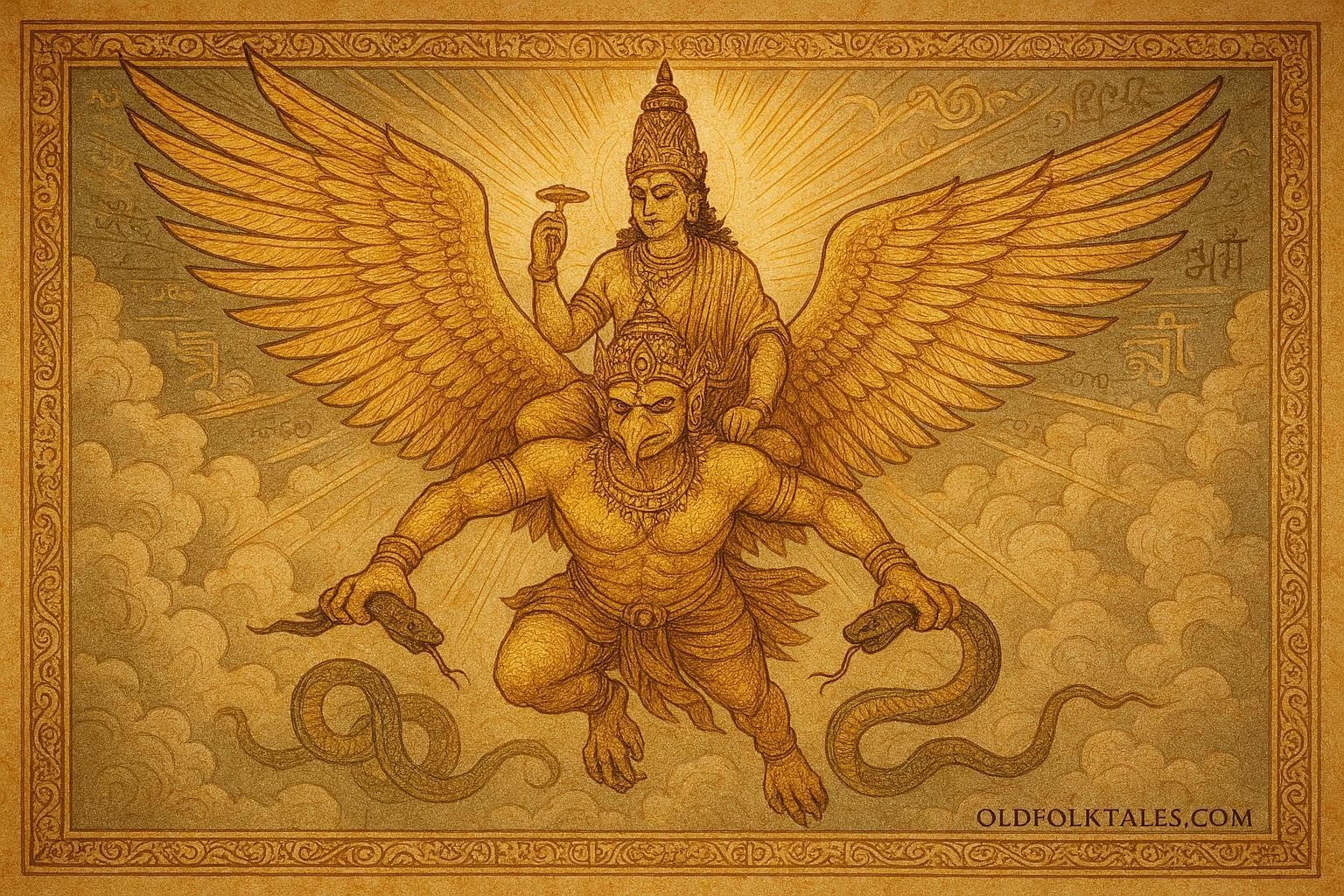
Garuda’s appearance is awe-inspiring and divine: his body blazes like a thousand suns, his golden feathers shimmer with fire, and his face radiates majesty. He possesses the strength of the storm, the swiftness of lightning, and the clarity of celestial vision. His vast wings create thunder when he takes flight; his eyes burn with the heat of the sun, striking terror into evil spirits and serpents alike. In many depictions he has a human torso with wings and an eagle’s beak, sometimes with four arms, two holding serpents, others bearing weapons or folded in devotion to Viṣṇu.
He is simultaneously warrior and devotee: an unflinching defender of dharma yet utterly devoted to his divine master. Garuda’s energy and might symbolize divine speed, the force by which Viṣṇu traverses the three worlds.
Myth and Narrative
The Garuda cycle in the Mahābhārata unfolds as an allegory of bondage and liberation.
When Garuda learned of his mother’s enslavement to Kadrū, he vowed to obtain the Amṛta, the nectar of immortality, as ransom. His quest led him through cosmic realms: past the blazing sun, across oceans of fire, and into the heavens guarded by gods. Along his journey he devoured serpents to sustain himself hence his enmity with their race.
The gods, fearing his power, sought to stop him, but Viṣṇu himself appeared and, admiring the bird’s courage, granted him immortality even before he obtained the nectar. Garuda, in gratitude, agreed to serve Viṣṇu eternally as his mount. When he finally seized the Amṛta from Indra’s heaven, he did not drink it but offered it honorably to the Nāgas to free his mother. Indra then reclaimed the nectar, and the serpents, licking its remnants from the grass, split their tongues, explaining, mythically, why snakes have forked tongues.
In later Purāṇas, Garuda becomes a cosmic figure: he holds up the heavens, guards the directions, and serves as the standard on Viṣṇu’s banner. The Garuda Purāṇa, named after him, deals with eschatology and the journey of the soul, signifying his role as a psychopomp, guiding spirits through cosmic thresholds.
Powers and Attributes
Garuda embodies speed, radiance, and spiritual freedom. His wings generate hurricane winds that clear away darkness; his mere shadow is said to neutralize poison. Devotees invoke him in rituals against snakebite, and charms bearing his image are used to protect from venom and treachery.
He is also described as amṛta-sāra, “essence of immortality”, since his devotion to Viṣṇu transcends death. Garuda’s primary weapon is his beak and talons, but his true power is moral: the undaunted will to free others from bondage.
Symbolically, Garuda represents the liberated soul (ātman), unfettered by material chains, soaring beyond ignorance. The Nāgas, in contrast, symbolize attachment and hidden knowledge; their subjugation by Garuda signifies the triumph of pure spiritual energy over base instinct.
Cultural Role and Symbolism
Across Hindu, Buddhist, and Southeast Asian traditions, Garuda’s image radiates sacred meaning.
1. In Hinduism
Garuda is Viṣṇu’s eternal companion and banner. Temples dedicated to Viṣṇu often feature Garuda stambhas, tall pillars topped with his image, facing the sanctum. Devotees recite the Garuda Mantra for protection against poison and fear. His story also emphasizes filial devotion, his quest to free Vinata is a model of matṛ-bhakti (love of the mother).
2. In Buddhism
Adopted into Buddhist cosmology, Garuḍas appear as semi-divine bird-beings, enemies of Nāgas but protectors of the Dharma. In Tibetan art they represent the power of insight that destroys deceit and illusion.
3. In Southeast Asia
Garuda became a national and royal emblem:
– In Indonesia, the state symbol Garuda Pancasila depicts him as a guardian of unity and justice.
– In Thailand, he is Krut (ครุฑ), emblem of kingship and protector of the realm.
– In Cambodia, Preah Kreut adorns Angkor temples as a heraldic deity gripping serpents.
This diffusion shows how deeply the myth transcended its Indian origin, transforming Garuda into a pan-Asian emblem of divine authority and moral clarity.
Moral and Philosophical Meaning
The story of Garuda teaches freedom through righteousness. His strength is not born of pride but of purpose: he fights for love, not domination. The serpents represent deceit and attachment; Garuda’s conquest of them symbolizes liberation from ignorance.
His flight is the soul’s ascent toward enlightenment, the eternal journey from bondage (Vinata’s servitude) to freedom (service to Viṣṇu). His oath to serve after gaining power reflects the Hindu ideal of bhakti (devotion), that true liberation culminates not in isolation but in service to the divine.
Encounter dragons, spirits, and beasts that roamed the myths of every civilization
Author’s Note
Among the grand pantheon of Hindu mythic beings, Garuda stands apart for embodying both might and humility. As researcher and storyteller, I find his myth a profound statement on the ethics of power: that the highest strength lies in compassion, and the swiftest flight is that of the heart unburdened.
Reading Ganguli’s Victorian prose today, one senses awe at the myth’s moral gravity. Garuda’s luminous wings carry not only Viṣṇu but also an enduring human aspiration, to rise beyond fear, to act out of love, and to serve a truth greater than oneself.
Knowledge Check (Q & A)
- Who are Garuda’s parents according to the epics?
Garuda was born to Vinata and the sage Kaśyapa, making him half-brother to the serpent race born of Kadrū. - What motivates Garuda’s quest for the Amṛta?
He seeks the nectar of immortality to ransom his mother from servitude to Kadrū and the Nāgas. - How does Garuda become Viṣṇu’s mount?
After witnessing his valor, Viṣṇu grants him immortality, and Garuda voluntarily becomes his vehicle in gratitude. - Why are snakes considered his eternal enemies?
Because the Nāgas enslaved his mother and became his prey during his quest; symbolically, they represent ignorance subdued by wisdom. - What does Garuda symbolize spiritually?
He represents liberation, speed, divine strength, and the soaring soul freed from material bondage. - Name one Southeast Asian nation where Garuda is a state emblem.
Indonesia, where Garuda Pancasila serves as the national symbol of unity and strength.
Source: Mahābhārata (Ganguli translation, public domain); Garuda Purāṇa and Vishnu Purāṇa (various translations)
Cultural Origin: India — Vedic to classical Hindu tradition, later Southeast Asian diffusion (Indonesia, Cambodia, Thailand)