Hecate (Greek: Ἑκάτη, Hekátē) is the enigmatic Greek goddess of crossroads, night-wandering spirits, witchcraft, and liminality, the sacred “in-between” spaces where worlds overlap. In early Greek tradition, she is a unique power: honored by Zeus above all others, granted authority over earth, sea, and sky, and revered as a guardian of households. Later, she becomes the torch-bearing guide of souls, a chthonic presence standing at the threshold between mortal life and the unseen realm.
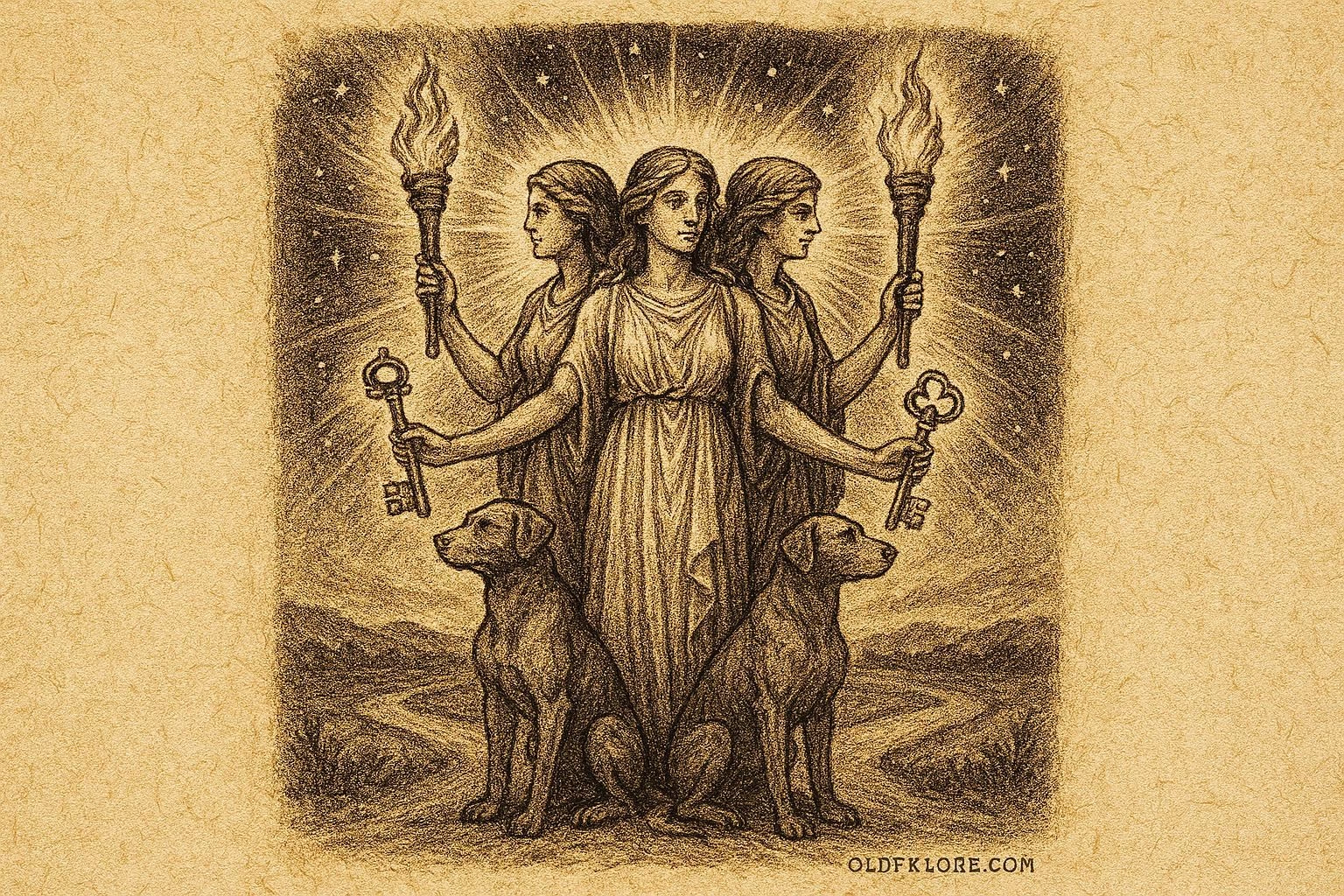
Symbols associated with Hecate include torches, keys, daggers, dogs, especially the howling night hounds that accompany her, and the triple-formed image representing her dominion over transitions and diverging paths. Shrines known as Hekataia were placed at crossroads and doorways, and offerings of food (deipna) were left for her on the dark moon.
Hecate appears across classical texts, from Hesiod’s Theogony (where she is richly praised) to magical papyri and inscriptions, marking her as both a protector and a figure invoked by those seeking divination, guidance, or the binding power of spells.
Mythic Story: The Night of the Crossroads
The moon had not yet risen when the villagers shuttered their homes and barred their doors. Only the wind moved through the olive groves, whispering through branches like fingers brushing ancient memory. It was the night of the dark moon, the night of Hecate.
At the edge of the village, where three roads met beneath a leaning ash tree, an old woman named Phileia approached with cautious steps. In her arms she carried a small clay bowl: bread soaked in honey, a cut of fish, and a handful of figs. Her grandmother had taught her long ago that such offerings must never be eaten the next morning, for they belonged not to mortal hands, but to “She-Who-Guides-in-Darkness.”
Phileia set the bowl down, bowed her head, and whispered the rites.
“Lady of the wayfarer… Keeper of the threshold… Torch-bearer of the night… Stand beside me.”
The wind stilled.
Then, a soft hum, like the low cry of distant dogs—rose along the road. Phileia’s breath caught. The air thickened. The crossroads, moments ago plain and silent, now felt layered, shifting, as though it extended into more than three paths: a dozen unseen avenues opening into shadow.
A pale flame flickered at the edge of the darkness. Then another. And another.
They were torches.
From the blackness between the roads stepped three figures, yet they were one. Hecate emerged in her ancient, triple-formed nature, each face turned toward a different road, each gaze watching a different future. One held a torch that burned without smoke. Another carried a blade that seemed forged from moonlight itself. The third bore a great key, silver-bright and ancient as the first dawn.
All three regarded Phileia.
Fear washed over the woman, but reverence steadied her. She had not come for herself tonight, but for her daughter, Myrine, who lay sick with a fever no healer could name. The old stories said: when a path is blocked, seek the goddess who stands where paths divide.
Phileia knelt.
“Lady Hecate… my child is slipping from me.”
The torch-bearing face inclined, expression unreadable.
“When mortals come to the crossroads,” Hecate’s voice drifted like wind through hollow stone, “they come seeking either guidance… or a price.”
Phileia bowed lower, heart trembling. “I ask only for your light.”
Hecate extended her torch. Its flame shimmered gold, then deepened into a glowing violet. The light illuminated the three roads, one straight, one winding into hills, and one descending into forest. Yet beneath the glow, Phileia suddenly saw more: faint silhouettes of paths no mortal eye was meant to perceive. Paths that led into shadowed realms, shimmering veils, and places where silence held its own echo.
“You stand,” Hecate said, “where every choice touches another world.”
The goddess circled the bowl of offerings. Dogs’ shadows slinked at her feet, though no animal could be seen. With a motion of her torch, the food darkened, dissolving into mist as it was taken into the unseen.
Then Hecate lifted the silver key.
“This opens the door between breath and spirit,” she said. “But the opening lasts only as long as the flame burns.”
Phileia felt warmth settle into her chest, hope, fragile and bright.
The goddess gestured. “Rise.”
As Phileia stood, Hecate touched the torch to the ground. A tremor passed through the earth. The road beneath them briefly gleamed like polished obsidian, reflecting not the night sky, but the image of a sleeping child, as if Myrine lay upon the surface of a still, dark pool.
Phileia gasped.
“My daughter…”
The reflection flickered. Shadows swirled around it, shapes of wandering spirits and untold destinies. Hecate raised the blade of moonlight, and with a single precise stroke, cut the shadows away from the child’s form.
The darkness retreated.
The reflected Myrine breathed more deeply, her fever-light dimming.
Phileia, tears falling freely, whispered, “Blessed Lady… how can I repay?”
Hecate lowered her three gazes, each expression solemn but not unkind.
“Remember this: every healing carries a crossroads. In saving one path, another changes. Walk wisely.”
With that, the goddess stepped back. The torches guttered into sparks. The key’s shine dimmed. Dog-shadows scattered into smoke. Hecate’s three forms dissolved into the dark roads, absorbed by night’s veil.
The crossroads returned to silence.
Phileia stood alone beneath the ash tree, yet she felt newly whole. She understood: the goddess of thresholds had not merely healed her child; she had granted her the burden and blessing of choice.
At dawn, Phileia rushed home. Myrine lay sleeping peacefully, color restored to her cheeks. And though the girl would never know the path that had been cut away for her, a faint scent of torchlight lingered in the air, warm, distant, and divine.
Learn the ancient stories behind deities of light, storm, and shadow from cultures across the world
Author’s Note
Hecate’s myth reminds us that every transition, every choice, holds unseen depths. She teaches that guidance often comes not as certainty, but illumination: a torch that reveals the path only as we dare to walk it. In reverence for liminality, she embodies the truth that thresholds are sacred, for they shape the destinies that unfold beyond them.
Knowledge Check
Q1: What domains does Hecate preside over?
A: Crossroads, witchcraft, night, spirits, and liminal thresholds.
Q2: What are Hecate’s primary symbols?
A: Torches, keys, daggers, and dogs.
Q3: Where were Hecate’s shrines commonly placed?
A: Doorways and three-way crossroads.
Q4: Which primary text praises Hecate’s authority?
A: Hesiod’s Theogony.
Q5: What ritual offering was associated with her?
A: The dark-moon Hecate’s Supper (deipnon).
Q6: What core theme does the myth illustrate?
A: The sacred power of choice and the guidance found at life’s thresholds.
Source: Greek Mythology, Greece.
Source Origin: Greece