
Before the rivers carved their winding roads through the northern forests, before the great pines whispered the names of the nations, a child was born beneath a sky veiled in aurora fire. His mother, they say, heard the wind speak before his birth: “A voice of peace shall rise from your line.” Thus was Hiawatha marked with divine purpose, his spirit touched by the unseen forces that guard the Haudenosaunee world.
But destiny seldom reveals itself gently.
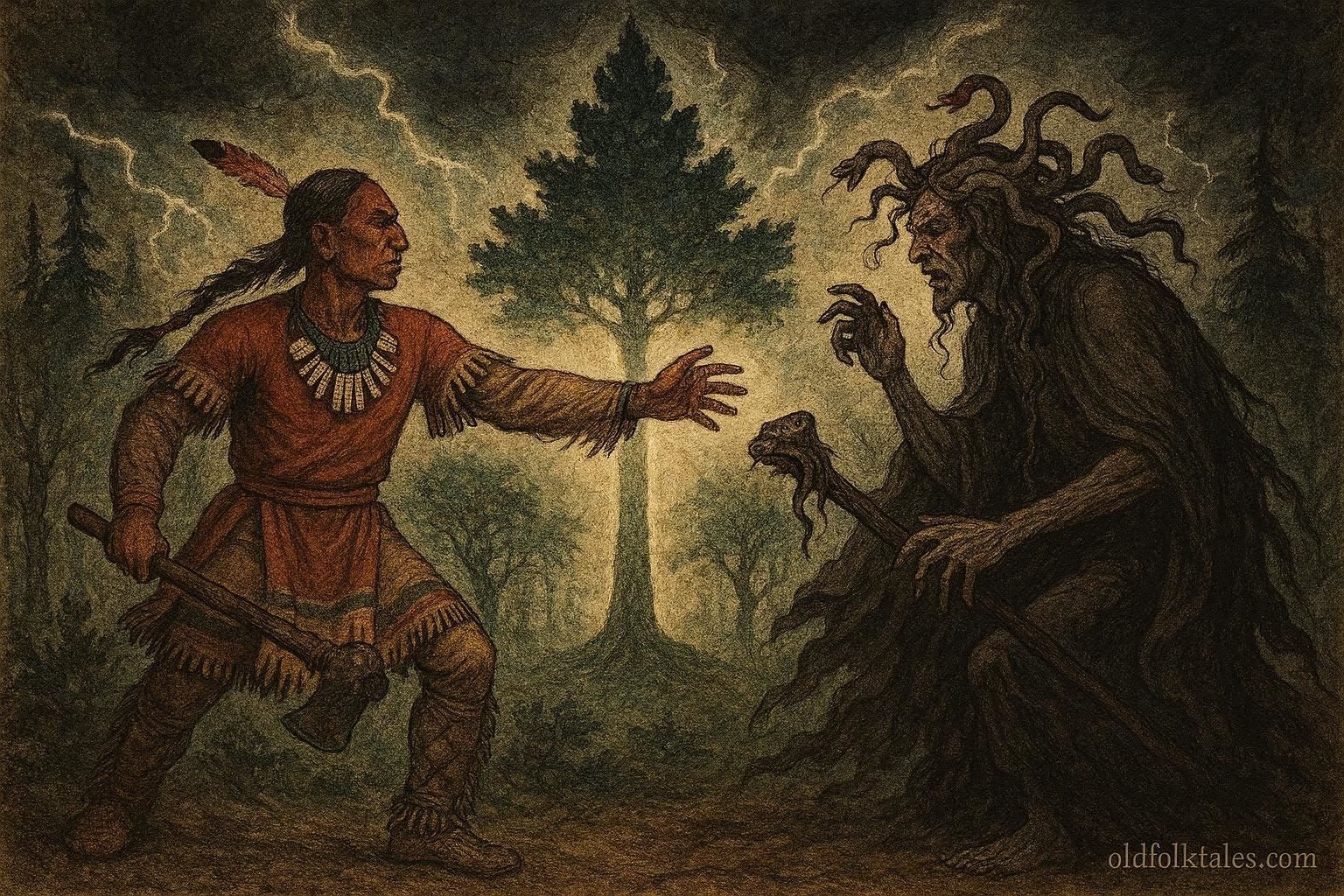
Hiawatha grew into a man of great wisdom and fierce loyalty. Though he possessed a healer’s hands and a visionary’s eyes, he lived in a time when blood stained the earth. Among the nations, the Mohawk, Oneida, Onondaga, Cayuga, and Seneca, vengeance spiraled like a storm that would not end. Warriors raided, children wept, and councils fell into discord. None suffered so grievously as Hiawatha, for the sorcerer-tyrant Tadodaho, twisted of mind and body, his hair writhing like serpents, brought ruin upon all who sought peace.
When Tadodaho’s wrath fell upon Hiawatha’s home, his family perished. Sunlight dimmed in his eyes, and the voice of creation grew silent. In grief, Hiawatha wandered the forests alone, his tears falling into the lakes like pale stones. For moons upon moons he drifted, sheltering beneath thunder-shaken skies, asking the spirits why they had marked him for such sorrow.
One morning, as dawn poured gold upon the water, a strange canoe of shining white stone glided toward him. In it sat a man of serene presence, dressed in garments of pure weave, his face radiant with calm. He named himself the Great Peacemaker, a divine messenger sent to restore harmony to the world.
“Hiawatha,” he said, “your suffering has carved a path within you. Walk it not toward revenge, but toward union. Let your voice be the one that binds nations.”
“But my heart is broken,” Hiawatha whispered.
“All sacred work is done by those who have learned the weight of pain.”
Thus began Hiawatha’s rebirth.
The Peacemaker taught him the Power of the Good Mind: the path of reason over wrath, compassion over conquest, unity over chaos. Hiawatha learned to speak so that anger dissolved like ice under sunlight, and to listen until every voice found its rightful place. Together, they traveled from nation to nation, calling for an end to bloodshed.
At first, many warriors scoffed. “Peace is the dream of children,” they said. But when Hiawatha spoke, his words moved like the steady flow of a river that wears down even the hardest stone. Elders felt the old wounds inside them ease. Chiefs found their tempers steady. Mothers felt fear loosen its grip.
Yet one final obstacle shadowed their mission: Tadodaho, the war-lord of the Onondaga, whose power rested on terror and chaos. To bring peace to the land, they would have to face him.
Across marshland and hills they traveled, until they reached the place where the air itself seemed to shudder. There, upon a blackened mound, sat Tadodaho, his body contorted, his hair alive with serpents, his voice a rasp of storm and poison.
“Leave,” Tadodaho snarled, “or be broken.”
The Peacemaker did not flinch. “We have not come to break you,” he said softly. “We have come to heal you.”
Tadodaho laughed, a sound like splintering bone.
But Hiawatha stepped forward. His fear hammered in his chest like a drum, but he remembered the lessons of the Good Mind. He began to sing, not a war cry, but a song of condolence, a song to lift grief from the heart. The words flowed like clear water, washing over the battlefield of long-held sorrow.
As he sang, the Peacemaker gently smoothed Tadodaho’s twisted limbs, and Hiawatha combed serpents from his hair. With each serpent removed, a cry escaped Tadodaho, not of rage, but of anguish long buried. At last he trembled, exhausted, his eyes stripped of malice.
“What do you offer me?” Tadodaho whispered.
“Not your defeat,” said Hiawatha. “Your transformation. Sit with us in council. Become the guardian of this new union.”
And so the old tyrant became the first Firekeeper, the watcher of peace rather than war.
On a sacred hill, the Peacemaker, Hiawatha, Tadodaho, and the chiefs of the Five Nations planted the Tree of Peace. Its white roots stretched in four directions, inviting all who sought refuge to take shelter beneath its branches. An eagle perched at its summit, its fierce gaze ever watchful for the approach of danger.
Hiawatha stood before the gathered peoples. “Let our minds be of one mind. Let our words be woven as one cord. Let the generations rise knowing peace as their inheritance.”
The nations answered in one voice, and the Great Law of Peace was born.
And though the Peacemaker departed across the waters in his stone canoe, Hiawatha remained, his heart healed, his purpose fulfilled. From that day forward, the land breathed differently. The winds carried fewer cries of vengeance and more songs of unity.
Hiawatha’s name became the pulse of harmony, his journey a map for all who walk the hard but sacred path of forgiveness.
AUTHOR’S NOTE
Hiawatha is not merely a figure of legend but a symbol of the Haudenosaunee world’s greatest achievement: the establishment of the Iroquois Confederacy, one of the oldest participatory democracies on Earth. His epic reminds us that peace is not born of ease but of courage, sacrifice, and a mind disciplined toward harmony. Through his transformation of Tadodaho and his guidance of the Five Nations, Hiawatha embodies the power of moral clarity and compassionate leadership.
KNOWLEDGE CHECK
-
What divine sign marked Hiawatha’s origin?
-
What great tragedy set him on his path of wandering?
-
Who arrived in the stone canoe, and what did he teach Hiawatha?
-
Why was Tadodaho the final obstacle to peace?
-
What symbolic act created the union of the Five Nations?
-
What is the lasting legacy of Hiawatha in the Haudenosaunee world?
CULTURAL ORIGIN: Haudenosaunee (Iroquois) oral epic tradition, northeastern North America.
SOURCE: Arthur C. Parker, The Constitution of the Five Nations (1916).









