Among the great epic traditions of the Western Sahel, the monster known as Hira stands as one of the most fearsome beings in the repertoire of Songhai oral storytellers. Rooted in the pre-Islamic heroic cycles once performed by griots along the Niger River, Hira embodies the primal power of the wilderness, raw strength, cunning intelligence, and the chaotic potential of nature when it clashes with human society. Though the details vary across regions, the creature consistently appears as an enormous, supernatural buffalo-like beast, capable of shattering trees, overturning warriors, and even outwitting or transforming itself to deceive heroes.
Form and Appearance
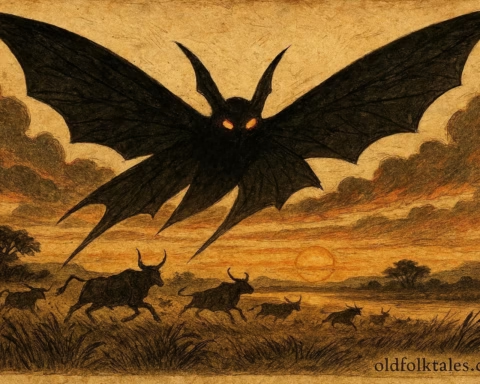
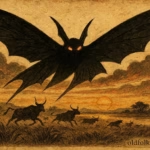
Hira’s primary form is that of a massive buffalo, larger than any animal known in the Sahel. Its hide is said to shimmer black-blue like storm clouds, and its horns curve outward like polished crescents capable of tearing through shields and armored riders. In some recitations, griots describe Hira’s hooves as sparking fire when they strike the earth, symbolizing its supernatural origins.
Relive the heroic sagas of every age – stories of triumph, tragedy, and timeless valor
But Hira is not simply a beast. As a creature of myth, it possesses the ability to shift appearances. This is especially evident in a famous variant where a female Hira assumes the shape of a calm and gentle elephant, a form culturally associated with nobility and wisdom. By disguising herself, she escapes a male Hira’s pursuit and later manipulates the unfolding story. This motif of deception and counter-deception shows that Hira belongs not only to the world of monstrous strength but also to roles that require intelligence and shape-changing craft.
Powers and Abilities
Hira is not merely a strong animal, it bears nearly elemental force. Storytellers highlight several key abilities:
- Unmatched physical power: Hira can uproot trees, scatter soldiers, and endure spear thrusts. Its skin is sometimes said to be as tough as enchanted leather.
- Shape-shifting: The creature may become other animals, especially elephants, or take on altered forms to trick heroes.
- Spiritual presence: Some versions suggest Hira is tied to river spirits, land guardians, or ancient wilderness forces that predate the Songhai Empire.
- Buffalo rage: When enraged, Hira becomes “a walking storm,” according to some griots, so unstoppable that only the greatest culture-heroes dare challenge it.
Behavior and Narrative Function
In the Songhai tradition, the epic hero Moussa Gname (sometimes spelled Moussa Gne or Moussa Guindo) is the figure most closely tied to Hira. The central conflict pits human order against wild, supernatural danger. Moussa, representing community, courage, and moral order, must defeat Hira to protect his people and prove his heroic status.
Hira plays a classic role in West African epic structure:
the trial that defines the hero.
Its behavior mirrors figures like the buffalo-monsters in Mande religion or the great forest beasts in Fulani myth:
- It tests the hero’s bravery.
- It forces the hero to seek guidance from elders, seers, or spirit allies.
- It represents chaotic nature, whose defeat or taming signals the rise of civilization.
Yet Hira is not always portrayed as evil. In some performances, Hira guards sacred places; in others, it disrupts human life not out of malice but because humans have encroached upon land once ruled by spirits.
Myths and Stories
The Battle with Moussa Gname
In the most widespread tale, Hira terrorizes a region of the Sahel, destroying fields and threatening caravans. Moussa Gname is called upon to face the monster. His preparation includes ritual purification, consultations with elders, and sometimes the acquisition of a magical charm. The battle is long and fierce. Moussa must learn the buffalo’s rhythms, its charging patterns, its moments of vulnerability. Ultimately, he defeats Hira, restoring order and ensuring the safety of the land.
The Female Hira as Elephant
Another fascinating tale involves a female Hira who escapes the male Hira’s violence by transforming into an elephant. Her ability to deceive him and overturn expectations introduces themes of gendered intelligence, protection, and the subtle power of the feminine. In some tellings, she outwits the male Hira entirely, ensuring her own safety while demonstrating the dangerous unpredictability of shape-shifting spirits.
This story also highlights the symbolic complexity of Hira. It is a monster, yes, but also a metaphor for survival, adaptation, and the hidden wisdom embedded in nature.
Cultural Role and Symbolism
Within Songhai cosmology, Hira symbolizes several interconnected concepts:
- Untamed Wilderness: Hira is the embodiment of the wild landscapes surrounding the Niger River: deep forests, hidden watering holes, and animal migration paths. It reminds listeners that the land is powerful and must be respected.
- The Trial of the Hero: Hira functions as the great obstacle that shapes a hero’s destiny. To defeat it is to earn legitimacy and leadership.
- Balance Between Humans and Nature: The creature’s destruction often arises when humans disturb the natural order. Its defeat marks the reestablishment of balance, not absolute dominance over nature, but a restoration of boundaries.
- Feminine Wisdom and Survival (female Hira variant): The story of the elephant-disguise highlights themes of strategic intelligence and resilience.
- Cultural Memory of Buffalo Hunting: The buffalo, once central to many West African societies, embodied strength, danger, and prestige. Hira expands this real-world symbolism into supernatural scale.
Author’s Note
Hira is one of those mythical beings whose details differ widely depending on the griot, the region, and the audience. While the monster appears in modern summaries (including Wikipedia), its deeper roots lie in the living oral tradition of the Songhai, where storytellers shape each performance to fit cultural needs, teaching respect for nature, courage, humility, and the cunning necessary to navigate life in the Sahel.
Knowledge Check
- What creature is Hira primarily depicted as?
A supernatural buffalo-like monster of enormous size and strength. - Which hero is most associated with defeating Hira?
Moussa Gname, a major figure in the Songhai epic cycle. - What symbolic role does Hira play?
It represents untamed wilderness, the challenges of the hero, and the boundary between humans and nature. - Can Hira change shape?
Yes—especially in tales where a female Hira becomes an elephant. - Is Hira purely evil?
No. It may act out of wild instinct or territoriality rather than malice. - What cultural lesson does the Moussa–Hira story teach?
Courage, balance with nature, and the idea that leadership is earned through trials.
Source: Songhai oral epic tradition; early ethnographic summaries; modern transcriptions
Origin: Western Sahel (Niger River / Mali–Niger region)