Before time was measured, when darkness reigned unbroken over the heavens, Coatlicue, the Great Serpent Skirted Mother, and her son Huitzilopochtli dwelt upon the Sacred Mountain of Coatepec. She was the womb of worlds, the one who spun suns from her blood and stars from her tears. Her temple was crowned with clouds, and her heart pulsed with the rhythm of creation and decay.
One day, as Coatlicue swept the temple floor, a miracle occurred. From the heavens descended a ball of hummingbird feathers, shimmering blue and gold. When she tucked it into her bosom, it vanished, and within her womb, life quickened. The gods trembled, for they knew no mortal man had touched her. The stars above, the mighty Centzon Huitznahuas, her four hundred sons, were enraged. Their sister, the fierce Coyolxauhqui, Moon-Maiden of silver fire, fanned their fury.
“Mother has shamed us!” she cried. “She carries an unknown child, a serpent seed. Let us strike her down before she births dishonor upon the heavens!”
So the stars conspired with the Moon. In glittering armor of starlight, they gathered upon Coatepec to destroy their mother and the unborn god within her. But Coatlicue, weeping and afraid, heard whispers in her womb. The voice of her child spoke, calm and radiant.
“Fear not, Mother. I, Huitzilopochtli, your son of the South, am ready. I am the fire that conquers darkness. I am the Sun yet unrisen.”
And so came the dawn of battle before the first dawn ever was.
Coyolxauhqui led her brothers up the sacred mountain, their weapons blazing like meteors. The sky roared, the wind shrieked through the serpent rocks, and the earth shuddered beneath the march of the stars. As they reached the summit, Coatlicue knelt in sorrow, clutching her swollen belly.
Then, light exploded from her womb.
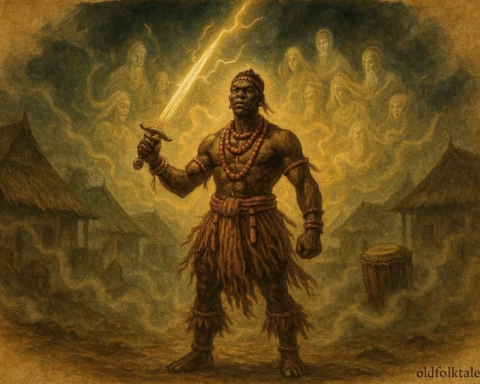
Huitzilopochtli was born not as an infant but as a warrior fully grown, his skin gleaming with gold, his face painted with the blue of the sky and the black of night. In his hand he bore the xiuhcoatl, the serpent of fire, and upon his back shimmered feathers of the sacred hummingbird, symbol of ceaseless motion.
“Mother,” he said, his voice a thunderclap across the void, “your tears shall be avenged. The sun shall rise.”
He turned upon his siblings, who had come to slay their mother. Coyolxauhqui stood foremost, her moonlit armor bright with pride. “Brother,” she said, “you are born of shame and deceit. Step aside, or be consumed by your arrogance.”
But Huitzilopochtli only lifted his burning serpent weapon. “Sister, you are the shadow of night, and I am the light that must end you.”
The battle that followed split the heavens. Fire and starlight clashed in storms of molten color. Huitzilopochtli’s serpent blazed across the sky, cutting through the ranks of the four hundred star-brothers. One by one they fell, their light dimming into the distant night, cast forever into the firmament as wandering stars.
At last he met Coyolxauhqui upon the peak. Her laughter echoed coldly as she hurled her silver blades, crescent-shaped and deadly. They carved sparks from his armor but could not pierce his flame. With a cry that shook the cosmos, Huitzilopochtli struck her down. Her radiant body fell, tumbling down the mountain, her limbs scattering across the stones.
Thus was born the eternal pattern of heaven: the Sun’s triumph over the Moon and stars, the day’s victory over night.
Yet though victorious, Huitzilopochtli felt no joy. His heart, bright as fire, pulsed with sorrow for the kin he had slain. “Was this my purpose?” he asked the silent sky. “To shine only by the blood of my own?”
From the shadows came Coatlicue’s voice, gentle as the wind. “All creation is born of sacrifice, my son. To bring forth light, darkness must yield. To keep the sun alive, hearts must feed it, and blood must flow as rivers back to heaven.”
Huitzilopochtli bowed his head. “Then let it be so. I shall rise each day, conquering darkness anew, but never without the gift of life returned to me.”
Thus began the sacred covenant between gods and men. The Mexica, children of the sun, built great temples and offered their own blood in gratitude and duty, so that Huitzilopochtli might rise each dawn and carry the light through the heavens. In the flaming circle of the sun they saw his face; in the beating of their hearts, his eternal fire.
And still, each evening, as the sun sinks into the western underworld, he descends to battle his fallen siblings again. Coyolxauhqui’s dismembered form glows as the moon, chasing him across the night sky. The stars, the Centzon Huitznahuas, gather to strike, but every dawn he is reborn, radiant, relentless, his serpent weapon blazing anew.
For as long as men remember to honor the balance of life and death, Huitzilopochtli’s fire shall burn, and the world shall see another sunrise.
Author’s Note
The tale of Huitzilopochtli is the Mexica vision of cosmic order, a reminder that existence itself is a cycle of sacrifice and renewal. His war against the Moon and stars is not mere violence but the eternal struggle of creation against oblivion. The Mexica saw themselves as warriors in this same cosmic drama, feeding the sun with their courage and offerings so that life could continue.
Huitzilopochtli’s moral struggle, the sorrow of necessary destruction, reveals the tragic wisdom of the Aztec worldview: that life demands balance, and light is never free from the price of shadow. To honor him was to accept that all power carries the burden of sacrifice.
Knowledge Check
-
Who was Coatlicue, and what miraculous event led to Huitzilopochtli’s conception?
-
Why did Coyolxauhqui and her brothers decide to attack their mother?
-
What weapon did Huitzilopochtli wield when he was born?
-
What cosmic order was established by Huitzilopochtli’s victory over Coyolxauhqui?
-
What moral or spiritual lesson does Huitzilopochtli’s story teach about creation and sacrifice?
-
How does the daily journey of the sun reflect Huitzilopochtli’s eternal struggle?
Cultural Origin: Mexica (Aztec)
Source: Codex Florentine; Historia de los Mexicanos por sus Pinturas; Bernardino de Sahagún, Florentine Codex, Book 3 (16th century)