Elegant, elusive, and enchantingly ambiguous, the Huli-jing (狐狸精) is one of the most enduring spirits of the Chinese imagination. In its simplest form, it is a fox capable of transforming into a human, most often a beautiful woman. Yet beneath this simple disguise lies a creature that moves between worlds, animal and divine, lust and virtue, illusion and enlightenment.
Ancient references in Han dynasty inscriptions already mention “foxes that live a thousand years and become human.” Daoist writings expanded this, teaching that any creature capable of deep cultivation might attain spirit form and even immortality. The fox, quick and nocturnal, symbolized yin energy, secrecy, and sensuality, all traits that made it an ideal liminal being.
Relive the heroic sagas of every age – stories of triumph, tragedy, and timeless valor
By the Tang dynasty (7th–9th centuries), fox spirits appeared in poetry and anecdotal collections, sometimes as bewitching temptresses, sometimes as faithful lovers or spirit-wives. Pu Songling (蒲松齡, 1640–1715) gathered centuries of such tales into his Liaozhai zhiyi (Strange Tales from a Chinese Studio). His fox women could deceive, heal, seduce, or redeem, each story a parable of human weakness and transcendence.
Quoted excerpt:
“A fox in human shape lay in a maiden’s bed, and the family discovered an old tail.”, Pu Songling, Liaozhai zhiyi (trans. Herbert A. Giles, 1880)
In Pu Songling’s hands, the huli-jing transcends simple demonology. The fox may fall in love with a mortal scholar, live as a virtuous wife, and then vanish into mist when discovered, leaving behind only the scent of orchids or a tuft of fur. Some become protective household spirits, ensuring wealth and fertility; others, when angered or wronged, bring misfortune.
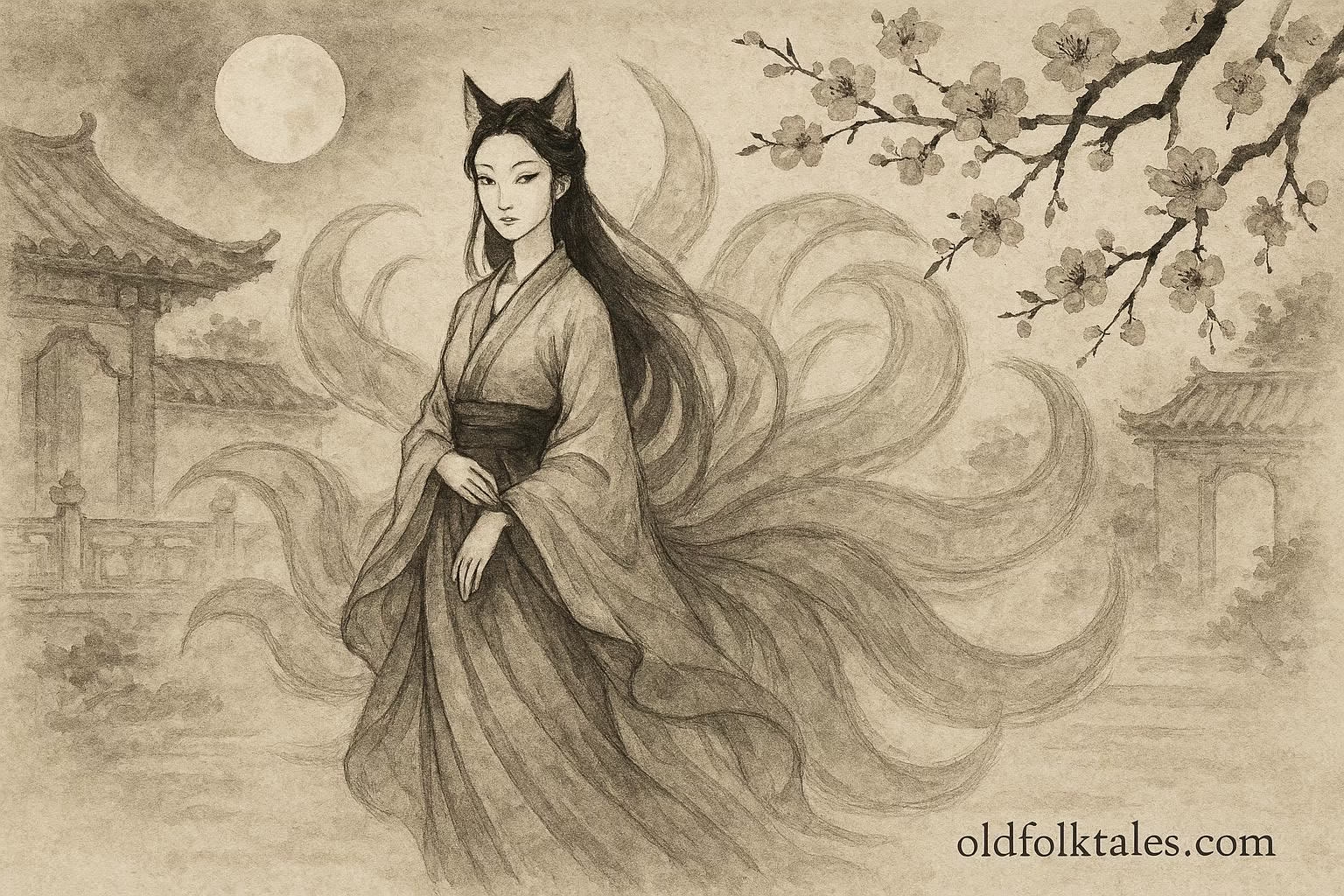
Descriptions vary: at night, an old fox might reveal glowing eyes and a flicking tail; by day, she appears as a refined young woman in pale robes. Certain legends speak of nine-tailed foxes (jiuweihu, 九尾狐), supreme among their kind, echoing older mythic motifs from the Shan Hai Jing (“Classic of Mountains and Seas”).
Daoist cosmology teaches that foxes, through long life and meditation, acquire the ability to shift form and absorb human essence. Yet unlike ghosts, they are living beings, spirits of longevity and cunning rather than death. The huli-jing’s power rests on qi manipulation and illusion: she bends reality by suggestion, not brute force.
Cultural Role
The huli-jing embodies the moral ambivalence of desire and cultivation in Chinese thought. In Confucian terms, she is a warning against lust, deceit, and deviation from social order. In Daoist and popular religion, however, she symbolizes the transformative power of yin energy, nature’s capacity for metamorphosis and renewal.
In rural northern China, shrines dedicated to Huxian (the Fox Immortal) persisted into the twentieth century. Worshippers prayed for fertility, prosperity, or protection. The fox deity could be benevolent, answering petitions with dreams and oracles; but neglected, she might bring madness or ruin. These rites often blurred the line between religion and magic, a coexistence typical of Chinese folk spirituality.
In literature, fox-spirit stories allowed authors to explore the boundaries of morality, gender, and illusion. Scholars seduced by fox maidens grappled with temptation, loyalty, and enlightenment. Some foxes aided scholars to success, rewarding kindness or virtue; others punished greed and hypocrisy. Thus, the huli-jing served as both moral mirror and cosmic mediator.
Modern Chinese still use “狐狸精” colloquially to describe a seductive, manipulative woman, an echo of ancient fears of charm and control. Yet within Daoist-Buddhist synthesis, the same being can transcend to immortality: the fox that attains virtue becomes a celestial attendant of deities.
In art and theater, fox spirits appear with flowing robes, half-hidden tails, and luminous eyes. Symbolically they represent female power, mystery, and transformation. Across East Asia, the Chinese huli-jing gave rise to the Japanese kitsune and Korean kumiho, carrying the same tension between wisdom and seduction.
Ultimately, the huli-jing myth expresses a deep cultural truth: that spirit and desire, good and evil, can reside within the same being, and that enlightenment may emerge from illusion itself.
Explore the mysterious creatures of legend, from guardians of the sacred to bringers of chaos
Author’s Note
The huli-jing is one of the most human of spirits. Her stories reveal how Chinese thought merges morality with cosmology: passion becomes both a danger and a path toward transcendence. Reading Pu Songling’s fox tales, one feels not fear, but melancholy admiration, for beings that loved too deeply to remain in either world.
Knowledge Check (Q & A)
- What does “huli-jing” literally mean?
→ “Fox spirit” or “fox essence.” - Which classic collection made fox-spirit tales famous in Chinese literature?
→ Liaozhai zhiyi(Strange Tales from a Chinese Studio)by Pu Songling. - Are all huli-jing evil?
→ No; they range from benevolent immortals to mischievous or demonic beings. - What transformation power is central to huli-jing myth?
→ Shapeshifting between fox and human form through spiritual cultivation. - What does the fox symbolize in Daoist belief?
→ Yin energy, longevity, and transformation through meditation. - How has the modern meaning of “狐狸精” changed?
→ It’s now a colloquial term for a seductive or manipulative woman.
Source:
- Primary / archival: Strange Tales from a Chinese Studio (Liaozhai zhiyi), Pu Songling, 17th century. Trans. Herbert A. Giles, 1880, Public Domain (Project Gutenberg).
- Secondary / academic: Scholarly analyses of Chinese fox belief and iconography (e.g., academic essays on “Fox Cults in Chinese Religion,” Takao Club museum archives).
Origin: China; earliest references appear in Han-period inscriptions and Daoist texts (1st century BCE onward). The literary form crystallized in late Ming and Qing fiction, particularly in Pu Songling’s Liaozhai zhiyi (c. 1670s). Regional continuity persists through northern Chinese folktales and temple practices venerating Huxian (狐仙), the Fox Immortal.