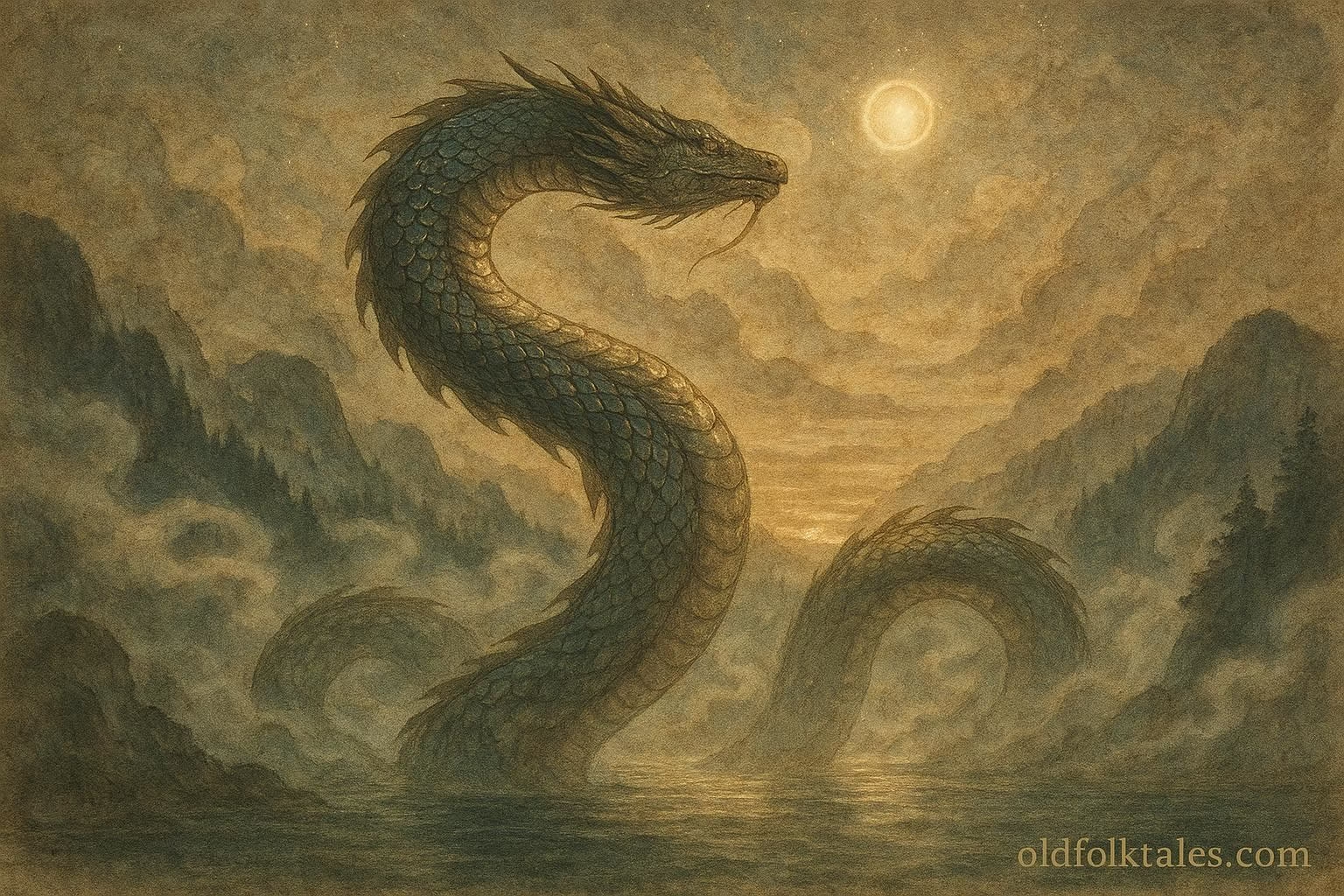
In Korean mythology, few beings capture the imagination quite like the Imugi (이무기), a creature suspended between what it is and what it longs to become. Described as a massive serpent or eel-like spirit, the Imugi is a proto-dragon, a being of great potential but not yet fully divine. It embodies aspiration, transition, and the ancient Korean idea that spiritual elevation comes through patience, virtue, and natural alignment with cosmic forces.
Appearance
Imugi are most commonly portrayed as enormous, python-like serpents, stretching hundreds of meters in length. Their bodies glisten like wet stone or the dark surface of a mountain stream, and their scales shimmer faintly with hints of jade or deep blue. Unlike fully ascended Korean dragons (yong), the Imugi lacks the long whiskers, antlered horns, and elaborate facial hair associated with celestial authority. Instead, its face is smoother, more serpentine, with large expressive eyes that appear almost mournful, an emotional quality emphasized in many folk stories.
Discover the gods, goddesses, and divine spirits who ruled the heavens and shaped human fate
Often, the Imugi’s body is veined with faint light, as though currents of heavenly energy pulse beneath the skin. This glow strengthens when it is near transformation. Some traditions describe a subtle crest forming on its head, an early sign of the dragon it hopes to become. Others note a faint ring of mist constantly swirling around its form, symbolizing its strong connection to water and sky.
Habitat and Behavior
Imugi dwell in the thresholds of nature, places that mirror their own in-between state. They favor:
-
Deep rivers
-
Mountain lakes
-
Wells
-
Waterfalls
-
Caves connected to underground streams
These sites were viewed in historical Korea as spiritually potent, often linked to local guardian deities (sansin, yongwang). In many villages, isolated pools or misty hollows were said to be “Imugi-haunted,” a belief that encouraged respectful behavior toward natural water sources.
Behaviorally, Imugi are not predators. Unlike Western dragons, which often represent greed or destruction, the Imugi is gentle, patient, and introspective. It rarely harms humans. Instead, it guards its watery homes, controls rainfall, and occasionally appears during times of drought or change.
Powers
Though not yet fully divine, the Imugi possesses formidable spiritual abilities:
1. Water and Weather Influence: Imugi are associated with rainfall, fog, and seasonal cycles. They can call mist, summon gentle rain, or stir the currents of rivers.
2. Protection: In many stories, Imugi protect villages from illness, misfortune, or invading spirits. Their presence near a settlement is considered auspicious.
3. Transformation Potential: The defining trait of the Imugi is its capacity for ascension. According to various traditions, transformation into a full dragon (yong) requires:
-
Surviving one thousand years,
-
Obtaining the yeouiju (a heavenly orb of power), or
-
Completing a cosmic test of virtue or endurance.
This longing for transformation makes the Imugi one of the most emotionally resonant spirits in Korean myth.
Myths and Beliefs
The Trial of the Yeouiju: A well-known motif involves the Imugi trying to seize the yeouiju, which occasionally falls from the heavens like a glowing meteorite. Only dragons may rightfully wield this orb, but proto-dragons often attempt to claim it in hopes of accelerating their transformation. In some tales, humans help or hinder the creature, teaching lessons about compassion and greed.
The Benevolent Lake Guardian: Stories tell of farmers who prayed to an Imugi living in a nearby reservoir for rain. When villagers treated the creature with respect, offering rice cakes or simply maintaining the forest around its pool, the rains would come at the right time, and crops flourished.
The Imugi of the Mountain Cave: One tale describes an Imugi that lived quietly in a cavern, waiting for the thousand-year cycle to complete. When it finally ascended in a beam of watery light, the surrounding valley reportedly experienced a year of abundant harvests and clear weather.
The Misunderstood Monster: Later retellings sometimes depict Imugi as monstrous, confused, or prone to causing accidental damage due to their size. These versions reflect social anxieties around natural disasters, floods, landslides, and storms, while preserving the belief that the Imugi is fundamentally non-malicious.
Cultural Role
Symbol of Transformation: More than any other Korean mythical creature, the Imugi symbolizes aspiration, patience, and the pursuit of spiritual elevation. It stands at the boundary between animal and deity, nature and cosmos.
Guardian of Water: Its connection to the land’s lifeblood, water, links it to agricultural fertility and community survival.
Moral Symbol: The Imugi’s journey reflects the Confucian ideal of self-cultivation and the Buddhist concept of long-term effort leading to enlightenment.
Its message: Greatness is not inherent. It is earned.
Explore the mysterious creatures of legend, from guardians of the sacred to bringers of chaos
Author’s Note
The Imugi spoke to me as I wrote because it embodies ambition without arrogance, a creature striving upward with humility and devotion. In a world obsessed with immediate transformation, the Imugi reminds us that becoming something wonderful takes time, patience, and alignment with our inner nature. Its story is timeless because every culture understands the longing to grow into one’s true form.
Knowledge Check (Q&A)
-
Q: What is the Imugi’s primary goal in Korean mythology?
A: To transform into a full dragon (yong). -
Q: What environments do Imugi typically inhabit?
A: Lakes, rivers, caves, reservoirs, and other water-linked natural places. -
Q: Are Imugi considered harmful to humans?
A: Generally no, they are benevolent or neutral. -
Q: What object is sometimes required for their transformation?
A: The yeouiju, a heavenly orb of divine power. -
Q: What does the Imugi symbolize culturally?
A: Growth, patience, aspiration, and spiritual cultivation. -
Q: How do Imugi influence the natural world?
A: They can affect rain, weather, and water conditions.
Source: Adapted from Korean folkloric motifs, oral tradition, dragon mythology studies, and secondary academic summaries (e.g., Mythlok, Wikipedia).
Origin: Korea (Folk tradition; themes traceable to pre-modern animistic and shamanistic cosmology)