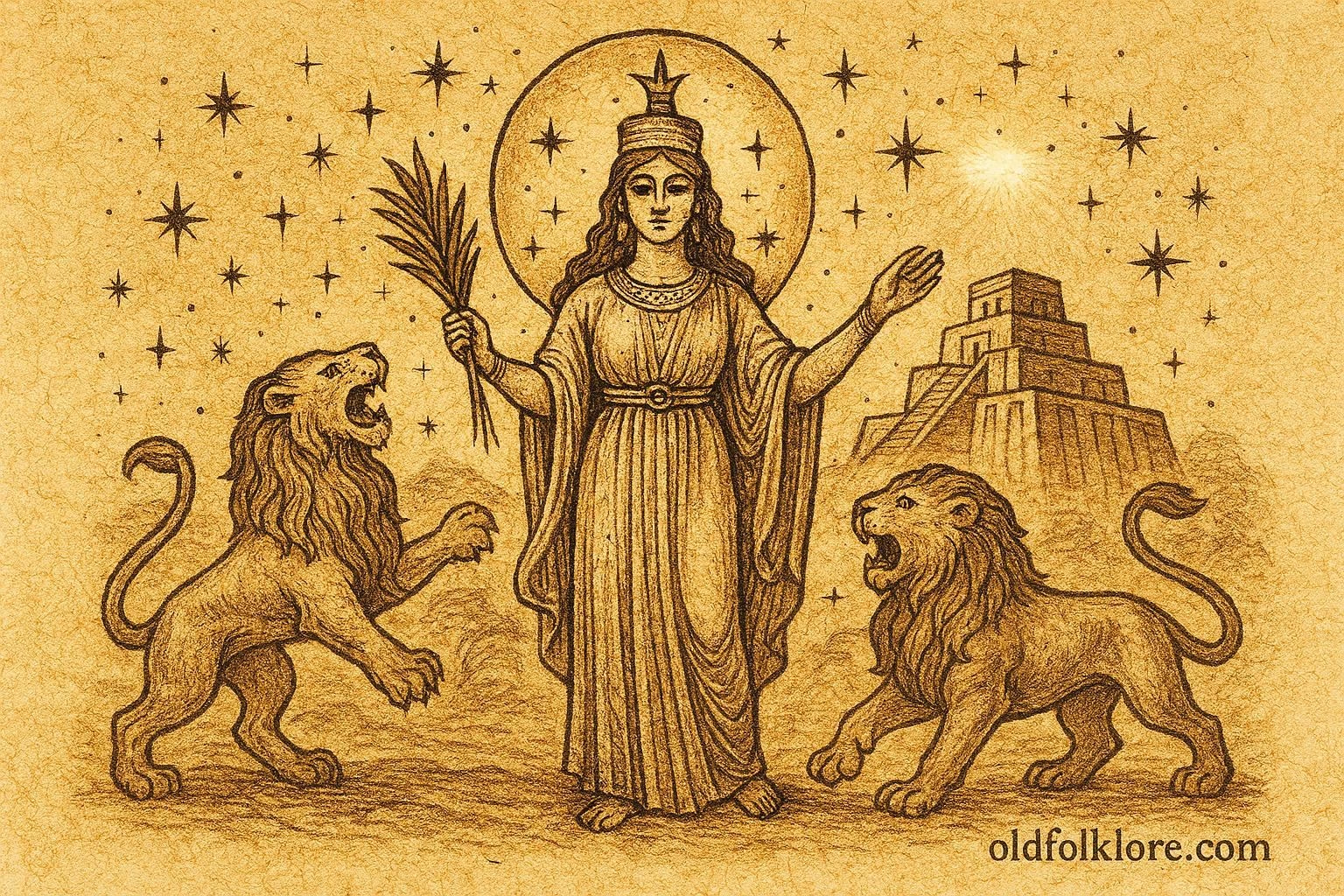
Inanna, known to the Akkadians and Babylonians as Ishtar, was the radiant Queen of Heaven, goddess of love, beauty, war, fertility, and divine justice. She embodied duality: passion and destruction, creation and chaos, tenderness and wrath. Her sacred symbols included the eight-pointed star, the lion, and the reed gate, each representing divine authority and cosmic passage.
Inanna’s temples, the Eanna (“House of Heaven”) at Uruk and others across Mesopotamia, were among the oldest ritual centers in recorded history. She was venerated as both the bringer of abundance and the breaker of order, commanding armies and lovers alike. Her myths intertwine with those of Dumuzi (Tammuz), her consort, whose fate became bound to the rhythm of death and rebirth, the heartbeat of the agricultural year.
Among all tales, none reveals her power and paradox more deeply than The Descent of Inanna, a sacred poem inscribed on Sumerian tablets more than four thousand years ago, a journey to the shadowed realm of her sister, Ereshkigal, Queen of the Dead.
The Mythic Story: The Descent of Inanna
In the ancient city of Uruk, Inanna ruled from her glittering temple of lapis and gold. She was clothed in divine radiance, her eyes flashing like morning stars, her heart restless. For reasons that no mortal could fathom, perhaps pride, perhaps destiny, she turned her gaze toward Kur, the great below, the land of the dead ruled by her dark sister, Ereshkigal.
Before departing, Inanna called her faithful servant, Ninshubur.
“If I do not return in three days,” she warned, “go to Enlil, to Nanna, and to Enki. Beg them for help, for the Queen of Heaven does not enter the Underworld lightly.”
Then she adorned herself in the seven sacred garments of power: the crown of the steppe, the necklace of lapis, the breastplate of judgment, golden bracelets, the measuring rod and line, the royal ring, and the flowing garment of sovereignty. Each was a symbol of her divinity, each would soon be stripped away.
At the first gate of the Underworld, the gatekeeper Neti challenged her. “Who seeks to enter the realm where none return?”
“I, Inanna, Queen of Heaven,” she answered. “I come to witness the funeral rites of my sister’s husband.”
Neti sent word to Ereshkigal, who, upon hearing her sister’s arrival, trembled with rage and sorrow. “Let the seven gates be opened,” she commanded, “but let her be humbled as she passes.”
So Inanna descended.
At the first gate, the crown was taken from her head.
At the second, her earrings of small measure.
At the third, the necklace from her neck.
At the fourth, the breastplate from her breast.
At the fifth, the girdle of birthstones.
At the sixth, her bracelets.
At the seventh, her royal robe, leaving her naked before the throne of the dead.
Ereshkigal rose from her dark seat, her face a storm of grief and power. The judges of the Underworld cast their gaze upon Inanna. Their word was law: “She has entered the realm of the dead; she shall not leave.”
Ereshkigal struck her down, and Inanna’s body was hung upon a hook, lifeless as clay.
Days passed. Ninshubur, faithful to her vow, went to the gods for aid. Enlil and Nanna refused, for none could defy death. Only Enki, the god of wisdom and water, took pity. From beneath the earth’s rivers he formed two tiny beings, neither male nor female, made of the purest essence of life. He gave them the food and water of rebirth and sent them into the Underworld.
There, they found Ereshkigal in agony, her cries echoing through the seven gates. The beings mourned with her, mirroring her pain. Moved by their empathy, Ereshkigal offered them a gift. “Ask of me what you will.”
“Give us the body of Inanna, the Queen who hangs upon the hook.”
Ereshkigal granted their request. They sprinkled Inanna with the food and water of life, and she rose, radiant once more. But a law of balance bound her: none may ascend from the realm of the dead unoffered. A soul must remain.
As Inanna returned through the gates, demons followed, demanding a substitute. They seized her attendants, but Inanna forbade it, until she came upon Dumuzi, her beloved consort, seated upon her throne, arrayed in splendor, unmourning. Rage filled her heart. “Take him,” she decreed. “Let him taste the shadow I have known.”
The demons carried Dumuzi away. Yet Inanna’s fury softened to grief, and she decreed that Dumuzi would spend half the year in the Underworld, while his sister Geshtinanna would take his place the other half. Thus the seasons turned: death and renewal, descent and ascent, the eternal rhythm of life.
Author’s Note
The Descent of Inanna stands among the world’s oldest spiritual narratives. It mirrors the cycles of fertility, mourning, and rebirth that governed both the earth and the soul. Inanna’s humility before Ereshkigal reveals that even the gods must surrender to transformation. The story teaches that power without compassion is hollow, and that every descent, whether divine or human, can become the path to renewal.
Knowledge Check
Q1. What domains does Inanna govern?
A: Love, war, fertility, beauty, and divine justice, representing both creation and destruction.
Q2. What symbols are associated with Inanna?
A: The eight-pointed star, lion, and reed gate, each reflecting divine power and passage.
Q3. What is the “Descent of Inanna”?
A: A Sumerian myth in which Inanna enters the Underworld, dies, and is revived, symbolizing death and rebirth.
Q4. Who helps revive Inanna from the Underworld?
A: Two spirit beings created by the god Enki, who restore her with the food and water of life.
Q5. Why is Dumuzi sent to the Underworld?
A: Because he did not mourn Inanna’s death; he becomes her substitute, spending half the year below.
Q6. What deeper meaning does the myth convey?
A: The necessity of descent, humility, and renewal, the eternal balance between life and death.
Source: Sumerian Mythology, Mesopotamia.
Source Origin: Sumeria (Ancient Mesopotamia, modern-day southern Iraq)