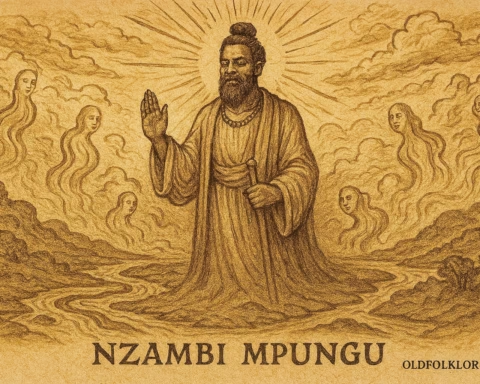
Kalunga is the sacred boundary separating the living from the dead in Mbundu and Kongo cosmology. Often envisioned as a vast river or ocean, it is the passage through which human souls travel to join the ancestors. While not a creator deity in itself, Kalunga embodies the omnipresent power of Nzambi, linking life, death, and the cosmic order.
Kalunga governs transitions, morality, and spiritual guidance. Souls of the departed must navigate its waters, aided by ancestral spirits or divine guides. The river reflects both a physical and metaphysical reality: a literal geographic waterway for some communities, and a symbolic threshold for the soul’s journey. Offerings, rituals, and prayers help ensure safe passage, honoring both the departed and the continuum of life.
Kalunga also functions as a moral regulator. Souls that lived selfishly, disrupted natural or social balance, or ignored sacred laws risk obstruction, returning as restless spirits. Its duality, as both life’s boundary and a conduit for eternal order, makes Kalunga central to understanding death, ethics, and the ancestral connection in Mbundu and Kongo belief systems.
Mythic Story: Crossing the Kalunga
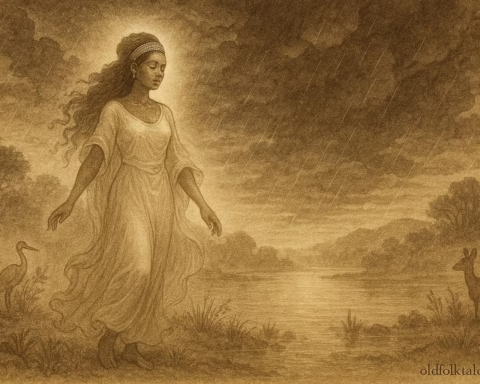
Long ago, when a person’s life on earth ended, their soul approached the fabled waters of Kalunga. The river stretched infinitely, shimmering with a mysterious glow, bridging the world of the living with that of the ancestors. Its currents were strong, sometimes turbulent, carrying echoes of past lives and whispers of ancestral wisdom.
Every soul faced Kalunga differently. Those who lived in harmony with the natural and social order found the waters calm, guided by benevolent spirits and ancestors who showed the safest paths. These guides appeared as luminous forms or familiar faces, offering reassurance, wisdom, and protective blessings. The journey demanded patience, courage, and humility, as the soul encountered visions of its earthly deeds, both virtuous and flawed.
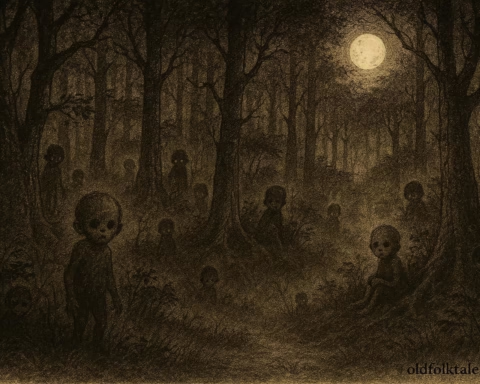
Yet, for those who acted with selfishness or disrupted the sacred balance of life, Kalunga’s waters turned treacherous. Waves rose as if animated by judgment itself, and spectral guardians would challenge the soul. Some were sent back to the mortal realm as restless spirits, unable to complete their journey until they acknowledged wrongdoing or restored balance. The river itself became a mirror of the soul’s moral state, reflecting the intimate link between human behavior and cosmic order.
Among the Mbundu, Kalunga is sometimes described as a freshwater river, its gentle currents symbolizing ancestral guidance and continuity. In the Kongo regions, Kalunga expands into a vast ocean, reflecting the boundless scope of divine oversight. Though its form varies, the essence remains consistent: Kalunga is the threshold of transformation, the sacred liminal space connecting mortality to eternity.
Communities honored Kalunga through ritual practices, especially at death rites. Offerings of food, libations, or symbolic items were placed at riverbanks or coastal sites. These gestures sought to ease the soul’s passage, honor ancestors, and maintain harmony between the worlds. The living learned that Kalunga was not merely a destination for the dead but a teaching force, reminding them of ethical living, respect for cosmic order, and the enduring bond between generations.
Kalunga’s myth extends beyond death, embodying the continuous cycle of existence. Life and death are not separate realms but parts of a sacred continuum, with Kalunga as the conduit of transition. The river, or ocean, teaches that morality, balance, and reverence for the ancestors shape both earthly life and the spiritual journey.
Through this sacred threshold, the Mbundu and Kongo peoples understand that existence is a web of interdependence: the living, the dead, and the divine all co-exist within a moral and spiritual order governed by Nzambi’s omnipresence. Kalunga, ever-flowing and eternal, embodies this truth, guiding every soul to its rightful place in the cosmic cycle.
Author’s Note
The myth of Kalunga reminds us that life and death are inseparable, connected by moral and spiritual currents. Kalunga teaches accountability, respect for the natural and social order, and the importance of ancestral guidance. It emphasizes that human actions resonate beyond the temporal world, shaping both our journey and the harmony of the cosmos.
Knowledge Check
Q1: What does Kalunga represent in Mbundu and Kongo mythology?
A: The liminal boundary between life and death, often conceptualized as a river or ocean.
Q2: Who assists souls in crossing Kalunga?
A: Ancestors or guiding spirits, depending on the soul’s moral conduct.
Q3: What happens to souls that disrupt natural or social balance?
A: They may be impeded, returned as restless spirits, or required to restore balance.
Q4: How do ritual practices honor Kalunga?
A: Through offerings, libations, and ceremonies at riverbanks or coasts to ease souls’ passage.
Q5: What is the symbolic significance of Kalunga’s waters?
A: They mirror the moral state of souls and connect mortality with the eternal spiritual order.
Q6: How does Kalunga relate to Nzambi?
A: It embodies Nzambi’s omnipresence and cosmic authority across life and death.
Source: Oral Tradition as History, Mbundu/Kongo
Source Origin: Mbundu/Kongo (Angola, Democratic Republic of the Congo)