In the vast forests stretching from Labrador to Maine, stories tell of Katshituashku, a monstrous bear-like being whose stiff, unbending legs make its movements both terrifying and unmistakable. Known variously as Katshituashku, Katcitowack, Katchitoakusku, and other linguistic variants, this creature stands at the boundary between animal reality and primordial myth.
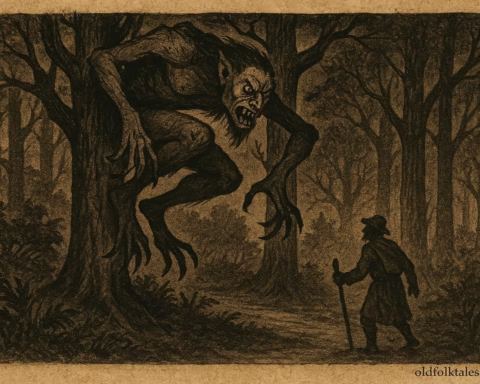
The Katshituashku is said to be a giant, man-eating bear, towering above the tallest humans. Its legs are straight and rigid, unable to bend at the joints, so it walks in a strange, upright, lumbering gait. Because it cannot crouch or lie down, it must lean against trees to sleep or rest, a detail that appears consistently across Innu, Cree, and Penobscot traditions.
Earlier Innu and Cree sources describe it as hairless or sparsely furred, with a massive head, a cavernous mouth, and an almost skeletal body beneath thick hide. It is not a normal bear but something much older, more monstrous, a being from a time when the world was raw, violent, and inhabited by giants.
Penobscot storytellers add another eerie detail: Katshituashku is so large and motionless when leaning against a tree that people often mistake it for the trunk of an ancient cedar, until it suddenly straightens and attacks.
Movement and Abilities
Despite its stiff legs, the creature is not slow. Rather, it moves in heavy, decisive strides, each step shaking branches and sending birds flying. Its immense size allows it to break through dense forest with ease, and its endurance is legendary; travelers could walk for hours thinking they had escaped it, only to hear its dragging, thundering gait behind them again.
Its senses are unnervingly sharp. It can smell humans across valleys, detect movement at distances no ordinary animal could, and approach prey in total silence despite its size. Some stories say it has spirit powers, able to track those who fear it or who disrespect the forest.
Behavior
The Katshituashku is almost always described as man-eating. It stalks hunters, travelers, and families who wander too far from camp. But the stories also give it a sense of tragic fate: it wanders because it must, unable to rest without the help of the trees it leans on.
Some tales even suggest it is older than the time of humans, a leftover from a primordial age when giant beings roamed the earth, now reduced to a hungry ghost of its former power.
Cultural Role (Symbolism, Meaning, Purpose)
- A Warning to Travelers and Hunters: Among the Innu and Cree, the northern forests are sacred but perilous. The Katshituashku symbolizes the dangers of arrogance, wanderlust, and carelessness. Elders warned young hunters to respect the land, remain humble, and avoid unnecessary risks, for the Stiff-Legged Bear stalked those who acted without proper preparation.
Its stiff legs became a visual metaphor: no matter how powerful, beings that cannot bend, literally or spiritually, are doomed to hardship.
- A Symbol of Ancient Memory: The unusual details of the creature, its immense size, rigid limbs, and lack of fur, have led some Indigenous storytellers and scholars to suggest that the Katshituashku may symbolize ancestral memory of prehistoric megafauna such as mastodons or giant sloths. In cultures where storytelling carried knowledge across millennia, myth and fossil evidence often intertwined.
Whether or not fossils inspired the legend, the Katshituashku clearly represents the deep time of the land, a being older than humans, a reminder that powerful creatures lived and died long before the present age.
- A Guardian Through Fear: Although monstrous, the Katshituashku serves a protective role. Its legend keeps children close to camp, discourages reckless exploration, and instills respect for the forest. Fear becomes a teacher; by imagining a giant bear who cannot rest and hungers endlessly, listeners come to understand the equally real dangers of the wilderness.
- Embodiment of Natural Power: Across Innu, Cree, and Penobscot worldviews, bears are sacred, beings of strength, endurance, and spiritual potency. The Katshituashku is an extreme form of that power, magnified to mythic proportions. It symbolizes the raw, untamed strength of nature, unsoftened by the laws of human society.
- A Cultural Bridge Across Nations: Because versions of Katshituashku appear in multiple tribes, the creature also represents the shared northern forest world, reflecting centuries of cultural exchange, seasonal travel, intermarriage, and overlapping territories.
Encounter dragons, spirits, and beasts that roamed the myths of every civilization
Author’s Note
The Katshituashku is one of those rare Indigenous monsters that feels both mythic and strangely biological. Its stiff legs, immense size, and odd appearance are unlike typical “big monster” folklore, details that hint at ancient memory, environmental observation, or encounters with old bones. But the heart of the story is not the creature itself; it is the lesson that the wilderness deserves reverence. The Stiff-Legged Bear reminds us that some dangers are older and larger than us, and that good judgment, humility, and respect keep communities safe.
Knowledge Check (Q&A)
- What is Katshituashku?
A giant, stiff-legged bear monster found in Innu, Cree, and Penobscot folklore. - Why are its legs important to the story?
They cannot bend, forcing it to walk upright and lean on trees to rest. - What frightening behavior is it known for?
It is a man-eater that stalks travelers and hunters. - Why might people mistake it for a tree?
Its immense size and stillness make it appear like a tree trunk until it moves. - What symbolic idea does the creature represent?
The dangerous power of nature and the need for humility in the wilderness. - What is one theory about the origins of the legend?
It may reflect memories of prehistoric megafauna such as mastodons.
Source: Based on traditional Innu, Cree, and Penobscot oral narratives and modern folkloric summaries (Native-Languages.org; Brewminate folkloric compilation; interpretive fossil-memory theories).
Origin: Innu (Montagnais-Naskapi), Cree (Subarctic Canada), and Penobscot (Northeast Woodlands, Maine)