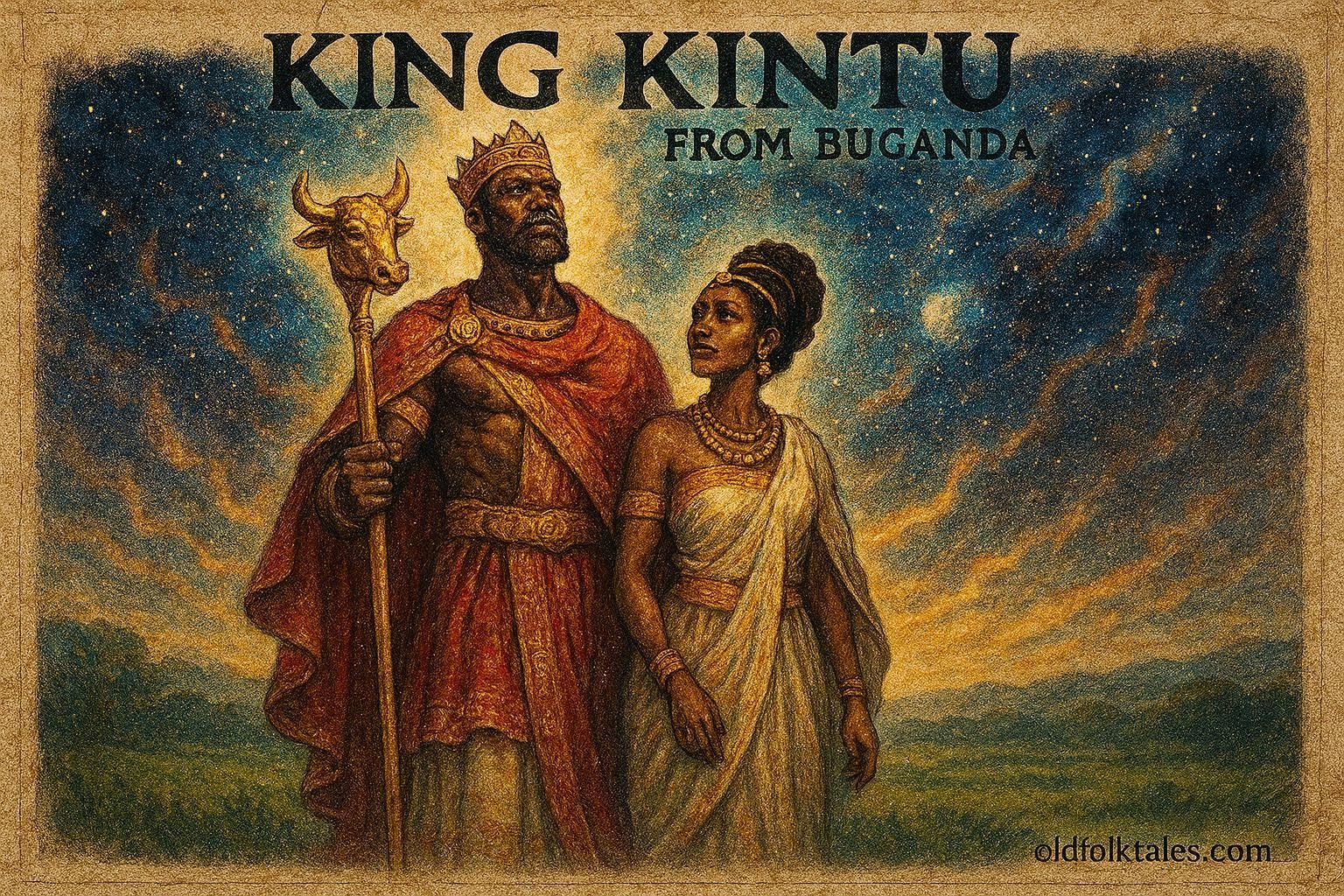
Before the world knew order, before clan drums beat across the rolling green hills, the land that would become Buganda lay open and unclaimed, a cradle awaiting a first heartbeat. From the high vault of heaven, where the sun brushed the edge of eternity, descended Kintu, a being neither wholly human nor wholly divine. Some said he rode on a wind woven from starlight. Others claimed he stepped down a path of cloud. But all agreed: Kintu entered the mortal world alone, bearing only a single cow whose milk sustained him like the breath of the gods.
Kintu lived quietly among the wild plains, drinking from his cow, gathering roots, and observing the rhythms of this new land. The earth knew him; the streams bowed to him; thunder itself hushed at his passing. Yet destiny, vast and unrelenting, stirred in the heavens above.
For high in the celestial realm dwelled Ggulu, lord of the upper worlds, whose children wandered occasionally to the mortal plain. Among these children was Nambi, radiant as forest dawn, curious as the young moon, and gentle as millet rain. She and her siblings came to earth to explore its wonders, and found Kintu standing beneath a fig tree, tall, serene, unlike any man they had known.
Nambi, watching him tend his single cow with reverence, felt a pull in her spirit, a calling older than creation itself. Her siblings urged caution, but the heart of a divine maiden does not easily bend. She approached Kintu boldly, her voice shimmering with heavenly cadence.
“Stranger,” she said, “from what region do you wander alone?”
Kintu bowed. “I came where the wind led me. I am Kintu, and this cow is my life.”
Nambi returned many times after that meeting, bringing fruits of the upper realm and trading questions about mortal and divine worlds. The bond between them grew until it glowed brighter than the morning star. When she told Ggulu that she wished to take Kintu as her husband, the celestial patriarch frowned.
“This man may be more than he appears,” Ggulu warned. “But you are of my blood. If he is to wed you, he must prove his worth.”
Thus began Kintu’s first heroic challenge.
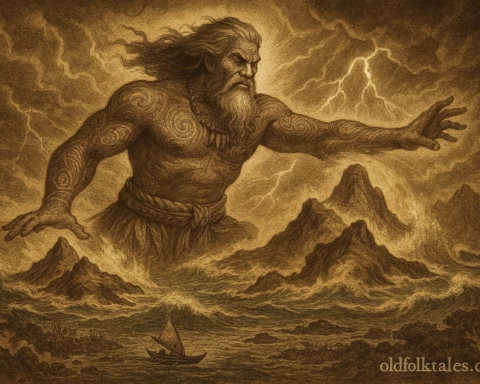
Ggulu summoned Kintu to the heavens and placed before him tests impossible for ordinary mortals. He commanded Kintu to identify his cow among countless identical herds; yet Kintu listened to the breath of the earth and found his companion by its heartbeat. Ggulu ordered him to retrieve a feast from a room watched by spirits; yet Kintu entered with calm courage, and the spirits bowed to him, sensing his destiny. Finally, Ggulu gave him millet seeds crushed to dust and demanded he restore them to whole grain. Kintu cupped the powder in his hands and prayed, and where the dust fell, new millet sprang from the ground in golden rows.
Ggulu, astonished, declared: “You are worthy. Take Nambi, but go swiftly. Above all—do not return for anything you forget.”
For Ggulu feared Walumbe, the spirit of death, whose envy could unravel the fragile thread between mortal and divine.
Nambi descended with Kintu, carrying seeds, livestock, and blessings for the kingdom they would build. But as they neared the earth, she suddenly gasped.
“My fowl! I left them behind. They cannot survive here without my care. Let us return quickly.”
Kintu’s heart trembled. Ggulu’s warning thundered through his mind, yet he could not deny Nambi’s plea. Love pulled him backward; fate beckoned forward. It was here that Kintu faced his moral struggle, whether to honor divine law or answer the call of compassion.
He chose love.
They returned to the heavens, and as Ggulu feared, Walumbe followed them back to earth. At first, Walumbe wandered silently, observing the new order Kintu and Nambi had begun. But when Kintu’s children multiplied, Walumbe demanded one for himself to serve him.
Kintu refused.
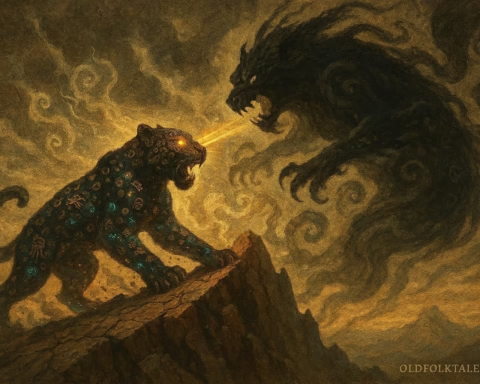
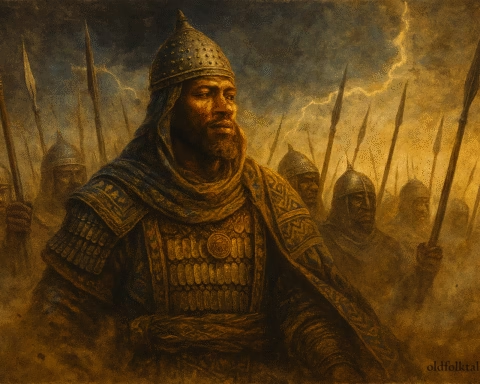
Thus, death entered the world. One by one, Walumbe stole the breath of Kintu’s children and spread mortality across the land. Kintu, furious and grieving, sought to drive him back to the celestial realms, aided by Kayikuzi, Nambi’s brother. Their battles shook the hills and cracked the earth; lightning marked their pursuit of the elusive spirit. But Walumbe burrowed deep into the underworld, beyond reach, claiming dominion over all mortal endings.
Heartbroken but resolute, Kintu gathered his people. Standing beneath the great sky, he proclaimed laws on kinship, labor, marriage, and unity, laws that shaped Buganda for generations. Though death now dwelled among humanity, Kintu taught his people to live with purpose, courage, and reverence for the divine.
With Nambi at his side, he founded a lineage of kings. His reign became the first thread in a tapestry of centuries, his name echoing in every clan, every drumbeat, every coronation.
And one dawn, after many seasons, Kintu vanished as mysteriously as he had arrived, some say returning to the heavens, others to realms deeper still. But Buganda stood, strong and luminous, a kingdom built from love, challenge, sacrifice, and eternal destiny.
AUTHOR’S NOTE
The epic of King Kintu endures because it explains not only the founding of Buganda, but the very nature of mortality and moral responsibility. Kintu represents the bridge between divine possibility and human limitation, his choices shape the world we inherit. In him, the Ganda people see both a founding father and a reminder that every act of love carries the weight of fate.
KNOWLEDGE CHECK
-
What divine realm does Nambi come from?
-
Why does Ggulu test Kintu before allowing the marriage?
-
What rule did Ggulu give Kintu and Nambi before they left heaven?
-
How does Walumbe enter the world of humans?
-
What symbolic meaning does Kintu’s moral struggle represent?
-
What laws does Kintu establish after Walumbe brings death?
CULTURAL ORIGIN: Ganda Creation Epics, Buganda (Uganda)
SOURCE: John Roscoe, The Baganda: Their Customs and Beliefs (1911).