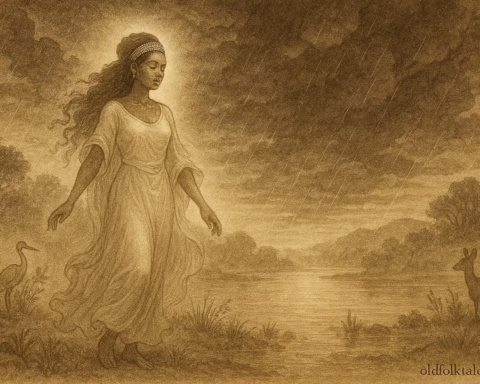
In the age when dharma still shimmered like gold upon the earth, when gods watched from luminous thresholds and kings bore destinies carved by cosmic law, there arose Kusha, the son of Sri Rama and Sita, born to the Solar Dynasty yet destined to radiate a light distinctly his own. Though the shadow of his father’s greatness stretched far across the land, Kusha’s path wound toward a different horizon, where lineage alone could not shield him, and virtue demanded its own forging.
Kusha’s birth came amidst seclusion and sorrow. Raised in Sage Valmiki’s forest hermitage, he and his twin brother Lava grew under the chanting of celestial hymns, unaware that the rhythms of those verses shaped not merely their learning, but the architecture of their souls. Kusha, the elder, possessed calm strength and a voice that carried the weight of command. His eyes were bright embers of Rama’s royal fire, yet in their depths rested the compassion of Sita, whose grace echoed in every gesture he made.
When the time came for the twin sons of Rama to perform the recitation of their father’s tale before the assembled court of Ayodhya, destiny revealed itself like the dawn unveiling a mountain. The shock of discovery, the sorrow of separation, the turbulent reunion of Rama, Sita, and the princes, these shaped Kusha’s heart into a vessel that could bear both grief and duty. But where Lava’s spirit leaned toward poetry and wandering, Kusha felt the call of kingship thrum through his blood.
After Sita returned to the earth and Rama prepared for his own heavenly departure, the kingdom of Kosala needed steady hands. Rama, seeing the clarity of purpose in Kusha, entrusted him with vast northern lands, sending him forth to establish a sacred realm: Kushavati.
Thus began the forging of Kusha’s independent saga.
Kushavati rose like a lotus from wilderness and riverbank. Its walls were carved with symbols of dharma; its markets rang with music, and its fields flourished beneath the prince’s wise decree. Yet prosperity is a flame that draws the watchful eyes of dark beings. When word reached Kusha that rakshasas were gathering in the Vindhya forests, terrorizing hermitages and corrupting sacred groves, he understood that rulership demanded more than fairness and protection, it demanded action sharpened like an arrow.
Armed with Rama’s bow and the blessings of sages, Kusha journeyed into the shadowed forests where the demons dwelled. Night upon night, he crossed valleys where the trees themselves whispered warnings. At last he confronted the demon-king Varamukha, a cunning shape-shifter who fed on fear and cloaked his realm in illusions that ensnared the faint-hearted.
Kusha’s heroic challenge began with deception. Varamukha conjured visions of Rama rebuking him, of Sita fading into the earth, of Lava falling beneath invisible arrows. These phantoms gnawed at Kusha’s heart, threatening to unravel his clarity. For the first time in his life, he questioned the weight of his lineage. Was he merely an extension of Rama’s legend, a prince carved from another man’s glory? Could he uphold dharma without drowning beneath the vast tide of expectation?
His moral struggle deepened as Varamukha’s illusions pressed harder. Kusha knew that to falter inwardly was to be conquered outwardly. So he stilled his breath, invoked the memory of Valmiki’s teachings, and touched the ground with reverence, anchoring himself to the eternal law that existed not in lineage but in one’s own deeds.
“I am not my father’s shadow,” he declared into the swirling dark. “I am Kusha, born of dharma, bearer of my own vow.”
The illusions shattered like brittle glass.
Freed from deception, Kusha fought Varamukha with divine fury. Their battle raged across the forest, arrows streaked like meteors, winds roared, mountains trembled. At last Kusha drove his blade of consecrated grass through the demon’s heart, purifying him in a flare of golden fire.
Peace returned to the hermitages. Forests blossomed anew.
Kusha’s symbolic outcome came not through conquest but transformation. By defeating the demon of illusion, he conquered the subtle darkness within himself, the fear of unworthiness, the burden of comparison, the weight of inherited greatness. He returned to Kushavati not as Rama’s son fulfilling obligation, but as a sovereign king whose authority flowed from his own merit.
Under his reign, Kushavati became a beacon of justice. Travelers spoke of a king who walked among his people without attendants, who listened before he commanded, who bore the divine lineage not as a crown of pride but as a lamp of responsibility. Even gods were said to pause in their journeys to witness the radiance of the city he shaped with wisdom, courage, and humility.
And thus the epic of Kusha stands, not as an echo of Rama’s glory, but as its shining continuation, proving that dharma is not a legacy one inherits, but a flame each soul must kindle anew.
AUTHOR’S NOTE
Kusha’s story, though often overshadowed by the grandeur of the Ramayana, reveals a powerful message: identity is not merely inherited, it is forged. His legacy endures as a symbol of self-realization, righteous kingship, and the courage to define one’s own path even when born into overwhelming destiny.
KNOWLEDGE CHECK (6 QUESTIONS)
-
What divine lineage does Kusha belong to, and how does it shape—but not define—his journey?
-
How does Kusha respond to the illusions cast by the demon Varamukha?
-
What internal struggle does Kusha face regarding his father Rama?
-
How does Kushavati symbolize Kusha’s independent destiny?
-
What is the significance of Kusha defeating a shape-shifting demon?
-
In what ways does Kusha’s reign embody dharma?
CULTURAL ORIGIN: Ancient India; Sanskrit epic tradition within the Ramayana cycle, especially the Uttara Kanda.
SOURCE: Uttara Kanda of the Ramayana; later Sanskrit and regional retellings in Indian literary traditions.