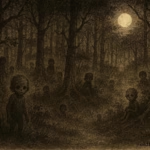
The Leshy (Russian: леший; Ukrainian / Belarusian: Лісовик / Lesovik) is the forest’s invisible master, a spirit older than the first oak, present in every whisper of leaves and every shifting shadow between trunks. Neither god nor demon, the Leshy belongs to the in-between world of Slavic cosmology, where nature itself breathes and judges.
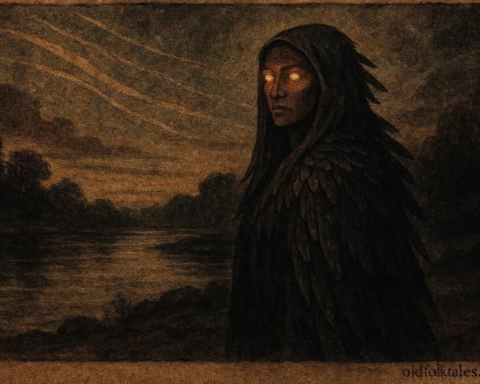
He is often described as a tall man with tangled green hair and a beard of moss, dressed in bark or animal skins. His eyes gleam like sunlight through branches, his laughter echoes like wind among pines. Yet his form is fluid: at times he rises taller than the tallest fir; at others he shrinks to the size of a blade of grass. This power of size-change is a hallmark of Slavic belief, symbolizing the forest’s boundless and unpredictable nature.
Journey through the world’s most powerful legends, where gods, mortals, and destiny intertwine
In Afanasyev’s Russian Folk-Tales, peasants speak of “the master of the woods who turns travelers astray.” A hunter may walk straight for hours, only to find himself circling the same clearing, proof the Leshy is playing tricks. Others say he kidnaps careless children or mimics voices to lure wanderers deeper into his realm. Yet those who show respect, bowing before entering the forest, leaving a crumb of bread or a few drops of vodka at a stump, earn his protection.
Thus the Leshy embodies the dual nature of the wild: perilous when ignored, benevolent when honored.
Myths, Powers, and Behavior
The Leshy rules every creature of the forest: deer, wolves, owls, and unseen sprites that nest beneath mushrooms. He is the shepherd of beasts, guiding their migrations, ensuring balance between hunter and hunted. If a poacher kills without measure or cuts sacred trees, the Leshy retaliates with misfortune, broken tools, lost paths, sudden storms.
He can mimic human voices, appear as a familiar friend, or disguise himself as an animal. In some accounts he assumes the guise of a grey wolf or a raven, teaching that the forest itself may test mortals through deception.
Traditional charms against his mischief are ancient: villagers turn their clothes inside out or wear shoes on opposite feet to confuse his sense of direction. Others carry birch twigs blessed at Easter or make the sign of the cross while facing east, calling on divine order to counter the forest’s trickster spirit.
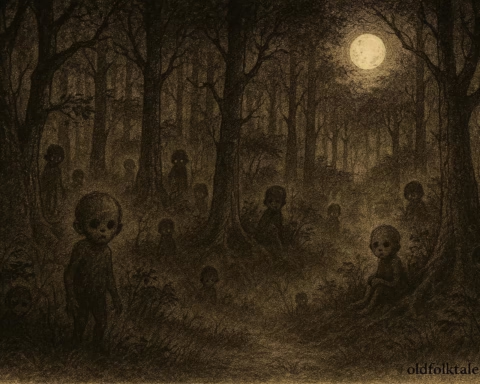
At times, the Leshy displays a household gentleness. In Belarusian lore, he has a wife, Leshachikha, and children, Leshonki, who dance in moonlight. These tales humanize the wilderness, portraying it as a family community rather than chaos. The Leshy’s family mirrors peasant life, proof that even the deep forest follows its own hidden order.
Cultural Role and Symbolism
In the symbolic geography of Slavic belief, the forest stands between civilization and the underworld, a living borderland. The Leshy presides over that boundary. He is the mediator between human and natural worlds, reminding villagers that the woods are neither property nor void, but a realm with its own sovereign.
Ethnographers note that many rural rituals acknowledged his presence. Before felling the first tree or beginning a hunt, villagers offered bread or coins “to the master of the forest.” During midsummer festivals (Kupala Night), youths left wreaths on tree stumps so the Leshy would not lead them astray. In return, hunters prayed to him for animal tracks, woodcutters for safe passage, and shepherds for pasture luck.
Unlike demons of Christianized folklore, the Leshy retains an ambiguous morality. He is not evil, merely wild. His mischief punishes arrogance, forgetfulness, and greed. His kindness rewards humility and balance. The tale pattern, lost, tested, enlightened, returned, mirrors ancient initiation journeys: those who confront him emerge wiser, more attuned to nature’s rhythm.
Scholars such as Marina Warner and Vladimir Propp interpret the Leshy as the residual echo of an earth deity, a diminished god of vegetation absorbed into folk memory after Christianization. His green hair and tree-like body recall seasonal regeneration myths. In agrarian villages dependent on timber and hunting, acknowledging such a spirit was both ecological wisdom and social discipline.
Regional Variants
The Leshy’s name and traits vary across the Slavic world:
- Russia: Leshy, male, solitary guardian; voice echoes thunder; companion to wolves.
- Ukraine / Belarus: Lesovik or Lisovyk, sometimes more domestic, depicted with a wife (Leshachikha).
- Poland: Borowy or Borovoi, closer to a woodland demon, often smaller and more tricksterish.
- Czech / Slovak regions: Lesník, transformed into a forest warden spirit, less supernatural.
These localizations show the spirit’s integration into daily rural experience. Each region reshaped him according to its ecological landscape, from pine forests of the north to Carpathian foothills.
Modern Echoes
Though industrialization eroded direct belief, the Leshy endures in Russian and Ukrainian folklore retellings, poems, and children’s stories. Soviet and post-Soviet literature reimagined him as a symbol of ecological conscience, the forest’s memory protesting human exploitation.
In modern fantasy culture, the Leshy reappears in video games and novels, but academic folklorists caution that these versions, often monstrous, simplify his role. In authentic oral tradition, he is not a monster to be slain but a spirit to be negotiated with, a metaphor for coexistence with nature’s power.
Contemporary environmental thinkers have revived him as an emblem of “rewilding ethics”: the idea that forests possess their own agency. In this light, the Leshy’s laughter from the treeline is not threat but warning, respect the wild, or be lost within it.
Encounter dragons, spirits, and beasts that roamed the myths of every civilization
Author’s Note
To walk in the Russian forest at dusk is to understand the Leshy’s persistence. Every shifting path, every sudden stillness feels inhabited. Peasants once said, “The forest sees and knows.” The Leshy is that seeing. He personifies awe, the sense that nature watches us back.
His myth carries an ecological morality older than science: survival through respect. The traveler who greets the forest as a neighbor returns safely; the one who mocks its silence may never return. The Leshy teaches not obedience, but relationship, an ancient pact between humankind and the green world.
Knowledge Check
- What does “Leshy” mean?
→ Literally “he of the forest” (from les, “forest” + suffix -iy). - What is his most distinctive ability?
→ Shapeshifting, able to grow tree-tall or shrink to a blade of grass. - How do travelers protect themselves from him?
→ Wear clothing inside-out, switch shoes, or offer bread and salt before entering the woods. - What animals are under his protection?
→ Wolves, deer, and most wild creatures of the forest. - What moral theme does the Leshy embody?
→ Harmony with nature and respect for the unseen powers of the wild. - Who collected key Leshy tales?
→ Aleksandr N. Afanasyev in his 19th-century Russian Folk-Tales.
Source: Afanasyev, A. N., Russian Folk-Tales (19th-century field collection; Project Gutenberg / Sacred-Texts)
Origin: East Slavic (Russia, Ukraine, Belarus; parallels in Poland, Czech lands, Balkans)