Before the winds carved their endless paths across the Tian Shan, before the hooves of a thousand steeds shaped the rhythm of the steppe, the sky-god Tengri cast his gaze upon the scattered tribes of Central Asia. The people were brave but divided, threatened by ceaseless invasions and the dimming of their ancestral fire. In that age of uncertainty, Tengri resolved to breathe thunder into mortal flesh. Thus began the tale of Manas, the storm-born child destined to unite a people and challenge the world.
His mother, Chakyp, dreamed of a white cloud descending upon her, glowing with celestial fire. From it emerged a mighty eagle, its wings spanning the horizon, its cry shaking the mountains. When she awoke, she found her body alight with sacred warmth. So was Manas conceived, half son of the steppe, half son of the heavens, his destiny marked long before his breath filled the mortal world.
Explore the shadows of world mythology, where demons test the soul and spirits watch over mankind
From infancy, signs of his divine origin echoed across the land. Wild horses calmed when he crawled near. Thunder rolled on clear days. And as he grew, his strength surpassed that of seasoned warriors; he could shatter stones and outrun the wind. The elders whispered that Tengri had placed a fragment of the sky within him, a living spark meant to shield the Kyrgyz from the darkness pressing at their borders.
When Manas reached manhood, that darkness finally surged forth. A vast coalition of invading armies spilled across the steppe, armored riders, iron-willed archers, and ruthless conquerors who sought to extinguish the freedom of the Kyrgyz. Villages burned like scattered stars falling from the heavens. Families fled to the mountains. The tribes quarreled among themselves, divided by old grudges.
It was then that Manas rose.
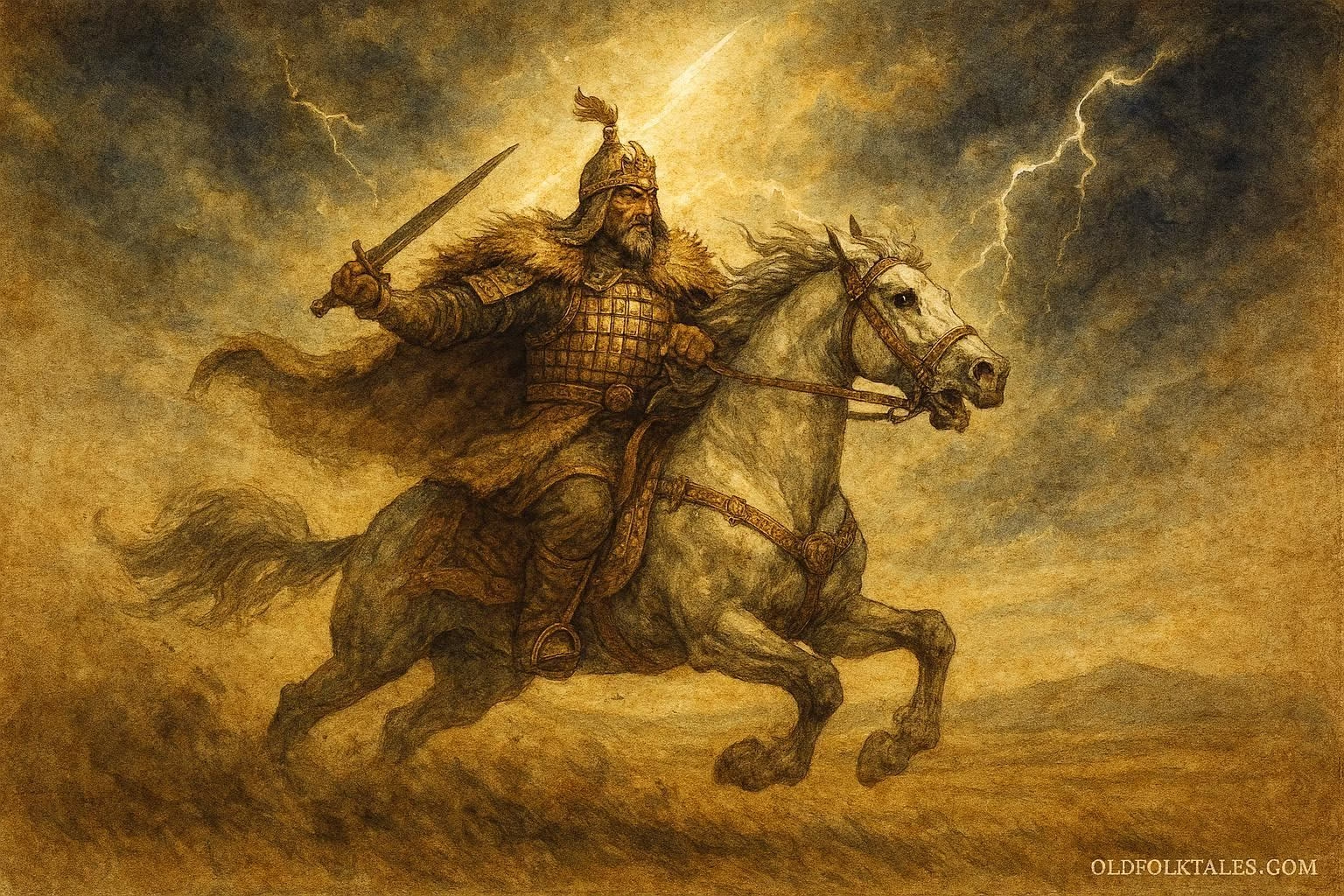
Standing upon a sun-bronzed hill, he called the tribes to him. His voice boomed like a rolling storm, shaking even the most stubborn hearts. He spoke not of vengeance, but of unity, honor, and the sacred duty of protecting the steppe bestowed upon them by Tengri. Many doubted him, for he was young, and the world was heavy with fear. But when he mounted his colossal horse, Ak-kula, an animal born of cloud and lightning, the people saw in him the echo of myth itself.
Under his banner, the tribes joined as one for the first time in generations.
The Heroic Challenge
Manas’s campaign was not merely a war of borders but a test of cosmic balance. The invading armies marched like a black storm across the plains, led by warlords who believed the steppe ripe for domination. Manas rode at the front of his people, his armor forged from heaven’s iron, his battle cry a thunderclap that haunted enemy dreams.
Time and again he met overwhelming odds. He broke enemy phalanxes like twigs beneath a tempest. He shattered siege towers with his bare hands. He defended the elderly, the widowed, the exiled, believing that the strength of the Kyrgyz lay not only in warriors but in every beating heart bound to the land.
Yet the greatest challenge was not the might of enemy swords, but the weight of leadership. Each victory carried a shadow; each sacrifice gnawed at him. Tengri had blessed him with power, but had not shielded him from doubt. What if the unity he forged survived only as long as his own strength? What if destiny demanded more than the life of a single man?
His moral struggle deepened when he learned that the enemy planned to break the Kyrgyz spirit by targeting not armies but families. Manas realized the war was no longer about borders, it was about identity, existence, and sacred memory. Rage surged within him, threatening to consume the moral compass Tengri had placed in his heart. In the solitude of night, beneath the eternal sky, he confronted the truth that even a divinely blessed hero must choose mercy over wrath, purpose over pride.
The Symbolic Outcome
The final battle stretched across a plain dusted with silver grass. The sky darkened, as though Tengri himself bent low to witness the clash. Manas fought at the center, every blow echoing like the heartbeat of the world. As the invaders faltered, he raised his voice, calling upon the tribes to stand firm, not for conquest, but for freedom.
In a surge of unified might, the Kyrgyz drove back the enemy, reclaiming the land as the sun broke through clouds, painting Ak-kula’s mane in gold. Peace echoed across the steppe for the first time in a generation.
Manas stood at the hilltop once more, not as a conqueror, but as a symbol, a reminder that unity empowered even the smallest tribe to shake the fate of nations. His legacy became a living wind, carrying the story of the Kyrgyz people across centuries.
Though his mortal journey ended, the thunder of his spirit remained. Even now, when storms roll across the steppe, many say it is Manas himself, guardian of his people, riding across the heavens.
Author’s Note
This retelling honors the Epic of Manas, one of the world’s longest oral epics and a foundational pillar of Kyrgyz cultural identity. Manas embodies courage, unity, and divine purpose, symbolizing the resilience of a people shaped by wind, mountain, and endless plain. His legacy persists not just in song, but in the spirit of the Kyrgyz nation.
Knowledge Check
-
What divine sign marked Manas’s conception?
-
Why did Tengri choose to create a hero for the Kyrgyz people?
-
What was Manas’s greatest challenge besides military conquest?
-
How did Manas unify the scattered tribes?
-
What moral struggle did he face during the invasions?
-
Why is Manas considered a lasting symbol for the Kyrgyz?
Cultural Origin: Kyrgyzstan, Central Asian nomadic epic tradition rooted in oral storytelling, hero-worship, and Tengrist cosmology.
Source: S. M. Abramzon, The Kyrgyz and Their Ethnogenesis (1971).