Before the rivers carved their winding silver paths through the vast Kongo forests, before the drums of the clans knew rhythm or unity, the land trembled beneath endless feuds. It was said that Nzambi Mpungu, Maker of All Things, looked upon the chaos with sorrow. Where harmony should have grown, only fire and blade reigned. Where families should have feasted together, they fortified their doors against the night. And so, in the age when spirits walked the boundary between mist and dawn, Nzambi shaped a savior, one not born but called into being.
Nganga a Nzambi entered the world on a night when the sky itself split open with luminous fire. Witnesses spoke of a star falling into the forest, of beasts bowing their heads, and of the winds pausing mid-breath. At the center of the radiant clearing lay a child wrapped in red earth and glowing with a warmth not of mortal blood. Elders from the nearby Kandi clan brought him forth, naming him Nganga, for they believed he had arrived as a healer of fates, a mender of broken cosmic order. They added a Nzambi to honor the divine hand they sensed upon him.
As the boy grew, signs of the sacred trailed him like a second shadow. Snakes, often feared as messengers of danger, curled peacefully around his ankles. Storms quelled when his voice rose in chant. Dreams whispered to him secrets of the land, when drought would fall, when rivers would swell, when spirits demanded appeasement. Though raised as a Kandi, he was claimed by no single clan. Already, some murmured that he carried the weight of all.
But divine gifts bring divine burdens, and as Nganga a Nzambi reached manhood, a prophecy unfurled around him like smoke around a flame. Three powerful clans, the Kandi, the Vunda, and the Nsaku, had entered a blood feud over land, lineage, and the right to rule. Their battles scarred the land with ash, and their leaders swore oaths sealed in iron that they would rather see the forest burn than bow to one another.
On the eve of a brutal confrontation, Nganga climbed the sacred Mount Lukanga, where spirits were said to linger between the roots of the ancient trees. There he prayed, his voice steady but his heart heavy. “Nzambi Mpungu,” he cried, “if I was shaped for unity, let me not falter in the face of men’s hatred. Show me the path.”
The sky dimmed, the mountain’s breath thickened, and a figure rose from the shadows, a radiant being clad in woven light. It was Nzambi Mpungu Himself, but not in human form; instead He took the shape of many things at once, bird, storm, ancestor, river, shifting like the hidden truths of the universe.
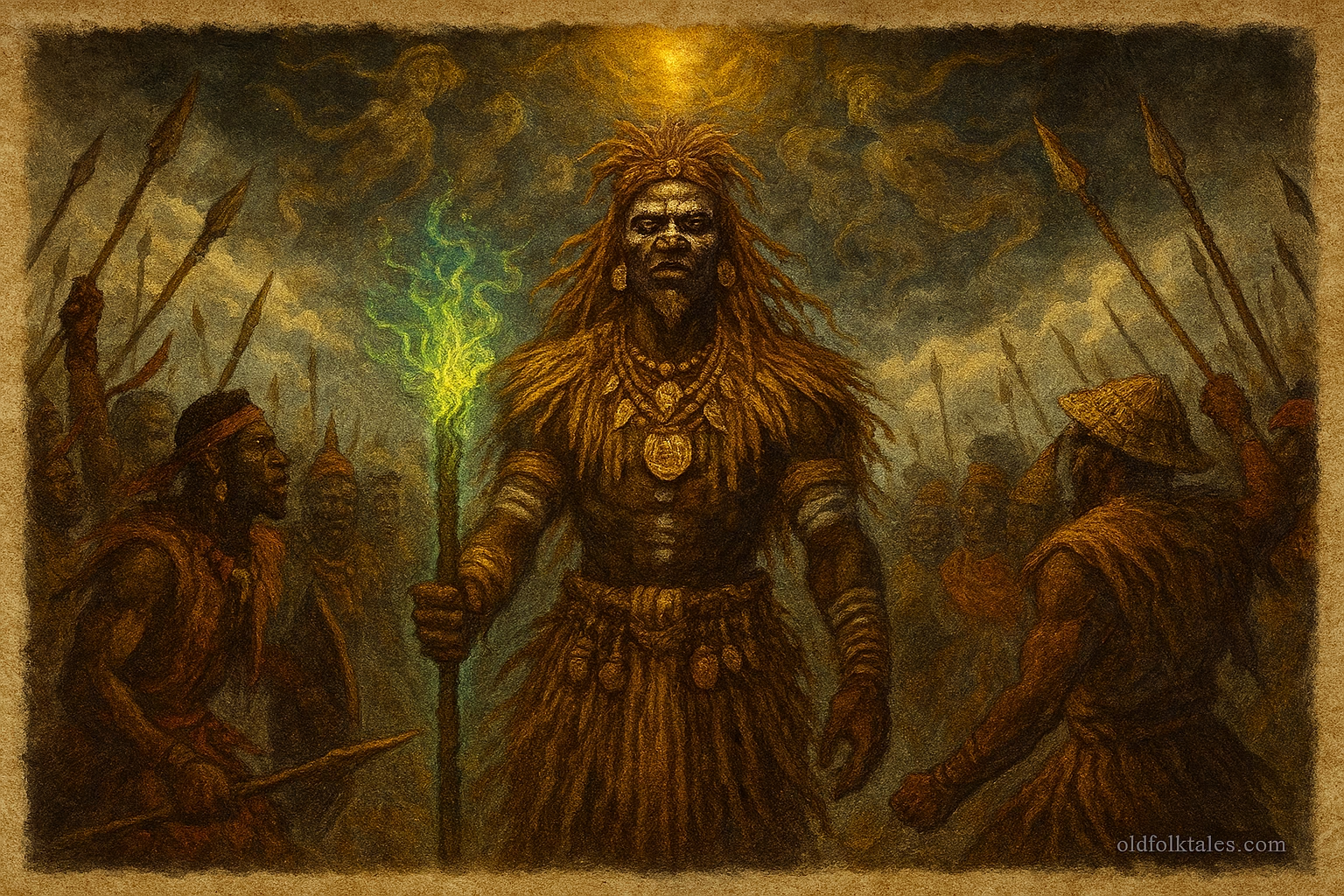
“Nganga,” the divine voice boomed, “to forge peace, you must face the spear of pride, the shield of fear, and the fire of vengeance. Only one who conquers themselves may conquer discord.” With that, Nzambi placed in Nganga’s hands a staff of whitewood swirling with symbols that glowed faintly, the Mfinda Staff, said to hold the breath of the forest itself.
When Nganga descended the mountain, he found the three clans already assembled for war. Shields gleamed. Spears thirsted. Drums thundered the rhythm of death.
Nganga walked alone into the battlefield.
The drums fell silent.
Many recoiled, for the staff he carried pulsed with unnatural light, and the air shimmered with spirits gathering to bear witness. Nganga spoke, not in the voice of a man but with the resonance of the mountain, the river, and the sky.
“I come not as Kandi, Vunda, or Nsaku, but as the breath of Nzambi. The blood you spill today will not build thrones, only graves. Stand down, or face judgment.”
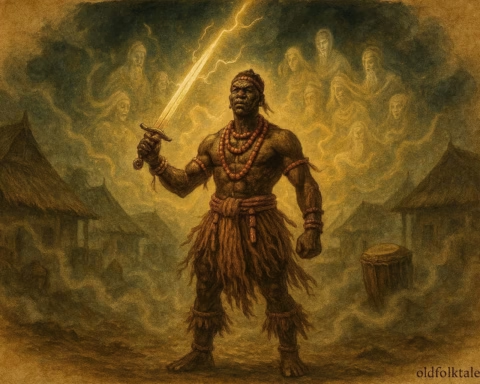
The clan chiefs, hardened by years of feuding, scoffed. The Vunda leader hurled a spear at Nganga’s heart. He did not move. The spear turned to ash before reaching him.
Yet peace cannot be declared by miracles alone. Nganga knew the roots of hatred ran deep. So he challenged the chiefs to the ancient Trial of Truth, a contest not of weapons, but of spirit, where each must confront the darkest reflection of themselves.
Within a sacred circle drawn with the Mfinda Staff, the chiefs were engulfed by visions. They faced specters of their own making, fear of losing power, pride in ancient wrongs, the guilt of past betrayals. Many faltered. Some broke under the weight of truth. But Nganga remained by their side, his steady chant guiding them back from the abyss.
By nightfall, all three chiefs knelt before him. They offered their weapons to the earth and their pride to the wind, acknowledging Nganga a Nzambi as Manikongo, the One King.
Under his rule, the clans forged a covenant stronger than iron: they would be bound not by conquest, but by kimpa kia moyo, unity of the heart. Under his guidance, the kingdom flourished with trade, artistry, and spiritual wisdom. And though he wielded great power, Nganga governed with humble restraint, consulting elders, listening to the spirits, ensuring prosperity flowed like water through all lands.
Yet divine-born heroes live on borrowed time. When his work was done, Nganga a Nzambi walked alone into the forest with the Mfinda Staff. Some say he merged with the trees. Others say he ascended on a pillar of light. But most believe he returned to Nzambi Mpungu, his spirit destined to awaken again should the land ever fall to discord.
AUTHOR’S NOTE
Nganga a Nzambi represents the Kongo ideal of leadership rooted not in domination but in moral clarity, spiritual wisdom, and unity. His legacy symbolizes the eternal struggle to rise above human flaws and forge harmony from division. Through him, the Kongo epics affirm that true kingship is a sacred calling, demanding both strength and humility.
KNOWLEDGE CHECK
-
What signs marked Nganga a Nzambi’s divine origin?
-
What were the three clans in conflict?
-
What gift did Nzambi Mpungu give Nganga on Mount Lukanga?
-
How did Nganga stop the clans from warring?
-
What was the Trial of Truth meant to reveal?
-
How does the story explain Nganga’s departure?
CULTURAL ORIGIN: Kongo Kingdom mythic tradition; Central African Bantu cosmology.
SOURCE: Inspired by Kongo oral epics and 18th-century documentation attributed to Joseph de Guignes.