
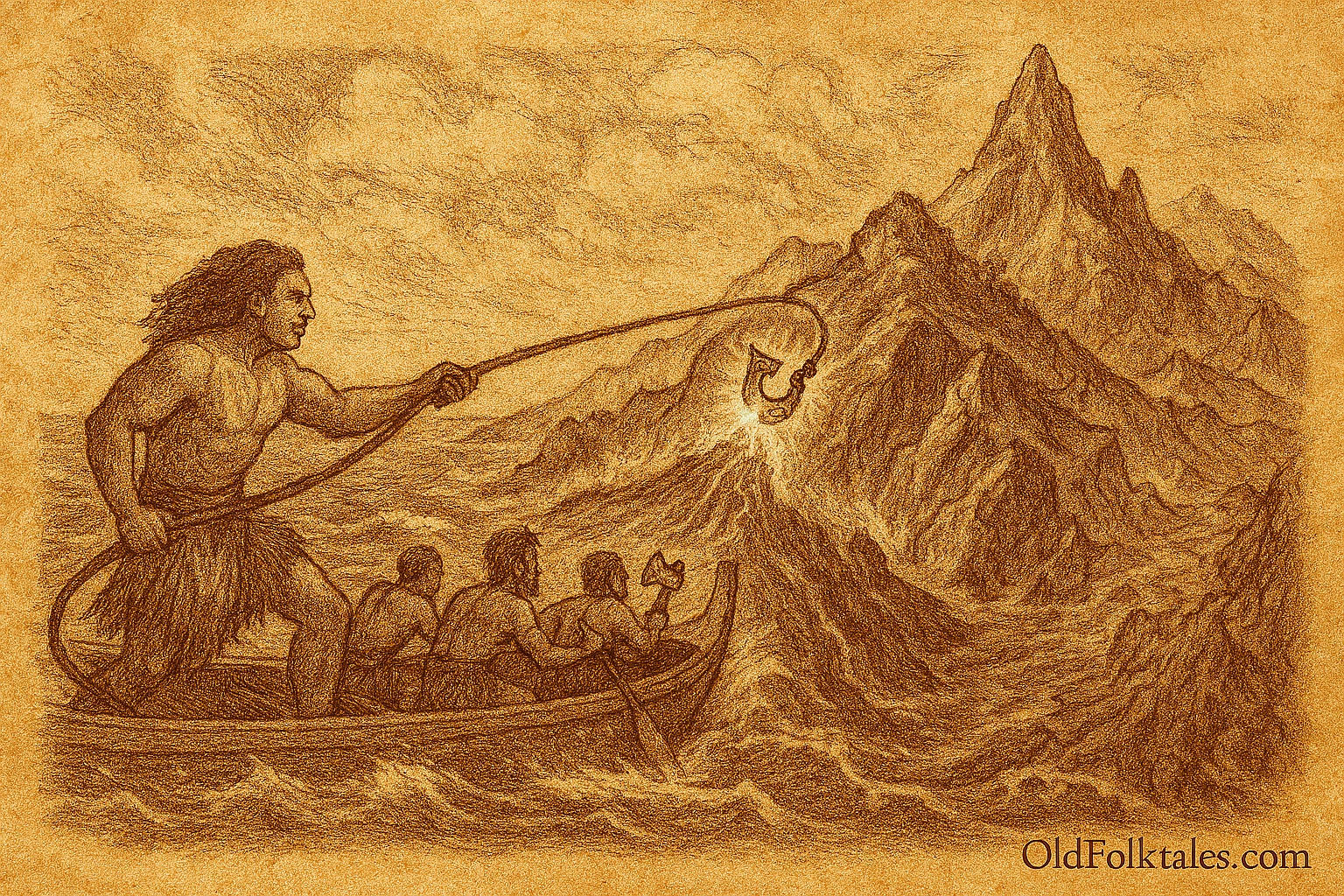
In the time before time, when the world was young and the vast Pacific Ocean stretched endlessly in all directions like a blue blanket with no edges, there lived a demigod named Māui. He was the youngest of several brothers, born with the blood of gods flowing through his veins and mischief dancing in his eyes. Māui was clever beyond measure, bold beyond reason, and possessed powers that could reshape the very fabric of creation itself.
The ocean in those ancient days was a lonely realm nothing but water meeting sky, wave following wave, with no solid ground for weary travelers to rest upon. The people of that time knew only the deep, and they longed for islands where they might plant their feet and build their homes.
Click to read all Myths & Legends – timeless stories of creation, fate, and the divine across every culture and continent
One morning, as the sun painted the eastern sky in streaks of orange and pink, Māui’s older brothers prepared their great fishing canoe for a journey into the deep waters. They were proud men, strong and skilled with the paddle and the fishing line, but they had little patience for their youngest brother. Māui was known for his tricks and his wild schemes, and his brothers had no desire for his company on this particular voyage.
“Stay behind, little brother,” they told him, their voices firm as they pushed the canoe toward the surf. “This is work for men, not for pranksters who speak more than they fish.”
But Māui only smiled a small, knowing smile that touched the corners of his mouth. As his brothers loaded their provisions and fishing gear, Māui crept silently aboard and concealed himself beneath the floorboards of the canoe, folding his body into the cramped darkness. There he lay, still as stone, breathing quietly as the canoe was launched and the brothers began to paddle.
The rhythmic splash of paddles cutting through water became a song, and the canoe glided across the ocean’s surface like a bird in flight. The brothers paddled for hours, until the familiar stars of their home waters had shifted positions in the sky and they found themselves in waters so deep that the ocean appeared black as night, even under the brilliant sun.
“Here,” announced the eldest brother, and they shipped their paddles. “Here the fish are fat and plentiful. Let us cast our lines.”
It was then that Māui emerged from his hiding place, unfolding himself from beneath the floorboards with a grin that showed all his teeth. His brothers groaned and shouted their displeasure, but it was too late they were too far from shore to turn back now.
“Since you’re here, make yourself useful,” they grumbled, thrusting a fishing line into his hands. “But stay out of our way.”
Māui took the line but said nothing. His brothers cast their hooks, baited with the finest flying fish and squid, and soon they were pulling up their catch fish of good size that thrashed and gleamed in the sunlight. But Māui did not use the line they had given him. Instead, he reached into the woven bag he carried and drew forth something that made his brothers gasp.
It was a fishhook unlike any they had ever seen. The hook was crafted from bone not ordinary bone, but the sacred jawbone of his ancestress, Murirangawhenua. The hook had been shaped with prayers and ritual, carved with patterns that held deep meaning, and imbued with mana so powerful it seemed to hum in Māui’s hand. The bone gleamed with an inner light, as if the spirit of his ancestor still lived within it.
“That’s forbidden!” one brother hissed. “You cannot use such a sacred object for fishing!”
But Māui’s eyes held a distant look, as if he saw beyond the horizon, beyond the present moment. “I fish for something greater than dinner, brothers,” he said quietly.
With practiced movements, Māui attached the magical hook to a line made from the strongest fibers, plaited with his own hair for added strength. Then, without bait for what bait could attract what he sought? he cast the hook far out into the deep water. As the hook sank, disappearing beneath the surface, Māui began to chant.
His voice rose and fell like the waves themselves, speaking words in the old tongue, the language of creation. These were karakia sacred incantations passed down from the time when gods walked freely among mortals. The words spoke of binding and calling, of commanding the very bones of the earth to awaken and rise.
The brothers fell silent, their own fishing forgotten, as they listened to Māui’s chanting. The air around the canoe seemed to thicken and shimmer. The water grew unnaturally still, as if the ocean itself were holding its breath.
Then the line went taut.
The force was like nothing the brothers had ever experienced. The fishing line snapped straight as an arrow, cutting through the water with a sound like tearing cloth. The canoe lurched violently, tilting so far to one side that water poured over the gunwale. The brothers scrambled to keep their balance, terror written across their faces.
“Let it go!” they screamed at Māui. “Cut the line! Whatever you’ve hooked will drag us all to the bottom!”
But Māui’s jaw was set with determination. He braced his feet against the edge of the canoe, his legs trembling with the strain. His muscles stood out like cords beneath his skin as he gripped the line with both hands. Sweat poured down his face, mixing with the spray of seawater.
“Help me, brothers!” Māui commanded through gritted teeth. “Do not let the canoe tip! Whatever you do, do not look back at what I am hauling up. Keep the canoe steady and look only forward!”
The brothers, seeing the terrible strain on their youngest sibling’s face, grabbed the sides of the canoe and used their weight to balance it. The canoe groaned and creaked, wood protesting against impossible forces. Slowly, hand over hand, Māui began to pull.
The ocean around them began to churn and roil. Great bubbles rose from the depths, bursting on the surface with sounds like thunder. The water changed color, from deep blue to turquoise to a muddy brown, as if something massive were rising from the sea floor far below.
Māui pulled, and pulled, and pulled. His hands bled where the line cut into his flesh, but he did not stop. His chanting grew louder, more forceful, commanding the depths to yield their treasure. The ancestors’ mana flowed through him, giving him strength beyond mortal limits.
And then, breaking through the surface of the water, came the land.
At first it appeared as darkness beneath the waves a vast shadow rising from the abyss. Then jagged peaks broke through the surface, streaming water like waterfalls. Black volcanic rock emerged, then brown earth, then green vegetation still dripping with brine. Mountains rose, valleys formed, and plains spread out as Māui continued to haul on his magical line.
The brothers, unable to contain their curiosity despite Māui’s warning, turned to look. Their eyes widened with awe and disbelief. Behind their canoe, a massive landmass was emerging from the ocean an island unlike anything they had imagined, with mountains that seemed to touch the clouds and forests that covered rolling hills.
The land kept rising, spreading in all directions. In the Māori tradition, this was Te Ika-a-Māui the great fish of Māui which would become Aotearoa, the North Island of New Zealand. In Hawaiian stories, it was the chain of islands that would bear many names. In Samoan and Tahitian tellings, it was their own ancestral lands pulling free from the sea’s grip. The land took different forms in different tellings, but always it was vast, always it was magnificent, and always it was the work of Māui’s magic.
Finally, when Māui could pull no more, when his strength was spent and the land had risen as far as it would come, he released the line and collapsed in the bottom of the canoe, gasping for breath. The sacred fishhook remained embedded somewhere in the newly risen land, still pulsing with ancestral power.
“Listen to me carefully,” Māui said, his voice hoarse from chanting and exertion. “I must go ashore alone and perform the proper rituals. The land is sacred it has been pulled from the realm of Tangaroa, the ocean god, and it must be blessed before anyone can claim it. You must wait here in the canoe. Touch nothing until I return. Do you understand?”
The brothers nodded, still speechless with wonder. But as Māui prepared to swim to shore, a terrible thought seized them. This land was vast and rich mountains full of stone for tools, forests full of timber for canoes, soil for planting, and rivers of fresh water. If they waited for Māui to perform his rituals, he might claim the best portions for himself. Greed kindled in their hearts, burning away their awe and their sense of sacredness.
As soon as Māui dove into the water and began swimming toward the shore, the brothers seized their tools. They grabbed their stone adzes, their digging sticks, their knives of sharpened shell. They leaped onto the newly risen land and began to hack and cut, each trying to carve out a piece for himself before Māui could stop them.
“This mountain is mine!” shouted one, swinging his adze at the rock.
“This valley belongs to me!” cried another, digging frantically at the earth.
They chopped and carved with frantic energy, thinking only of their own claims and their own wealth. Their tools bit into the land with savage fury, cutting and splitting and breaking.
Their greed had terrible consequences. Where they struck with their adzes, the smooth land cracked and fractured. Deep gorges opened up where none had been before. Mountains that should have been smooth and rounded became jagged and sharp. The coastline that should have been gentle became a chaos of cliffs and inlets, bays and promontories. The land writhed under their assault, twisting and buckling, forming the rugged, dramatic landscapes that exist to this day.
When Māui finally reached the shore and saw what his brothers had done, rage and sorrow filled his heart. “Foolish men!” he cried. “Your greed has marred what should have been perfect! These rough cliffs, these treacherous gorges, these jagged peaks all are monuments to your selfish haste!”
But the damage was done. The land had set in its new form, scarred by the brothers’ impatience. Yet despite their actions, the islands remained solid ground in the endless ocean, a home for the people who would come after. The land rose by Māui’s power, shaped by his brothers’ greed, and blessed by the gods who saw that despite its imperfections, it was good.
And so the islands took their place in the great Pacific, each one a testament to Māui’s strength and his ancestors’ mana, each coastline a reminder that greed and impatience leave their mark upon even the greatest of gifts.
The Moral Lesson
The legend of Māui fishing up the islands teaches us that great achievements require not only power and courage but also respect for sacred protocols and patience to do things properly. The brothers’ greed and impatience marred what should have been perfect, demonstrating that even the greatest gifts can be damaged when we act selfishly and ignore proper procedures. This story reminds us that creation is sacred work requiring reverence, that we must listen to wisdom even when tempted by immediate gain, and that our hasty, greedy actions can have lasting consequences that reshape the world around us. The rugged beauty of the Pacific islands stands as both a triumph of Māui’s power and a warning about the cost of impatience.
Knowledge Check
Q1: Who was Māui and what made him powerful enough to fish up the islands? A1: Māui was a demigod part human, part divine who possessed extraordinary powers inherited from his godly ancestry. He was the youngest of several brothers, known for his cleverness and magical abilities. His power came from his divine bloodline and his connection to ancestral mana (spiritual force), which he channeled through sacred objects and ancient incantations to perform miraculous feats.
Q2: What was the magical fishhook made from and why was it significant? A2: The magical fishhook was carved from the jawbone of Māui’s ancestress, Murirangawhenua. This made it a sacred object imbued with ancestral mana and spiritual power. Creating tools from the bones of revered ancestors was a practice that connected the living to their forebears’ strength and wisdom, making the hook powerful enough to catch and raise entire landmasses from the ocean floor.
Q3: Why did Māui hide in the canoe instead of asking to join his brothers? A3: Māui hid beneath the floorboards because his brothers did not want him to accompany them on their fishing expedition. They considered him a trickster and prankster who would be more trouble than help. By hiding, Māui ensured he could carry out his plan to fish up the islands, knowing his brothers would refuse if they knew his true intentions beforehand.
Q4: What did Māui warn his brothers not to do, and what happened when they disobeyed? A4: Māui specifically warned his brothers not to touch or cut the newly risen land until he could perform the proper sacred rituals to bless it. However, driven by greed and the desire to claim the best portions for themselves, the brothers disobeyed and began hacking at the land with their tools. Their actions caused the smooth landmass to crack and fracture, creating the jagged cliffs, deep gorges, and rugged coastlines that characterize the Pacific islands today.
Q5: How does this legend differ across various Polynesian cultures? A5: While the core story of Māui fishing up land remains consistent across Polynesian cultures, the specific islands raised vary by tradition. In Māori mythology, Māui pulled up Te Ika-a-Māui (the North Island of New Zealand/Aotearoa). In Hawaiian traditions, he raised the Hawaiian island chain. Samoan and Tahitian versions describe their own ancestral lands being pulled from the sea. Despite these variations, all versions emphasize Māui’s supernatural strength, the magical fishhook, and the consequences of the brothers’ greed.
Q6: What does this creation legend reveal about Polynesian values and worldview? A6: This legend reflects core Polynesian values including respect for ancestral mana and spiritual power, the importance of following proper protocols and rituals, the consequences of greed and impatience, and the interconnection between the physical and spiritual worlds. It demonstrates that great power must be wielded with responsibility, that sacred objects deserve reverence, and that proper ceremonies must accompany major undertakings. The story also explains the geographic features of the Pacific islands while teaching moral lessons about patience, respect, and the dangers of selfish behavior.
Source: Adapted from Polynesian Mythology and Ancient Traditional History of the New Zealand Race by Sir George Grey (1855)
Cultural Origin: Pan-Polynesian tradition, including Māori (Aotearoa/New Zealand), Hawaiian (Hawaiʻi), Samoan (Sāmoa), Tahitian (Tahiti), and other Pacific Island cultures across Polynesia






