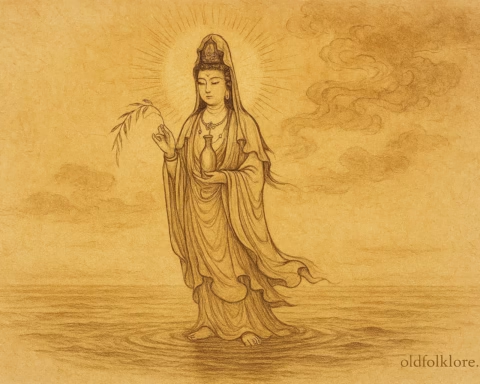
Mazu (媽祖), also known as “Maternal Ancestor” or “Heavenly Empress,” is the revered Chinese goddess of the sea, the protector of sailors, fishermen, and all who journey across the ocean. Born as Lin Moniang (林默娘) on the island of Meizhou in Fujian during the late Tang or early Song dynasty, she was said to possess mystical powers from childhood, a girl of profound calmness who could foresee storms and disasters.
In Chinese coastal religion, Mazu embodies both filial devotion and compassionate power. Her symbols include a red robe, a crown of pearls, and a staff or ceremonial tablet, signifying authority over the waters. Temples dedicated to her, known as Mazu miao (媽祖廟), are scattered across southern China, Taiwan, and the broader diaspora, from Malaysia to San Francisco. Offerings of incense, lanterns, and paper ships are still made to her today, particularly during her birthday festival on the 23rd day of the third lunar month.
Within the celestial hierarchy of Chinese folk religion, Mazu rose from a local guardian spirit to an imperial goddess, honored with titles such as “Heavenly Empress (天后, Tianhou)” and “Holy Mother in Heaven (天上聖母, Tian Shang Sheng Mu).” Her story bridges mortal compassion and divine majesty, the transformation of a human soul into a universal protector of those who brave the world’s most unpredictable element: the sea.
Mythic Story: “The Silent Maiden Who Calmed the Sea”
Long ago, in the mist-veiled coast of Meizhou, a child was born to the Lin family. Her name was Moniang, meaning “Silent Maiden,” for she did not cry upon entering the world. From her earliest days, her silence carried a strange serenity, a calm that seemed to echo the stillness of the sea before dawn.
As she grew, Moniang displayed extraordinary perception. She could sense when storms were coming, long before the winds rose. Fishermen whispered that her eyes, dark as the ocean depths, saw beyond the horizon into the realm of the spirits. Some said she learned the mysteries of Daoist alchemy; others claimed she communed with sea gods in her dreams. Yet to her family, she remained humble and kind, weaving nets and tending lamps for her father and brothers who fished the dangerous waters of the Taiwan Strait.
One fateful day, a violent storm struck. Moniang was at home, spinning thread, when suddenly she fell into a deep trance. Her spirit, it is said, soared over the raging waves. In her vision, she saw her father’s boat torn apart by the wind and her brothers flung into the churning sea. Without hesitation, she stretched out her arms in the spirit world, clutching one brother in each hand, holding them above the tempest. Her concentration was fierce, her face motionless, her breath still.
But her mother, frightened by her daughter’s strange state, shook her to wake her. At that instant, Moniang’s spirit was pulled back to her body, and one brother slipped into the sea, lost forever. When she awoke, tears filled her eyes. The surviving brother later returned home alive, trembling, and told of a mysterious red-clad maiden who had appeared amidst lightning and waves to guide his ship to safety.
From that day, the people knew that Lin Moniang’s soul was blessed by Heaven.
Years later, at the age of twenty-eight, Moniang climbed the cliffs overlooking the ocean during another tempest. She was last seen gazing into the storm, a faint red light surrounding her form. When the lightning cleared, she was gone. Some say she ascended to heaven upon a cloud of golden mist; others claim the sea took her gently into its embrace.
Not long after, fishermen began to report miraculous rescues, their boats guided by a radiant figure dressed in crimson, her face serene as moonlight. Word spread quickly: Lin Moniang had become a goddess, protector of those at sea.
Temples were built along every coast, their incense smoke rising like prayers toward the heavens. Sailors invoked her name, “Mazu! Mother Ancestor! Protect us!”, before setting sail, and when storms threatened, they lit lamps to guide her spirit to their aid. During the Ming and Qing dynasties, emperors themselves recognized her power, bestowing upon her imperial titles and building grand shrines in her honor.
Centuries have passed, but the sea still bears her name. From Fujian to Taiwan, from the Pearl River to Penang, her festivals fill the ports with red banners, dragon dances, and offerings of paper ships set aflame to carry blessings across the waves. To this day, Mazu remains not only a deity but a motherly guardian, a symbol of compassion, courage, and the enduring bond between humankind and the vast, unpredictable ocean.
Discover the gods, goddesses, and divine spirits who ruled the heavens and shaped human fate
Author’s Note
The story of Mazu speaks of devotion transformed into divinity. Her compassion for her family and community transcended mortality, turning human love into divine guardianship. Through her, we learn that the sacred often arises not from grandeur, but from service, from the quiet courage of one who chooses to protect others, even at the cost of self. Mazu’s myth reminds us that faith and gratitude are born from awe, and that the sea, though perilous, is never without mercy.
Knowledge Check
Q1. Who was Mazu before her deification?
A: Mazu was Lin Moniang, a mortal woman from Fujian known for her spiritual gifts and compassion.
Q2. What event led to Mazu’s divine recognition?
A: Her spirit saved her brothers during a storm, revealing her supernatural power and selfless love.
Q3. What is Mazu’s main role in Chinese mythology?
A: She is the goddess of the sea and protector of sailors and travelers.
Q4. What are Mazu’s main symbols?
A: Her red robe, crown of pearls, and staff represent divine authority over the sea.
Q5. How did imperial recognition affect her worship?
A: Ming and Qing emperors granted her celestial titles, spreading her cult throughout China and beyond.
Q6. What lesson does Mazu’s story teach?
A: That compassion and devotion can transform mortal virtue into divine protection.
Source: Chinese Maritime Folk Religion, Fujian Province, China.
Source Origin: China (Fujian Province; venerated across East and Southeast Asia)